
We read your photo as:
Find the potential at a point due to a charge of 4x10⁻⁹ C located 9 cm away from it.
Physics
ScanSolve AI Answer
Answer
Step-by-step solution
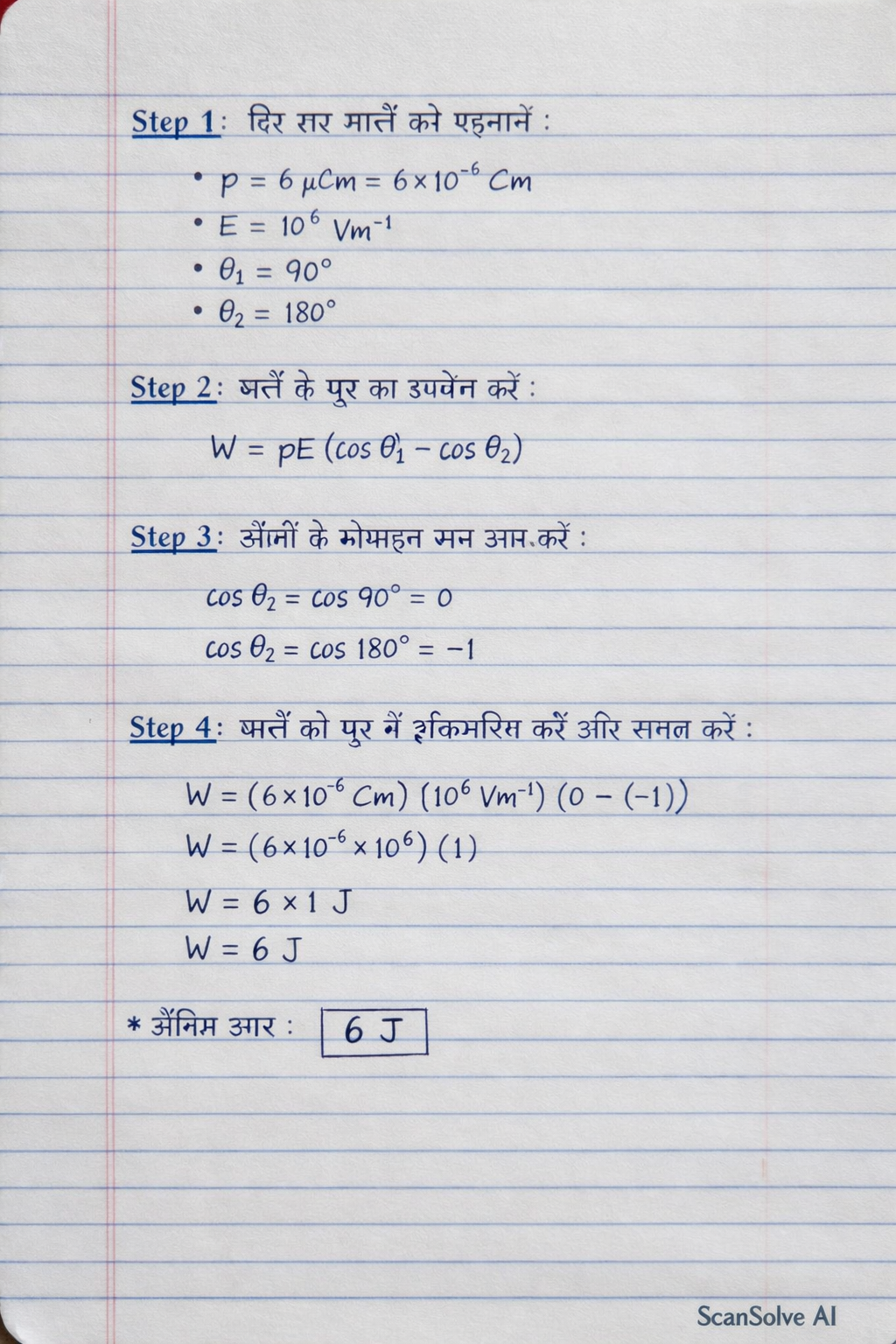
4 stepsदिए गए मानों को पहचानें।
हमें एक विद्युत द्विध्रुव को एक समान विद्युत क्षेत्र में घुमाने के लिए आवश्यक कार्य ज्ञात करना है।
- द्विध्रुव आघूर्ण ()
- बाह्य विद्युत क्षेत्र ()
- प्रारंभिक कोण (): द्विध्रुव आघूर्ण विद्युत क्षेत्र के लंबवत है, इसलिए .
- अंतिम कोण (): द्विध्रुव आघूर्ण विद्युत क्षेत्र के प्रति-समांतर है, इसलिए .
कार्य के सूत्र का उपयोग करें।
एक विद्युत द्विध्रुव को से कोण तक घुमाने में किया गया कार्य () निम्न सूत्र द्वारा दिया जाता है:
कोणों के कोसाइन मान ज्ञात करें।
मानों को सूत्र में प्रतिस्थापित करें और गणना करें।
अंतिम उत्तर:
Was this helpful?
Try one yourself
A new problem that tests the same skill.
Still stuck on this one?
Ask a follow-up, and the answer starts from this question.
Got a different question?Ask your own question
More Physics Questions
QCalculate the potential at the point P which is at a distance of 6mm & 10mm from two equal charges…QCalculate the electric field at a point 2.0 m away from a 4.0 nC charge, and the forces between…QTwo-point charges +9q and −q are kept 10 cm apart. Find a point on the line joining the charges…QThe figure below shows point charges (+44.4 and −22.2)μC placed at corners of the square of sides…QDetermine the net force on the middle charge (2.0 × 10⁻⁶ C) given three charges and their distances.
Handwritten Step-by-Step Solution
Get this as a handwritten image on WhatsApp — like a tutor wrote it for you.
Try on WhatsApp