Calculate the electric field at a point 2.0 m away from a 4.0 nC charge, and the forces between multiple charges.
|Physics
Calculate the electric field at a point 2.0 m away from a 4.0 nC charge, and the forces between multiple charges.
ScanSolve AI Answer
Answer
8.99 N/C
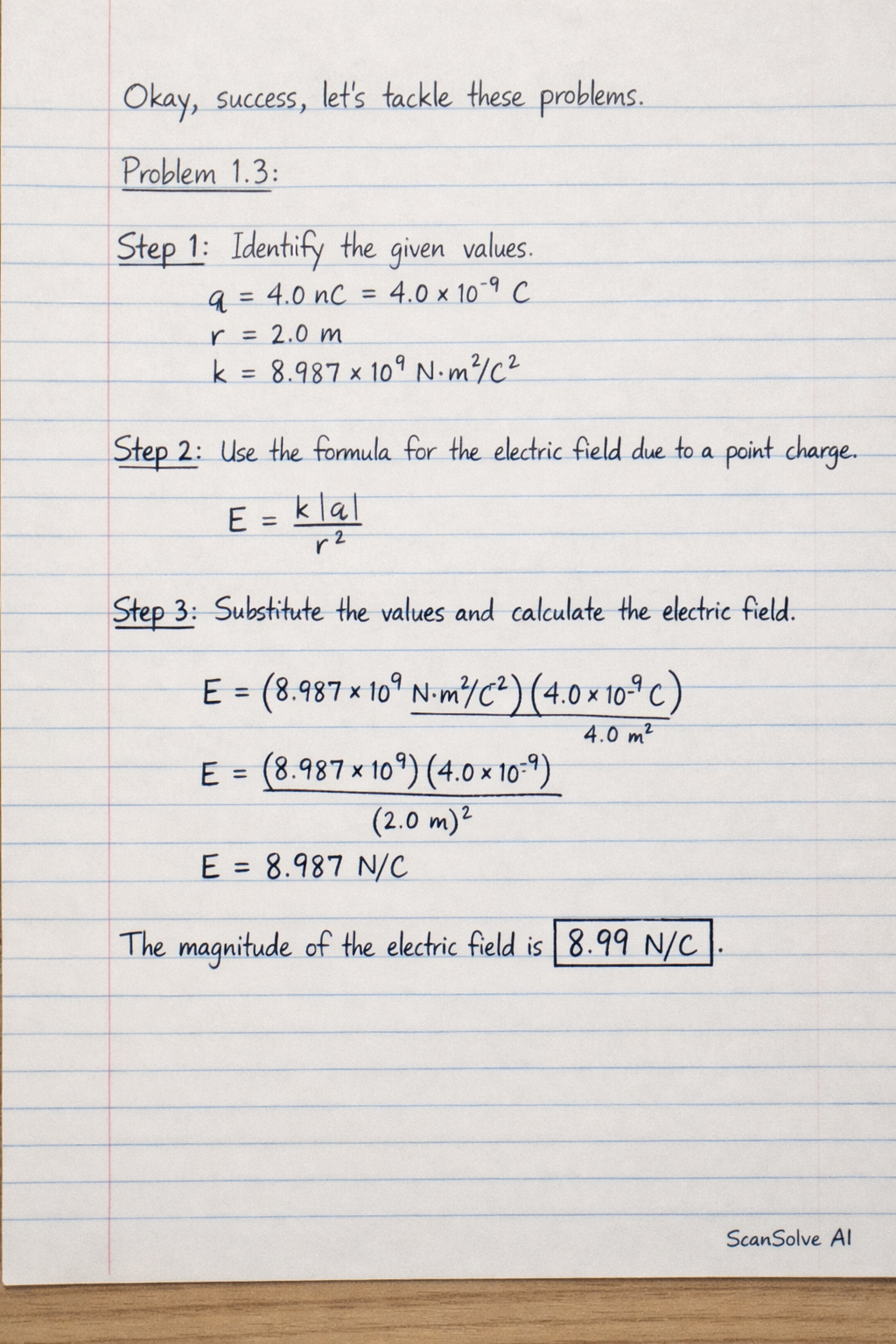
Okay, sucess, let's tackle these problems.
.3:
Step 1: Identify the given values.
The point charge is q=4.0nC=4.0×10⁻⁹ C.
The distance from the charge to the field point is r=2.0 m.
Coulomb's constant is k=8.987×10⁹N⋅m2/C2.
Step 2: Use the formula for the electric field due to a point charge.
The magnitude of the electric field E at a distance r from a point charge q is given by:
E=kr2∣q∣
Step 3: Substitute the values and calculate the electric field.
E=(8.987×10⁹N⋅m2/C2)(2.0m)2∣4.0×10−9C∣E=(8.987×109)4.04.0×10−9 N/CE=8.987 N/C
The magnitude of the electric field is ∗8.99N/C∗.
.4:
Step 1: Identify the charges and their positions, converting to SI units.
q1=+4.00nC=+4.00×10⁻⁹ C at x1=0 m.
q2=−1.20nC=−1.20×10⁻⁹ C at x2=6.00cm=0.06 m.
q3=−4.00nC=−4.00×10⁻⁹ C at x3=4.00cm=0.04 m.
Coulomb's constant k=8.987×10⁹N⋅m2/C2.
Step 2: Calculate the force exerted by q1 on q3 (F13).
The distance between q1 and q3 is r13=∣x3−x1∣=∣0.04m−0m∣=0.04 m.
Since q1 is positive and q3 is negative, they attract. q3 is to the right of q1, so F13 is in the positive x-direction.
F13=kr132∣q1q3∣F13=(8.987×10⁹N⋅m2/C2)(0.04m)2∣(4.00×10−9C)(−4.00×10−9C)∣F13=(8.987×109)0.001616.00×10−18 NF13=8.987×10⁻⁵ N
So, F13=+8.987×10⁻⁵ N (in the positive x-direction).
Step 3: Calculate the force exerted by q2 on q3 (F23).
The distance between q2 and q3 is r23=∣x3−x2∣=∣0.04m−0.06m∣=0.02 m.
Since q2 is negative and q3 is negative, they repel. q3 is to the left of q2, so F23 is in the negative x-direction.
F23=kr232∣q2q3∣F23=(8.987×10⁹N⋅m2/C2)(0.02m)2∣(−1.20×10−9C)(−4.00×10−9C)∣F23=(8.987×109)0.00044.80×10−18 NF23=1.07844×10⁻⁴ N
So, F23=−1.07844×10⁻⁴ N (in the negative x-direction).
Step 4: Calculate the total electric force on q3.
The total force is the vector sum of F13 and F23.
Fnet=F13+F23Fnet=(8.987×10⁻⁵N)+(−1.07844×10⁻⁴N)Fnet=(8.987×10⁻⁵N)−(10.7844×10⁻⁵N)Fnet=(8.987−10.7844)×10−5 NFnet=−1.7974×10⁻⁵ N
The total electric force on q3 is ∗−1.80×10⁻⁵N∗. The negative sign indicates the force is in the negative x-direction.
That's 2 down. 3 left today — send the next one.
Was this helpful?
Need help with your own homework?
Get instant step-by-step solutions to any question. Free to start.
This physics problem tests your understanding of fundamental physical laws and their applications. The step-by-step solution below breaks down the problem using relevant equations and physical reasoning.
ScanSolve AI Answer
Okay, sucess, let's tackle these problems. Problem 1.3: Step 1: Identify the given values. The point charge is q = 4.0 nC = 4.0 × 10^-9 C. The distance from the charge to the field point is r = 2.0 m. Coulomb's constant is k = 8.987 × 10^9 N · m^2/C^2. Step 2: Use the formula for the electric field due to a point charge. The magnitude of the electric field E at a distance r from a point charge q is given by: E = k (|q|)/(r^2) Step 3: Substitute the values and calculate the electric field. E = (8.987 × 10^9 N · m^2/C^2) |4.0 × 10^-9 C|(2.0 m)^2 E = (8.987 × 10^9) 4.0 × 10^-94.0 N/C E = 8.987 N/C The magnitude of the electric field is 8.99 N/C. --- Problem 1.4: Step 1: Identify the charges and their positions, converting to SI units. q_1 = +4.00 nC = +4.00 × 10^-9 C at x_1 = 0 m. q_2 = -1.20 nC = -1.20 × 10^-9 C at x_2 = 6.00 cm = 0.06 m. q_3 = -4.00 nC = -4.00 × 10^-9 C at x_3 = 4.00 cm = 0.04 m. Coulomb's constant k = 8.987 × 10^9 N · m^2/C^2. Step 2: Calculate the force exerted by q_1 on q_3 (F_13). The distance between q_1 and q_3 is r_13 = |x_3 - x_1| = |0.04 m - 0 m| = 0.04 m. Since q_1 is positive and q_3 is negative, they attract. q_3 is to the right of q_1, so F_13 is in the positive x-direction. F_13 = k (|q_1 q_3|)/(r_13)^2 F_13 = (8.987 × 10^9 N · m^2/C^2) |(4.00 × 10^-9 C)(-4.00 × 10^-9 C)|(0.04 m)^2 F_13 = (8.987 × 10^9) 16.00 × 10^-180.0016 N F_13 = 8.987 × 10^-5 N So, F_13 = +8.987 × 10^-5 N (in the positive x-direction). Step 3: Calculate the force exerted by q_2 on q_3 (F_23). The distance between q_2 and q_3 is r_23 = |x_3 - x_2| = |0.04 m - 0.06 m| = 0.02 m. Since q_2 is negative and q_3 is negative, they repel. q_3 is to the left of q_2, so F_23 is in the negative x-direction. F_23 = k (|q_2 q_3|)/(r_23)^2 F_23 = (8.987 × 10^9 N · m^2/C^2) |(-1.20 × 10^-9 C)(-4.00 × 10^-9 C)|(0.02 m)^2 F_23 = (8.987 × 10^9) 4.80 × 10^-180.0004 N F_23 = 1.07844 × 10^-4 N So, F_23 = -1.07844 × 10^-4 N (in the negative x-direction). Step 4: Calculate the total electric force on q_3. The total force is the vector sum of F_13 and F_23. F_net = F_13 + F_23 F_net = (8.987 × 10^-5 N) + (-1.07844 × 10^-4 N) F_net = (8.987 × 10^-5 N) - (10.7844 × 10^-5 N) F_net = (8.987 - 10.7844) × 10^-5 N F_net = -1.7974 × 10^-5 N The total electric force on q_3 is -1.80 × 10^-5 N. The negative sign indicates the force is in the negative x-direction. That's 2 down. 3 left today — send the next one.