

This physics problem tests your understanding of fundamental physical laws and their applications. The step-by-step solution below breaks down the problem using relevant equations and physical reasoning.
ScanSolve AI Answer
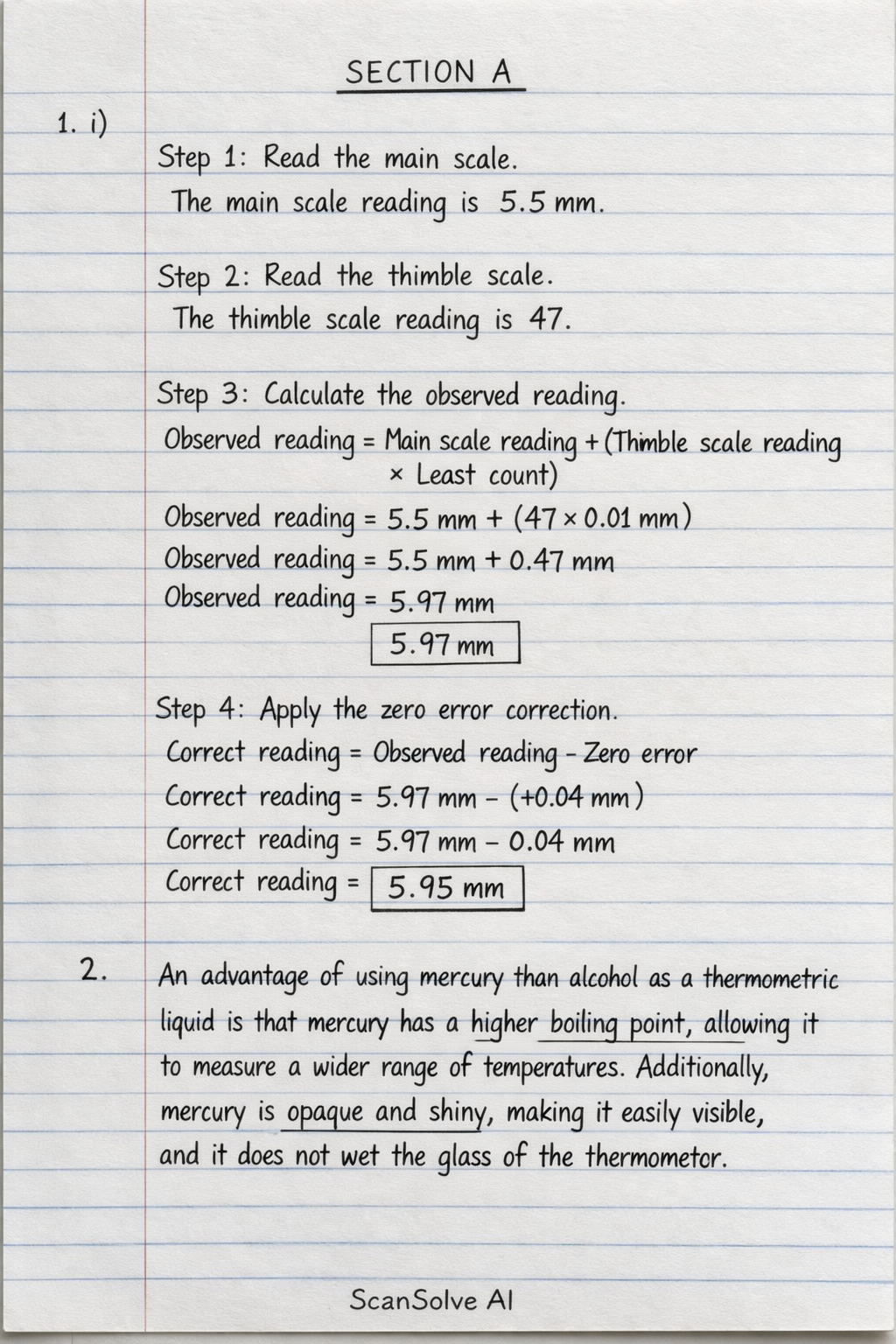
SECTION A 1. i) Step 1: Read the main scale. The main scale reading is 5.5 mm. Step 2: Read the thimble scale. The thimble scale reading is 47. Step 3: Calculate the observed reading. Observed reading = Main scale reading + (Thimble scale reading × Least count) Observed reading = 5.5 mm + (47 × 0.01 mm) Observed reading = 5.5 mm + 0.47 mm Observed reading = 5.97 mm Step 4: Apply the zero error correction. Correct reading = Observed reading - Zero error Correct reading = 5.97 mm - (+0.04 mm) Correct reading = 5.97 mm - 0.04 mm Correct reading = 5.93 mm 2. An advantage of using mercury than alcohol as a thermometric liquid is that mercury has a higher boiling point, allowing it to measure a wider range of temperatures. Additionally, mercury is opaque and shiny, making it easily visible, and it does not wet the glass of the thermometer. 3. The principle involved when determining the centre of gravity of a regular lamina using a plumb line is that the centre of gravity of an object always lies vertically below the point of suspension when the object is freely suspended and at rest. 4. Assumption: The metre rule is pivoted at the 10 cm mark. Step 1: Calculate the weight of the metre rule. Mass of rule, m = 200 g = 0.2 kg Acceleration due to gravity, g = 10 m/s^2 Weight of rule, W = mg W = 0.2 kg × 10 m/s^2 = 2 N For a uniform metre rule, its weight acts at its center of gravity, which is at the 50 cm mark. Step 2: Determine the distances from the pivot. Pivot point = 10 cm mark. Distance of weight from pivot, d_W = 50 cm - 10 cm = 40 cm. Distance of applied force from pivot, d_F = 65 cm - 10 cm = 55 cm. Step 3: Apply the principle of moments. For the rule to be horizontal, the sum of clockwise moments must equal the sum of anticlockwise moments about the pivot. Clockwise moment due to weight = W × d_W Anticlockwise moment due to applied force = F × d_F W × d_W = F × d_F 2 N × 40 cm = F × 55 cm 80 N cm = F × 55 cm Step 4: Calculate the force F. F = 80 N cm55 cm F = (16)/(11) N F ≈ 1.4545 N The force which would be applied vertically upward at the 65 cm mark is 1.45 N (to 3 significant figures). 5. Gravitational potential energy is the energy an object possesses due to its position or height within a gravitational field. It depends on the object's mass, the acceleration due to gravity, and its height. Elastic potential energy is the energy stored in an elastic material (like a spring or rubber band) when it is deformed (stretched or compressed) from its equilibrium position. It depends on the material's stiffness and the extent of its deformation.