

This physics problem tests your understanding of fundamental physical laws and their applications. The step-by-step solution below breaks down the problem using relevant equations and physical reasoning.
ScanSolve AI Answer
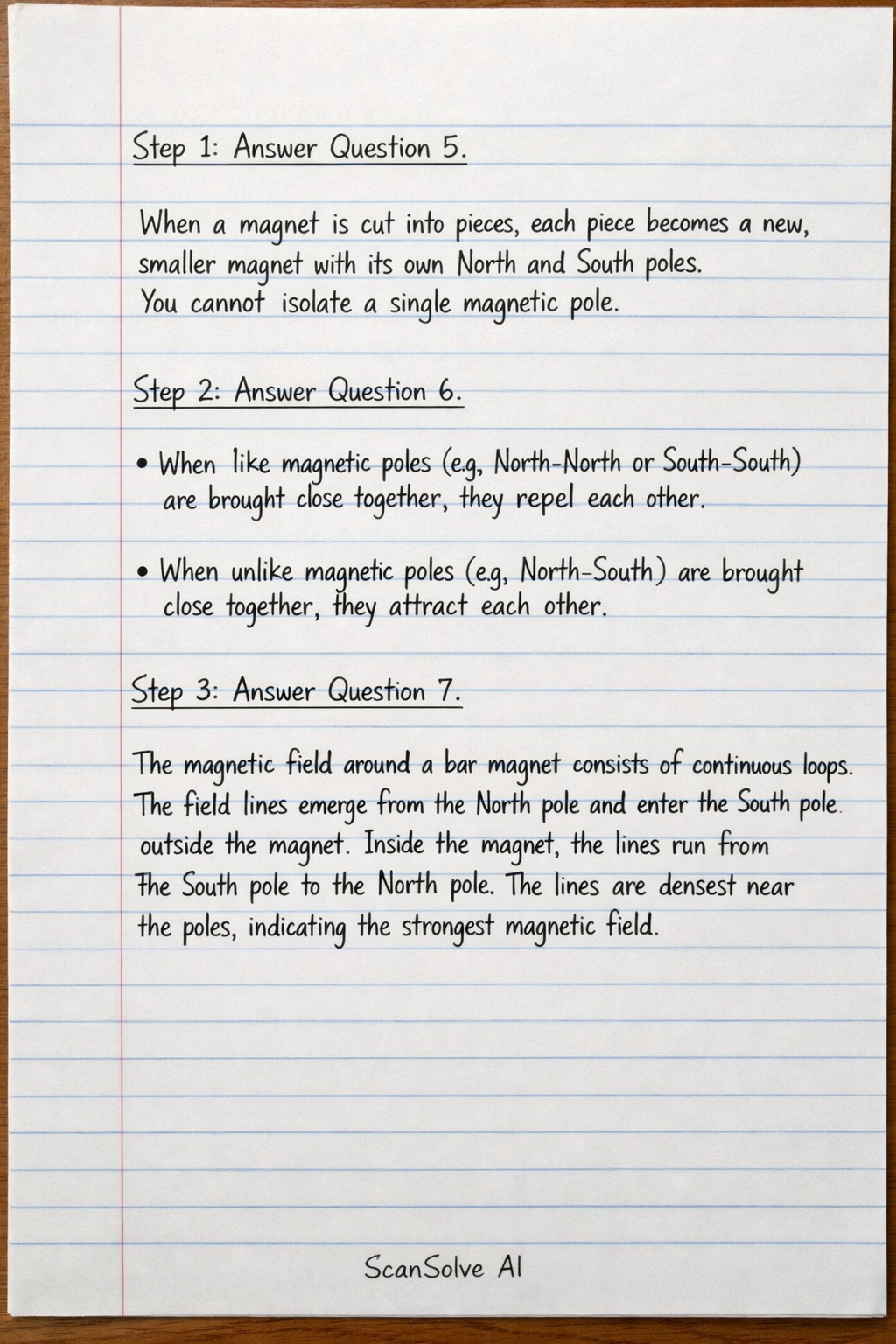
Step 1: Answer Question 5. When a magnet is cut into pieces, each piece becomes a new, smaller magnet with its own North and South poles. You cannot isolate a single magnetic pole. Step 2: Answer Question 6. • When like magnetic poles (e.g., North-North or South-South) are brought close together, they repel each other. • When unlike magnetic poles (e.g., North-South) are brought close together, they attract each other. Step 3: Answer Question 7. The magnetic field around a bar magnet consists of continuous loops. The field lines emerge from the North pole and enter the South pole outside the magnet. Inside the magnet, the lines run from the South pole to the North pole. The lines are densest near the poles, indicating the strongest magnetic field. Step 4: Answer Question 8. A compass needle is a small magnet itself. When placed in a magnetic field, the North pole of the compass needle is attracted to the South pole of the external magnetic field and repelled by the North pole. This causes the compass needle to align itself with the direction of the magnetic field lines, with its North pole pointing in the direction of the field. Step 5: Answer Question 9. Both the Earth's magnetic field and a bar magnet's magnetic field have North and South poles and produce magnetic field lines that extend into space. However, the Earth's magnetic field is generated by the convection currents of molten iron in its outer core (the dynamo effect), whereas a bar magnet's field arises from the alignment of atomic magnetic moments within the material. The Earth's magnetic North pole is geographically located near the South Pole, and its magnetic South pole is geographically near the North Pole, which is opposite to how a simple bar magnet's poles are named relative to geographic directions. Step 6: Answer Question 10. • The geographical North Pole is the northernmost point on Earth's axis of rotation. • The magnetic North Pole is the point on Earth's surface where the Earth's magnetic field lines point vertically downward. It is actually a magnetic South pole in terms of its magnetic properties, as it attracts the North pole of a compass needle. This magnetic pole is not fixed and drifts over time. Step 7: Answer Question 11. • For two similar magnetic poles (e.g., two North poles), the magnetic field lines emerge from both poles and curve away from each other, indicating repulsion. There is a region between them where the field lines are sparse, and a neutral point where the magnetic field is zero. • For two dissimilar magnetic poles (e.g., a North pole and a South pole), the magnetic field lines emerge from the North pole and enter the South pole, forming continuous loops that connect the two poles, indicating attraction. Step 8: Solve Question 12. Given: Length of wire, L = 0.50 m Current, I = 8.0 A Angle, = 90^ (right angles) Force, F = 0.40 N The formula for the magnetic force on a current-carrying wire in a magnetic field is: F = BIL Since the wire is at right angles to the field, = 90^, and (90^) = 1. So, the formula simplifies to: F = BIL We need to find the strength of the magnetic field, B. Rearrange the formula: B = (F)/(IL) Substitute the given values: B = 0.40 N(8.0 A)(0.50 m) B = 0.40 N4.0 A·m B = 0.10 T The strength of the magnetic field is 0.10 T. Step 9: Solve Question 13. Given: Length of wire, L = 0.80 m Current, I = 5.0 A Magnetic field strength, B = 0.60 T Angle, = 90^ (perpendicular) The formula for the magnetic force on a current-carrying wire in a magnetic field is: F = BIL Since the wire is perpendicular to the field, = 90^, and (90^) = 1. So, the formula simplifies to: F = BIL Substitute the given values: F = (0.60 T)(5.0 A)(0.80 m) F = 2.4 N The magnitude of the force on the wire is 2.4 N. Step 10: Address Question 14. The question states "An electric wire in the wall of a building carries a current of A vertically upward." The value of the current (in Amperes) is missing from the question. Assuming the current is I, the formula for the magnetic field at a distance r from a long straight wire is: B = (_0 I)/(2 r) Where: _0 = 4 × 10^-7 T·m/A (permeability of free space) r = 10 cm = 0.10 m If you provide the current I, I can calculate the numerical value. Step 11: Solve Question 15. Given: Charge of an electron, q = -1.602 × 10^-19 C Velocity of electron, v = 8.75 × 10^5 m/s (horizontally to the East) Magnetic field strength, B = 0.75 T (vertically upward) The formula for the magnetic force on a moving charge is: F = |q|vB The velocity is horizontal (East) and the magnetic field is vertical (upward), so the angle between v and B is 90^. (90^) = 1. Substitute the values: F = (1.602 × 10^-19 C)(8.75 × 10^5 m/s)(0.75 T)(1) F = 1.0513125 × 10^-13 N Rounding to three significant figures: F ≈ 1.05 × 10^-13 N To determine the direction, we use the right-hand rule for a positive charge and then reverse it for an electron. 1. Point your fingers in the direction of velocity (v), which is East. 2. Curl your fingers in the direction of the magnetic field (B), which is Up. 3. Your thumb points in the direction of the force for a positive charge. In this case, your thumb points North. Since the particle is an electron (negative charge), the direction of the magnetic force is opposite to what the right-hand rule indicates for a positive charge. Therefore, the direction of the force is South. The magnitude of the magnetic force is 1.05 × 10^-13 N and the direction is South. That's 2 down. 3 left today — send the next one.