
Please put the on the epicyclic gears train table
Physics
ScanSolve AI Answer
Answer
Step-by-step solution
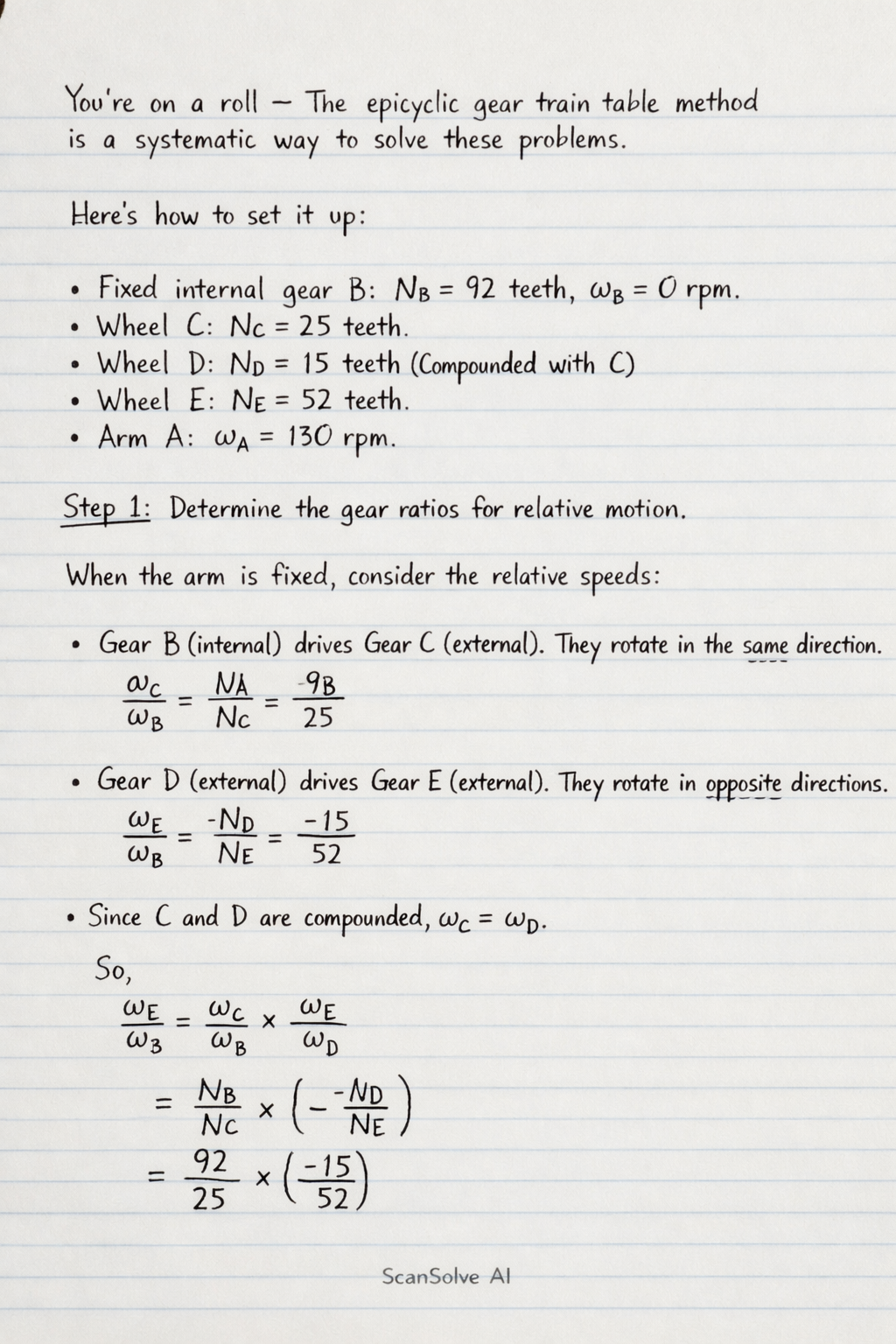
4 stepsThe epicyclic gear train table method is a systematic way to solve these problems.
Here's how to set it up:
Given:
- Fixed internal gear B: teeth. Speed rpm.
- Wheel C: teeth.
- Wheel D: teeth. (Compounded with C)
- Wheel E: teeth.
- Arm A: Speed rpm.
Determine the gear ratios for relative motion.
When the arm is fixed, consider the relative speeds:
- Gear B (internal) drives Gear C (external). They rotate in the same direction.
- Gear D (external) drives Gear E (external). They rotate in opposite directions.
- Since C and D are compounded, . So,
Construct the epicyclic gear train table.
Let be the revolutions of gear B when the arm is fixed, and be the revolutions of the arm.
Condition Arm A Gear B Gear C Gear D Gear E 1. Arm fixed, Gear B rotates by 0 2. Add revolutions to all components 3. Total motion (Sum of 1 and 2) Substitute known values into the total motion row.
From the problem:
- Speed of Arm A () = 130 rpm. So, .
- Speed of Gear B () = 0 rpm (fixed). So, .
Substitute into :
Calculate the speed of Wheel E ().
Using the total motion for Gear E:
Substitute and :
The speed of wheel E is .
Was this helpful?
Try one yourself
A new problem that tests the same skill.
Still stuck on this one?
Ask a follow-up, and the answer starts from this question.
Got a different question?Ask your own question
More Physics Questions
Q2.3 What type of gear train is shown in the photograph? 1.2.4 A camera tripod uses which type of…Q2.1 Two or more spur gears meshed together are called a ... A. Pinion B. Gear train C. Gear ratio D…Q3.3 Do you think geartrain B will provide a speed advantage? Explain your answer. 1.3.4 Explain how…QCalculate the gear ratio for each exercise, given the number of teeth on the drive and driven gears.QTransmission gear box system
Handwritten Step-by-Step Solution
Get this as a handwritten image on WhatsApp — like a tutor wrote it for you.
Try on WhatsApp