

This physics problem tests your understanding of fundamental physical laws and their applications. The step-by-step solution below breaks down the problem using relevant equations and physical reasoning.
ScanSolve AI Answer
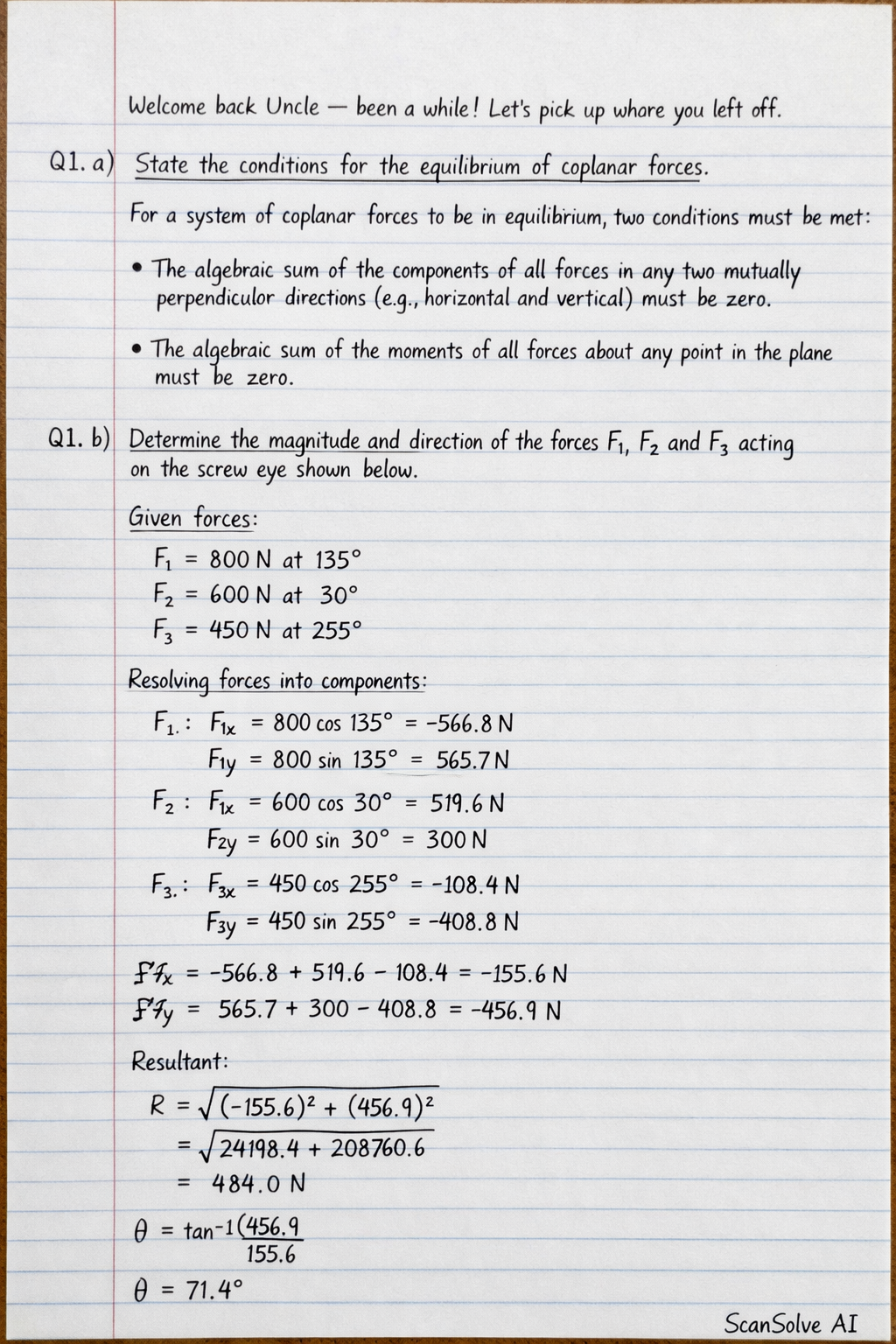
Q1. a) State the conditions for the equilibrium of coplanar forces For a system of coplanar forces to be in equilibrium, two conditions must be met: • The algebraic sum of the components of all forces in any two mutually perpendicular directions (e.g., horizontal and vertical) must be zero. • The algebraic sum of the moments of all forces about any point in the plane must be zero. Q1. b) Determine the magnitude and direction of the forces F1, F2 and F3 acting on the screw eye shown below. The question asks to determine the magnitude and direction of the forces. Assuming this implies finding the resultant force from the given forces, we will resolve each force into its x and y components, sum them, and then find the resultant magnitude and direction. Given forces: F_1 = 800 N at 135^ (from positive x-axis) F_2 = 600 N at 30^ (from positive x-axis) F_3 = 450 N at 255^ (from positive x-axis) Step 1: Resolve each force into its x and y components. For F_1: F_1x = 800 (135^) = 800 × (-0.7071) = -565.68 N F_1y = 800 (135^) = 800 × (0.7071) = 565.68 N For F_2: F_2x = 600 (30^) = 600 × (0.8660) = 519.62 N F_2y = 600 (30^) = 600 × (0.5) = 300.00 N For F_3: F_3x = 450 (255^) = 450 × (-0.2588) = -116.46 N F_3y = 450 (255^) = 450 × (-0.9659) = -434.66 N Step 2: Sum the x and y components to find the resultant components. F_x = F_1x + F_2x + F_3x = -565.68 + 519.62 - 116.46 = -162.52 N F_y = F_1y + F_2y + F_3y = 565.68 + 300.00 - 434.66 = 431.02 N Step 3: Calculate the magnitude of the resultant force R. R = sqrt(( F_x)^2 + ( F_y)^2) R = sqrt((-162.52)^2 + (431.02)^2) R = sqrt(26412.75 + 185778.24) = sqrt(212190.99) R ≈ 460.64 N Step 4: Calculate the direction of the resultant force . The reference angle _ref is given by: _ref = (|( F_y)/( F_x)|) = (|(431.02)/(-162.52)|) = (2.6521) _ref ≈ 69.35^ Since F_x is negative and F_y is positive, the resultant force lies in the second quadrant. = 180^ - _ref = 180^ - 69.35^ = 110.65^ The magnitude of the resultant force is 461 N. The direction of the resultant force is 111^ from the positive x-axis (counter-clockwise). Q2. a) Briefly explain the following i) Moment of force: The moment of a force (or torque) is a measure of its tendency to cause an object to rotate about an axis or point. It is calculated as the product of the force's magnitude and the perpendicular distance from the axis of rotation to the line of action of the force. ii) Equilibrium: Equilibrium is a state where an object is either at rest or moving with a constant velocity. In this state, the net force and net moment acting on the object are both zero, meaning there is no change in its translational or rotational motion. Q2. b) State the two condition for equilibrium The two conditions for equilibrium are: • The vector sum of all external forces acting on the body must be zero ( F = 0). • The vector sum of all external moments (torques) acting on the body about any point must be zero ( M = 0). Q2. c) A force of 45N is applied to a spanner at an effective length of 180mm from the center of a nut. Calculate Given: Force F = 45 N Effective length d_1 = 180 mm = 0.18 m i. The moment of the force applied to the nut Step 1: Calculate the moment using the formula M = F × d. M = 45 N × 0.18 m M = 8.1 Nm The moment of the force applied to the nut is 8.1 Nm. ii. The magnitude of the force required to produce the Moment if the effective length is reduced to 120mm. Given: New effective length d_2 = 120 mm = 0.12 m The moment M remains the same as calculated in part (i), M = 8.1 Nm. Step 1: Calculate the new force F_2 using the formula F_2 = M / d_2. F_2 = 8.1 Nm0.12 m F_2 = 67.5 N The magnitude of the force required is 67.5 N. Q3. a) State the principles of moment The principle of moments states that for an object to be in rotational equilibrium, the sum of the clockwise moments about any point must be equal to the sum of the anticlockwise moments about the same point. This is also known as Varignon's theorem, which states that the moment of a resultant force about any point is equal to the sum of the moments of its components about the same point. Q3. b) A beam PQ is 5.0m long and is supported at its ends in a horizontal position as shown below. It mass is equivalent to a force of 400N acting at its centre as shown. Point loads of 12KN and 20KN act on the beam in the position shown. When the beam is in equilibrium, determine (i.) the reaction of the support Rp and Rq (ii.) The position of which the 12 KN load must be moved for the force on the support to be equal. Given: Beam length L = 5.0 m Weight of beam W = 400 N at 2.5 m from P Load F_1 = 12 KN = 12000 N at 1.2 m from P Load F_2 = 20 KN = 20000 N at 1.2 + 1.3 + 1.5 = 4.0 m from P Supports R_P at P (0 m) and R_Q at Q (5.0 m) i) Determine the reaction of the support R_P and R_Q Step 1: Apply the condition for rotational equilibrium ( M_P = 0). Take moments about point P. (Clockwise moments are positive, counter-clockwise are negative) (-12000 N × 1.2 m) + (-400 N × 2.5 m) + (-20000 N × 4.0 m) + (R_Q × 5.0 m) = 0 -14400 Nm - 1000 Nm - 80000 Nm + 5.0 R_Q = 0 -95400 Nm + 5.0 R_Q = 0 5.0 R_Q = 95400 Nm R_Q = (95400)/(5.0) = 19080 N Step 2: Apply the condition for translational equilibrium ( F_y = 0). (Upward forces are positive, downward forces are negative) R_P + R_Q - 12000 N - 400 N - 20000 N = 0 R_P + 19080 N - 32400 N = 0 R_P - 13320 N = 0 R_P = 13320 N The reaction at support P is 13320 N (or 13.32 KN). The reaction at support Q is 19080 N (or 19.08 KN). ii) The position of which the 12 KN load must be moved for the force on the support to be equal. Step 1: Determine the equal support forces. If R_P = R_Q, then each support force must be half of the total downward load. Total downward load = 12000 N + 400 N + 20000 N = 32400 N. So, R_P = R_Q = 32400 N2 = 16200 N. Step 2: Let the new position of the 12 KN load be x from P. Apply the condition for rotational equilibrium ( M_P = 0). (-12000 N × x) + (-400 N × 2.5 m) + (-20000 N × 4.0 m) + (R_Q × 5.0 m) = 0 Substitute R_Q = 16200 N: -12000x - 1000 Nm - 80000 Nm + (16200 N × 5.0 m) = 0 -12000x - 81000 Nm + 81000 Nm = 0 -12000x = 0 x = 0 m The 12 KN load must be moved to a position of 0 m from P (i.e., directly over support P). Q4. a). Define i. Couple ii. Torque and state it units i) Couple: A couple is a pair of forces, equal in magnitude, opposite in direction, and separated by a perpendicular distance. A couple produces only rotation (a pure moment) and no translation. ii) Torque: Torque is the rotational equivalent of linear force. It is a measure of the twisting force that causes rotation about an axis. Torque is calculated as the product of a force and its perpendicular distance from the pivot point. Its standard unit is the Newton-meter (Nm). Q4. b). A pulley is 600mm in diameter and the difference in tension on the two sides of the driving belt is 1.5KN. If the Speed of the pulley is 500 rev/min, determine i.) the torque developed ii.) The work done in 3 minutes. Given: Diameter D = 600 mm = 0.6 m, so radius r = 0.3 m Difference in tension T = 1.5 KN = 1500 N Speed N = 500 rev/min Time t = 3 minutes i) The torque developed Step 1: Calculate the torque using the formula = T × r. = 1500 N × 0.3 m = 450 Nm The torque developed is 450 Nm. ii) The work done in 3 minutes Step 1: Convert the speed from rev/min to angular velocity in rad/s. = (2 N)/(60) = 2 × 500 rev/min60 s/min = (1000)/(60) = (50)/(3) rad/s ≈ 52.36 rad/s Step 2: Convert time from minutes to seconds. t = 3 min × 60 s/min = 180 s Step 3: Calculate the total angular displacement . = × t = (50)/(3) rad/s × 180 s = 3000 rad ≈ 9424.78 rad Step 4: Calculate the work done W = × . W = 450 Nm × 3000 rad W = 1350000 J ≈ 4241150 J W ≈ 4.24 × 10^6 J (or 4.24 MJ) The work done in 3 minutes is 4.24 MJ. Q5. An internal combustion engine of 60 horsepower (hp) transmit power to the car wheel of an automobile at 300 rev/min (rpm). Neglecting any transmission losses determine the minimum permissible diameter of the Solid circular section steel shaft if the maximum shear stress if the shaft is limited to 50Mps. What will be the Resulting angle of twist of the shaft due to the applied torque over a length of 2m. given the rigidity modulus G = 70 Gpa (Note that 1hp = 745.7w). Given: Power P = 60 hp Speed N = 300 rev/min Maximum shear stress _max = 50 MPa = 50 × 10^6 Pa Length of shaft L = 2 m Rigidity modulus G = 70 GPa = 70 × 10^9 Pa Conversion: 1 hp = 745.7 W Step 1: Convert power to Watts. P = 60 hp × 745.7 W/hp = 44742 W Step 2: Convert speed to angular velocity in rad/s. = (2 N)/(60) = 2 × 300 rev/min60 s/min = 10 rad/s ≈ 31.416 rad/s Step 3: Calculate the torque T transmitted by the shaft using P = T. T = (P)/() = 44742 W10 rad/s ≈ 1424.3 Nm Step 4: Determine the minimum permissible diameter d based on maximum shear stress. For a solid circular shaft, _max = (16T)/( d^3). Rearrange for d: d^3 = (16T)/( _max) d^3 = 16 × 1424.3 Nm × 50 × 10^6 Pa d^3 = (22788.8)/(157.0796 × 10^6) ≈ 1.4507 × 10^-4 m^3 d = (1.4507 × 10^-4)^1/3 m d ≈ 0.05254 m ≈ 52.54 mm The minimum permissible diameter is 52.5 mm. Step 5: Calculate the polar moment of inertia J for the shaft. J = ( d^4)/(32) = × (0.05254 m)^432 J = × 7.599 × 10^-6 m^432 ≈ 7.468 × 10^-7 m^4 Step 6: Calculate the resulting angle of twist . = TL ✂️ _That answer was long and got cut off. Reply continue and I'll finish it._