
We read your photo as:
Q4. a) Define i. Couple ii. Torque and state it units b) A pulley is 600mm in diameter and the difference in tension on the two sides of the driving belt is 1.5KN. If the Speed of the pulley is 500 rev/min, determine i.) the torque developed ii. The work done in 3 minutes.
ScanSolve AI Answer
Answer
Step-by-step solution
3 steps...GJ}$.
Step 7: Calculate the resulting angle of twist .
Converting to degrees:
The resulting angle of twist of the shaft is \boxed{\text{0.0545 rad or 3.12^\circ}}.
Q6. a) Define the following terms and state their relations
Part i
Radian
A radian is a unit of angular measure. It is defined as the angle subtended at the center of a circle by an arc whose length is equal to the radius of the circle. The relationship between radians and degrees is .
Part ii
Linear and angular velocity
- Linear velocity () is the rate of change of an object's position along a straight path, measured in meters per second (m/s).
- Angular velocity () is the rate of change of angular displacement, measured in radians per second (rad/s).
- Relation: For a point on a rotating object at a distance from the axis of rotation, the linear velocity is related to the angular velocity by the formula .
Part iii
Linear and angular acceleration
- Linear acceleration () is the rate of change of linear velocity, measured in meters per second squared (m/s).
- Angular acceleration () is the rate of change of angular velocity, measured in radians per second squared (rad/s).
- Relation: For a point on a rotating object at a distance from the axis of rotation, the linear acceleration is related to the angular acceleration by the formula .
Q6. b) The speed of the shaft increases uniformly from 300 revolutions per minute in 10 sec. Find the angular acceleration correct to 3 significant figures.
The phrasing "increases uniformly from 300 revolutions per minute in 10 sec" is ambiguous. We will assume it means the shaft increases its speed uniformly from rest to 300 revolutions per minute in 10 seconds.
Given:
Initial angular velocity rev/min (assumed from rest)
Final angular velocity rev/min
Time s
Convert the final angular velocity from revolutions per minute to radians per second.
Calculate the angular acceleration using the kinematic equation .
Since :
Round the angular acceleration to 3 significant figures.
The angular acceleration is .
Try one yourself
A new problem that tests the same skill.
Still stuck on this one?
Ask a follow-up, and the answer starts from this question.
More Physics Questions
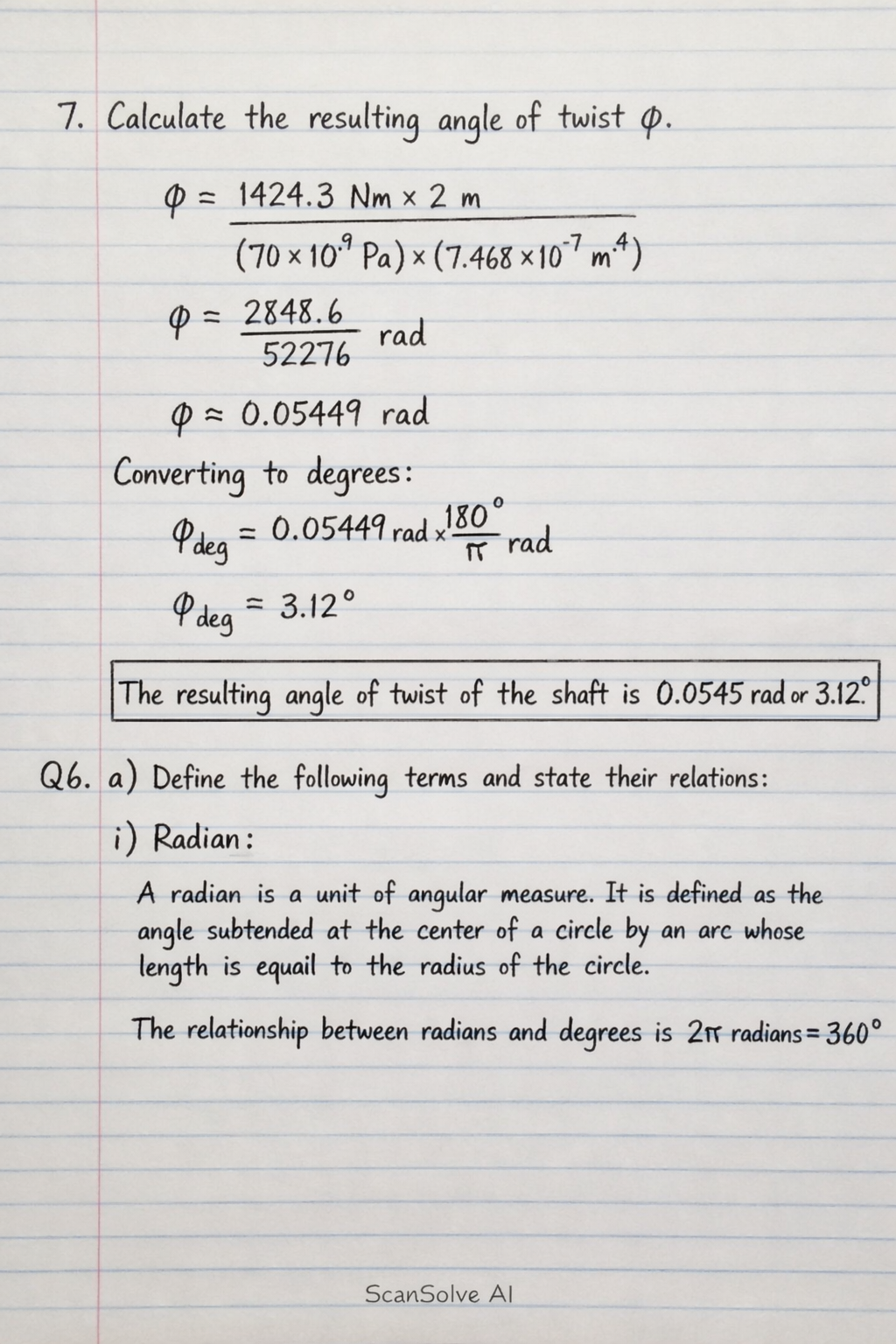
Handwritten Step-by-Step Solution
Get this as a handwritten image on WhatsApp — like a tutor wrote it for you.
Try on WhatsApp