
We read your photo as:
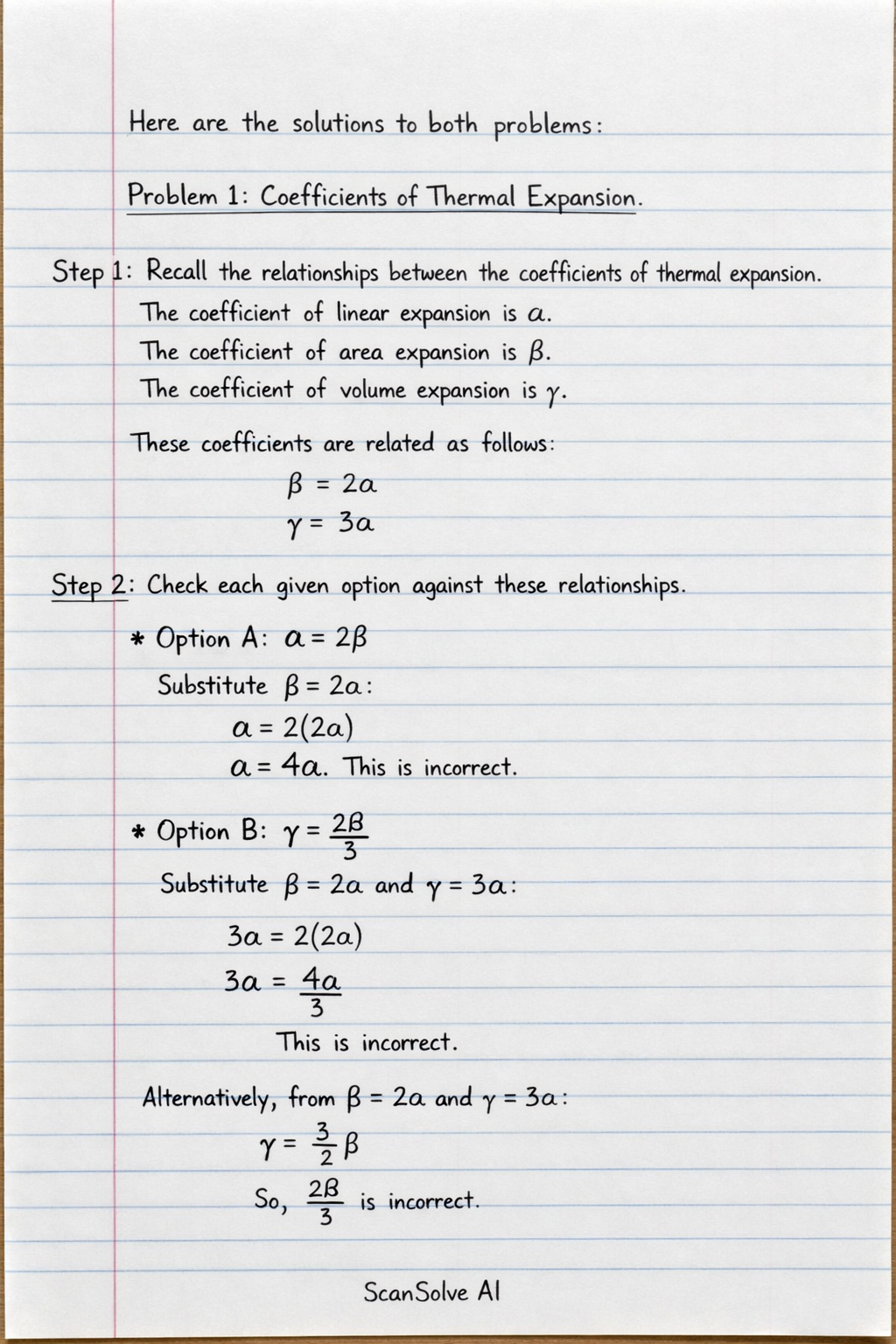
Recall the relationships between the coefficients of thermal expansion.
ScanSolve AI Answer
Step-by-step solution
6 stepsHere are the solutions to both problems:
: Coefficients of Thermal Expansion
Recall the relationships between the coefficients of thermal expansion.
The coefficient of linear expansion is .
The coefficient of area expansion is .
The coefficient of volume expansion is .These coefficients are related as follows:
Check each given option against these relationships.
-
Option A: Substitute : . This is incorrect.
-
Option B: Substitute and : . This is incorrect. Alternatively, from and , we can derive . So, is incorrect.
-
Option C: Substitute and : . This is incorrect. Alternatively, from and , we can derive . So, is incorrect.
Since none of the first three options are correct, the correct choice is "None of the other options".
The correct option is .
: Adiabatic Expansion of an Ideal Monatomic Gas
-
Understand the characteristics of an adiabatic expansion.
An adiabatic process means no heat exchange with the surroundings ().
An expansion means the volume of the gas increases, and the gas does work on its surroundings ().Apply the First Law of Thermodynamics.
The First Law of Thermodynamics states .
Since for an adiabatic process, the equation becomes .
Since it's an expansion, . Therefore, , which means .
A decrease in internal energy () for an ideal gas implies a decrease in its temperature ().Analyze the statements based on the temperature change.
-
I. The work done is zero. In an expansion (not free expansion), the gas does work against external pressure, so . This statement is incorrect.
-
II. The average speed of the atoms increases. Since the temperature decreases, the average kinetic energy of the atoms decreases. The average speed of the atoms is directly related to their average kinetic energy, so the average speed must decrease. This statement is incorrect.
-
III. The average speed of the atoms remains constant. As explained above, the temperature decreases, so the average speed of the atoms decreases. This statement is incorrect.
-
IV. The average speed of the atoms decrease. As the temperature of the gas decreases during an adiabatic expansion, the average kinetic energy of its atoms decreases, which in turn means their average speed decreases. This statement is correct.
-
Select the correct option.
Only statement IV is correct.
The correct option is .
Still stuck on this one?
Ask a follow-up, and the answer starts from this question.
More Physics Questions
Handwritten Step-by-Step Solution
Get this as a handwritten image on WhatsApp — like a tutor wrote it for you.
Try on WhatsApp