

This physics problem tests your understanding of fundamental physical laws and their applications. The step-by-step solution below breaks down the problem using relevant equations and physical reasoning.
ScanSolve AI Answer
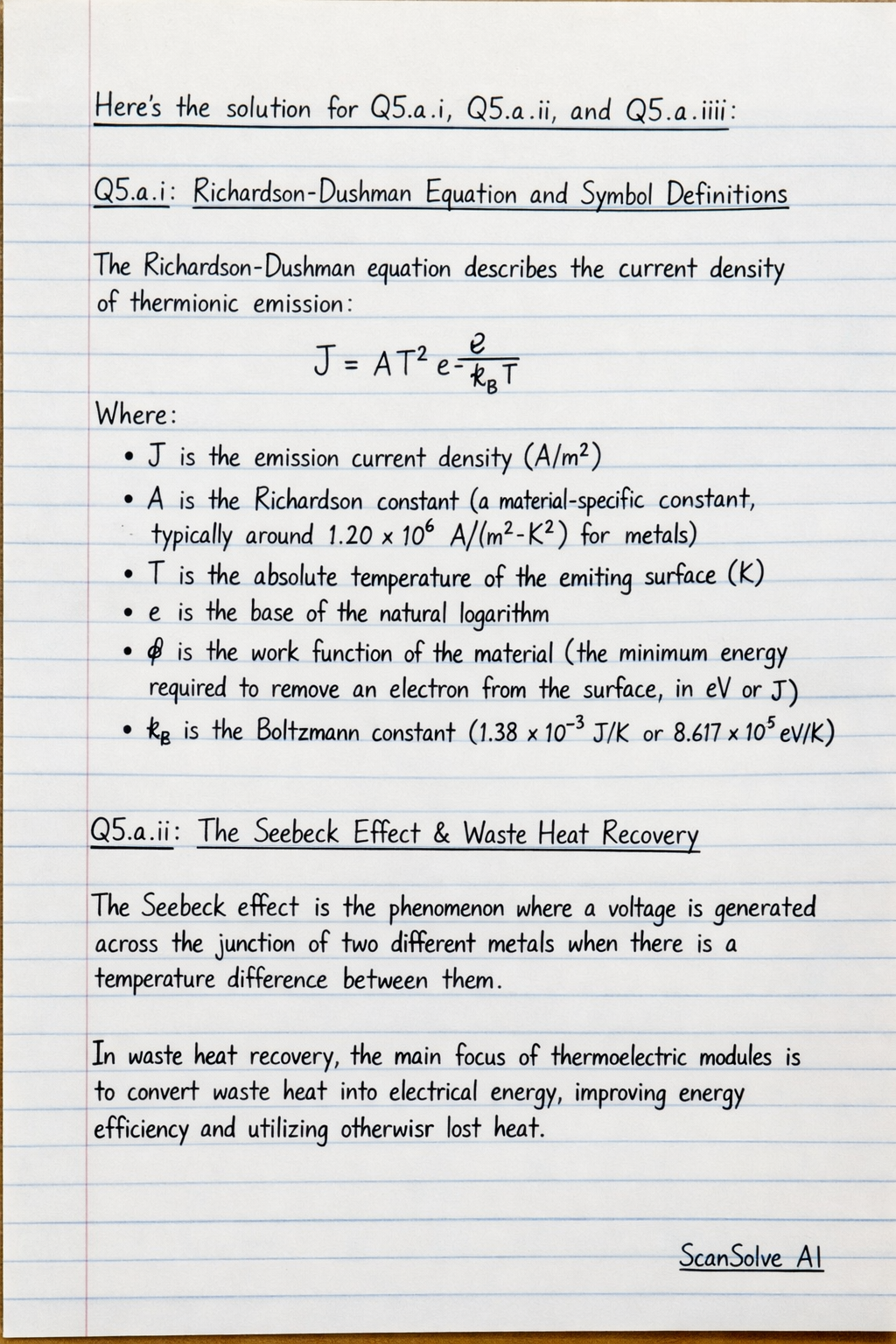
Here's the solution for Q5.a.i, Q5.a.ii, and Q5.a.iii: Q5.a.i: Write the Richardson-Dushman equation and state what each symbol represents. The Richardson-Dushman equation describes the current density of thermionic emission: J = A T^2 e^-()/(k_B T) Where: • J is the emission current density (A/m^2) • A is the Richardson constant (a material-specific constant, typically around 1.20 × 10^6 A/(m^2 · K^2) for metals) • T is the absolute temperature of the emitting surface (K) • e is the base of the natural logarithm • is the work function of the material (the minimum energy required to remove an electron from the surface, in eV or J) • k_B is the Boltzmann constant (1.38 × 10^-23 J/K or 8.617 × 10^-5 eV/K) Q5.a.ii: Explain the Seebeck effect. What is the main focus of thermoelectric module application in waste heat recovery? The Seebeck effect is a thermoelectric phenomenon where a voltage difference (electromotive force) is created across two dissimilar electrical conductors or semiconductors when their junctions are held at different temperatures. This temperature difference causes charge carriers (electrons or holes) to diffuse from the hotter side to the colder side, resulting in a net flow of charge and thus an electric current if a circuit is formed. The main focus of thermoelectric module application in waste heat recovery is to directly convert thermal energy (heat) into electrical energy using the temperature difference between a hot waste heat source and a colder sink. This allows for the generation of electricity from otherwise unused heat, improving overall energy efficiency. Q5.a.iii: List one application of thermionic conversion. Why do DEC devices provide low inertia to the grid? One application of thermionic conversion is in space power systems (e.g., for spacecraft or satellites) where high-temperature heat sources (like radioisotope thermoelectric generators or nuclear reactors) can be used to directly generate electricity. DEC (Direct Energy Conversion) devices provide low inertia to the grid because they typically do not involve large rotating masses (like the turbines and generators in conventional power plants). The rotational inertia of these heavy components helps stabilize grid frequency. DEC devices, such as fuel cells, solar PV, and some thermoelectric generators, convert energy directly without mechanical rotation, meaning they do not inherently contribute to the grid's rotational inertia, which can pose challenges for grid stability during disturbances. That's it for this one. Send me the next one 📸