
We read your photo as:
Define Simple Harmonic Motion. Give four examples of systems that undergo SHM. A 10kg mass attached to a spring oscillates with amplitude 5cm and frequency 50Hz. Find: (i) maximum velocity (ii) KE at
ScanSolve AI Answer
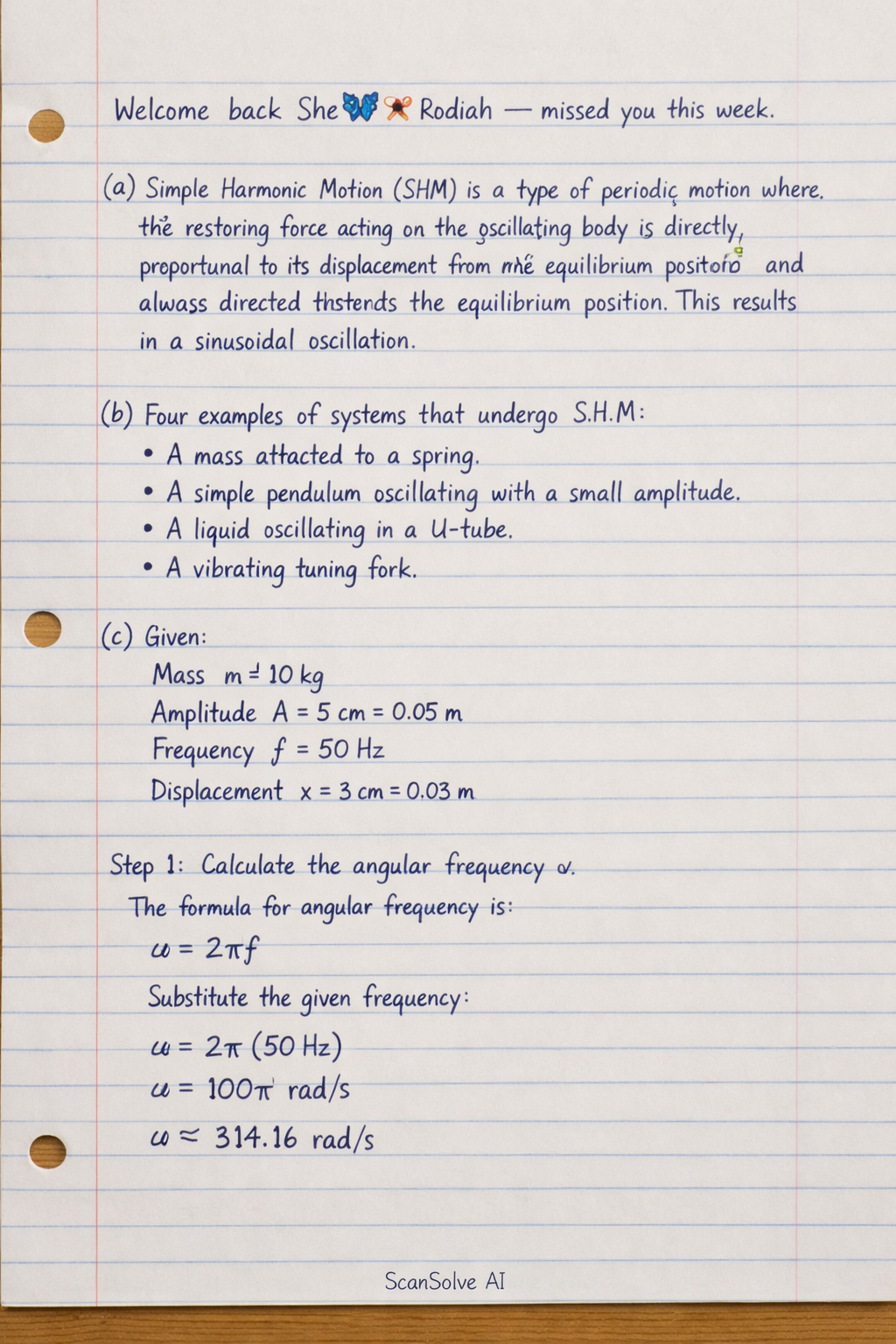
a) Simple Harmonic Motion (SHM) is a type of periodic motion where the restoring force acting on the oscillating body is directly proportional to its displacement from the equilibrium position and always directed towards the equilibrium position. This results in a sinusoidal oscillation.
b) Four examples of systems that undergo S.H.M:
- A mass attached to a spring.
- A simple pendulum oscillating with a small amplitude.
- A liquid oscillating in a U-tube.
- A vibrating tuning fork.
c) Given:
Mass
Amplitude
Frequency
Displacement
Step 1: Calculate the angular frequency .
The formula for angular frequency is:
Substitute the given frequency:
c) (i) Find the maximum velocity.
The formula for maximum velocity in SHM is:
Substitute the values for amplitude and angular frequency:
The maximum velocity is .
c) (ii) Find the Kinetic Energy (K.E) at a displacement of .
The formula for Kinetic Energy at a displacement is:
Substitute the given values:
The Kinetic Energy at displacement is .
c) (iii) Find the Total Energy.
The formula for Total Energy in SHM is:
Substitute the given values:
The Total Energy is .
c) (iv) Sketch the energy-distance graph.
The energy-distance graph for SHM illustrates how Kinetic Energy (K.E.), Potential Energy (P.E.), and Total Energy (T.E.) vary with displacement .
- The Total Energy is constant and is represented by a horizontal line across the graph.
- The Potential Energy is zero at the equilibrium position () and reaches its maximum value at the extreme positions (). It follows a parabolic curve, .
- The Kinetic Energy is maximum at the equilibrium position () and becomes zero at the extreme positions (). It also follows a parabolic curve, . The sum of K.E. and P.E. at any given displacement always equals the constant Total Energy.
Still stuck on this one?
Ask a follow-up, and the answer starts from this question.
More Physics Questions
Handwritten Step-by-Step Solution
Get this as a handwritten image on WhatsApp — like a tutor wrote it for you.
Try on WhatsApp