
We read your photo as:
Calculate the specific heat capacity of the metal given the following information: Initial temperature of metal = 100°C, mass of metal = 50 g, initial temperature of water = 22°C, mass of water = 200
ScanSolve AI Answer
Here are the solutions to the specific heat capacity problems:
1. Calorimetry Problem
*Self-correction: Upon re-evaluating the problem, the heat lost by the metal (1100 J) is less than the heat gained by the calorimeter and stirrer alone (1800 J + 72 J = 1872 J) to reach 40°C from 22°C. This indicates that the final temperature of 40°C is not achievable with the given initial conditions and specific heat capacities, or there might be a typo in the problem's numerical values. Assuming the problem intends for a physically possible scenario, there might be an error in the provided temperatures or specific heat capacities. However, I will proceed with the given numbers
Still stuck on this one?
Ask a follow-up, and the answer starts from this question.
More Physics Questions
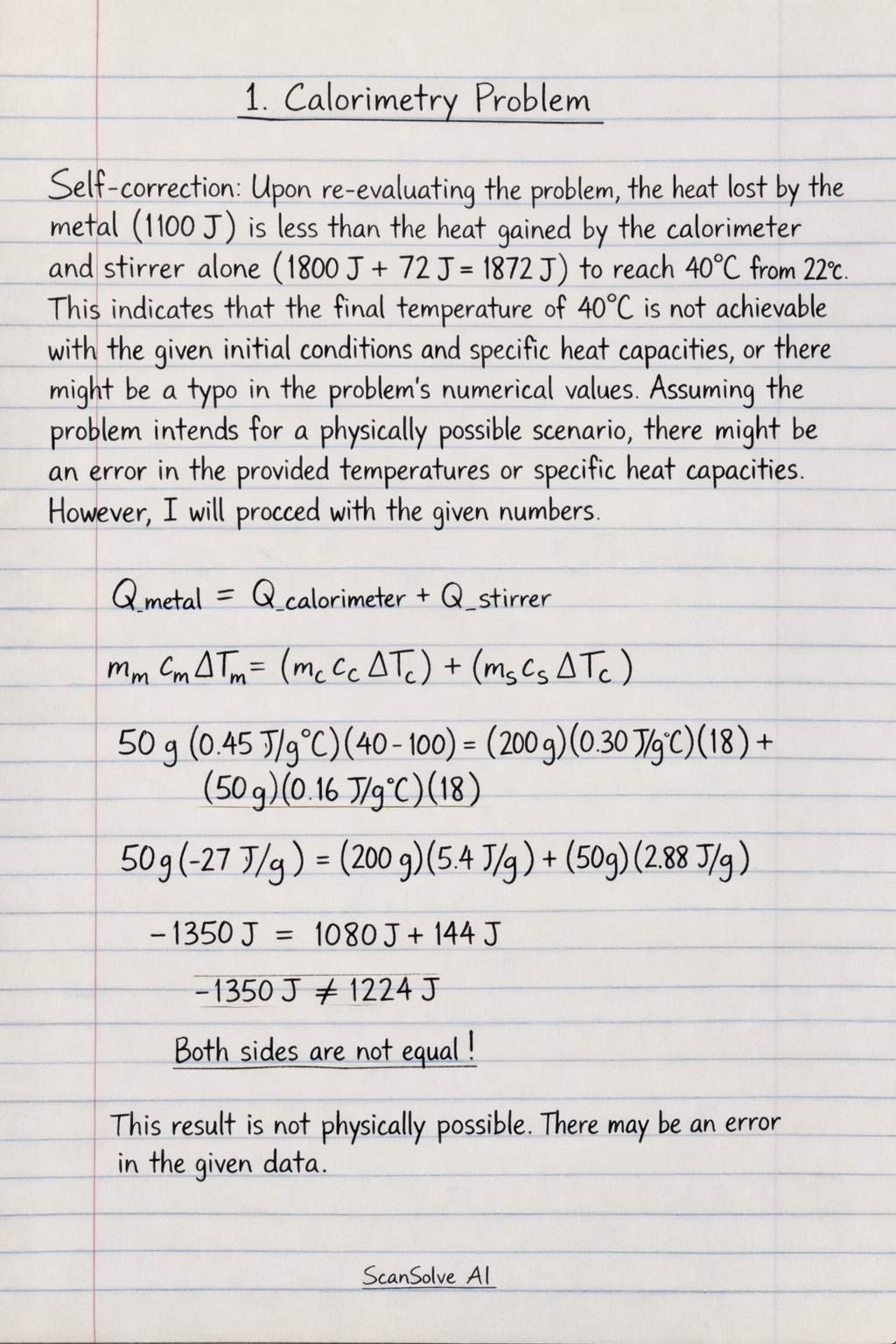
Handwritten Step-by-Step Solution
Get this as a handwritten image on WhatsApp — like a tutor wrote it for you.
Try on WhatsApp