
We read your photo as:
Determine the spring constant (k) of a helical spring using the dynamic method by measuring the period of oscillation for different masses.
ScanSolve AI Answer
Answer
The aim is to determine the spring constant () of a helical spring. This can be achieved using the dynamic method, which involves measuring the period of oscillation for different masses.
Step-by-step solution
5 stepsSet up the apparatus.
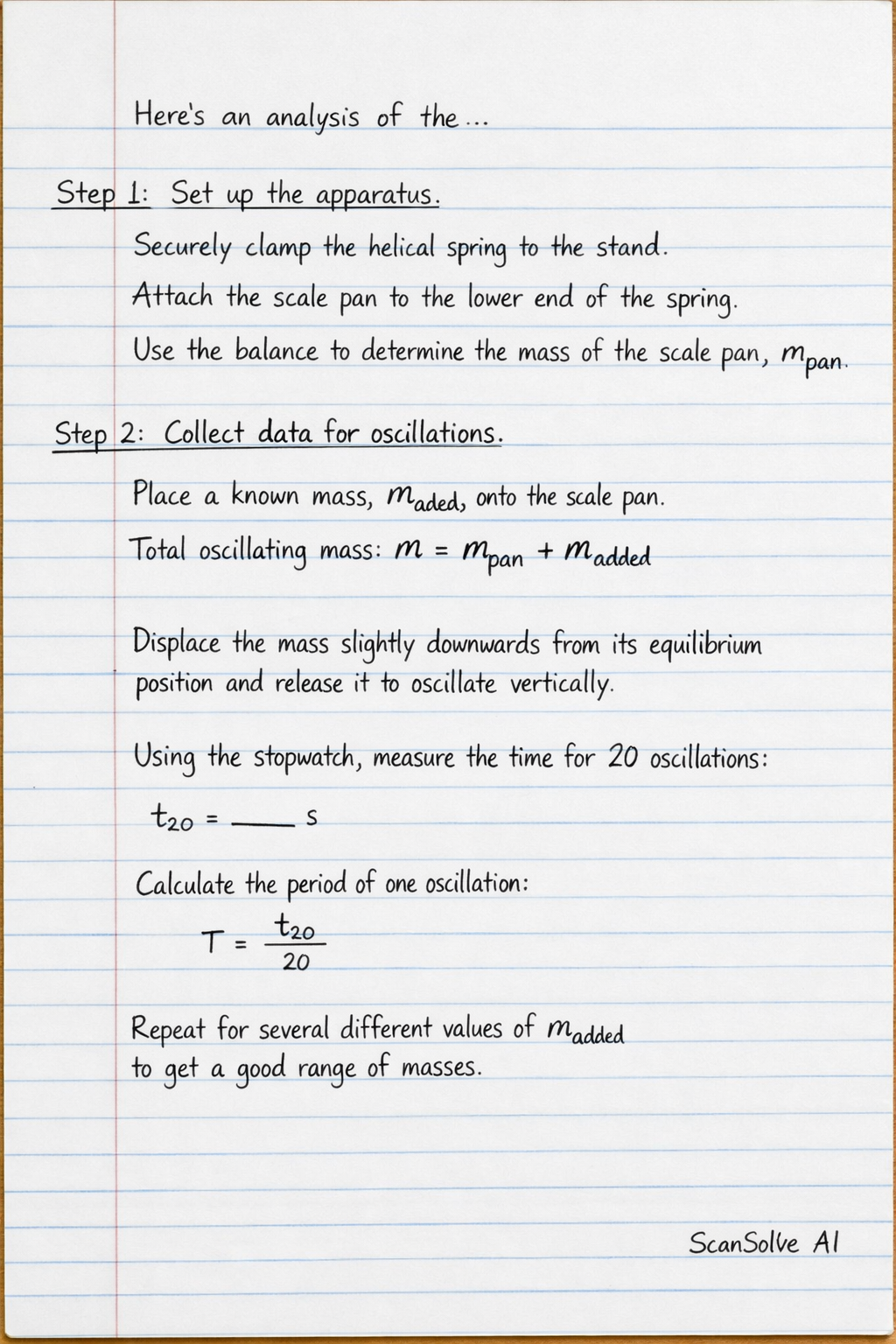
Securely clamp the helical spring to the stand. Attach the scale pan to the lower end of the spring. Use the balance to determine the mass of the scale pan, .
Collect data for oscillations.
Place a known mass, , onto the scale pan. The total oscillating mass will be . Displace the mass slightly downwards from its equilibrium position and release it to oscillate vertically. Using the stopwatch, measure the time taken for a specific number of complete oscillations (e.g., 20 oscillations). Let this time be . Calculate the period of one oscillation, . Repeat this measurement for several different values of , ensuring a good range of masses.
Analyze the data graphically.
For each set of measurements, calculate the square of the period, . Plot a graph of (on the y-axis) against the total oscillating mass (on the x-axis). The relationship between the period of oscillation , the oscillating mass , and the spring constant is given by:
Squaring both sides, we get:
This equation is in the form , where , , and the slope . Determine the slope of the straight line graph.
Calculate the spring constant.
From the slope of the vs. graph, calculate the spring constant :
The unit of the spring constant will be Newtons per meter (N/m).
Precautions for accuracy.
- Ensure the oscillations are purely vertical and not swinging sideways.
- Start the stopwatch after a few oscillations to allow the system to settle into regular motion.
- Measure the time for a large number of oscillations (e.g., 20 or more) to minimize the percentage error in timing.
- Ensure the spring is not stretched beyond its elastic limit.
Alternatively, the spring constant can be determined using the static method (Hooke's Law) by measuring the extension of the spring for different applied forces using the metre rule and plotting force versus extension. The slope of this graph would directly give the spring constant.
Still stuck on this one?
Ask a follow-up, and the answer starts from this question.
More Physics Questions
Handwritten Step-by-Step Solution
Get this as a handwritten image on WhatsApp — like a tutor wrote it for you.
Try on WhatsApp