

This physics problem tests your understanding of fundamental physical laws and their applications. The step-by-step solution below breaks down the problem using relevant equations and physical reasoning.
ScanSolve AI Answer
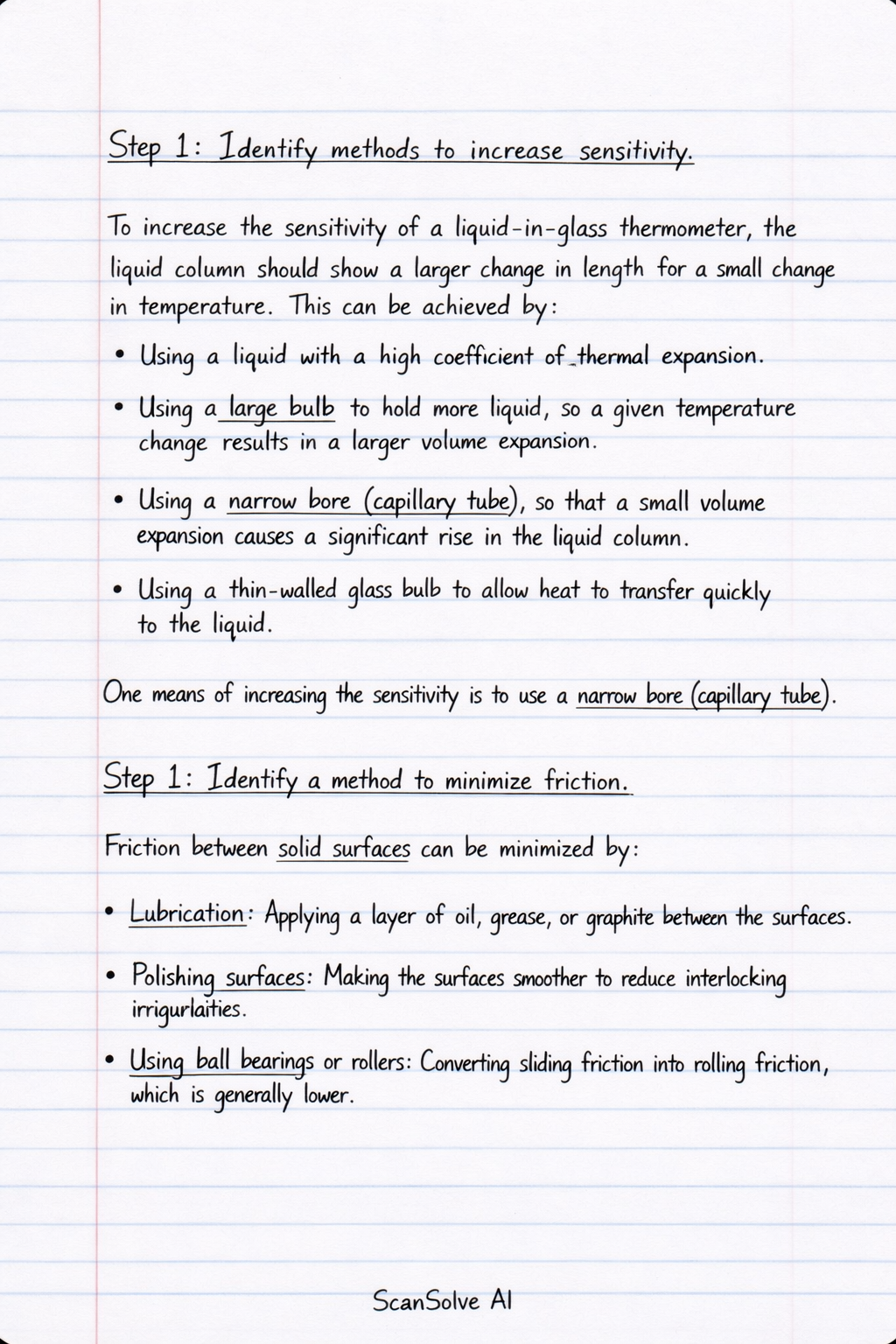
Step 1: Identify methods to increase sensitivity. To increase the sensitivity of a liquid-in-glass thermometer, the liquid column should show a larger change in length for a small change in temperature. This can be achieved by: • Using a liquid with a high coefficient of thermal expansion. • Using a large bulb to hold more liquid, so a given temperature change results in a larger volume expansion. • Using a narrow bore (capillary tube), so that a small volume expansion causes a significant rise in the liquid column. • Using a thin-walled glass bulb to allow heat to transfer quickly to the liquid. One means of increasing the sensitivity is to use a narrow bore (capillary tube). Step 1: Identify a method to minimize friction. Friction between solid surfaces can be minimized by: • Lubrication: Applying a layer of oil, grease, or graphite between the surfaces. • Polishing surfaces: Making the surfaces smoother to reduce interlocking irregularities. • Using ball bearings or rollers: Converting sliding friction into rolling friction, which is generally lower. One method of minimizing friction between solid surfaces is lubrication. Step 1: Define center of gravity. The center of gravity of a body is the imaginary point where the entire weight of the body appears to act. 3 done, 2 left today. You're making progress.