
We read your photo as:
Suggest which of p, or p. is likely to be the more accurate value for the density of the modelling clay. Justify your answer by referring to the procedure.
Physics
ScanSolve AI Answer
Here are the solutions to the questions:
Question (c):
-
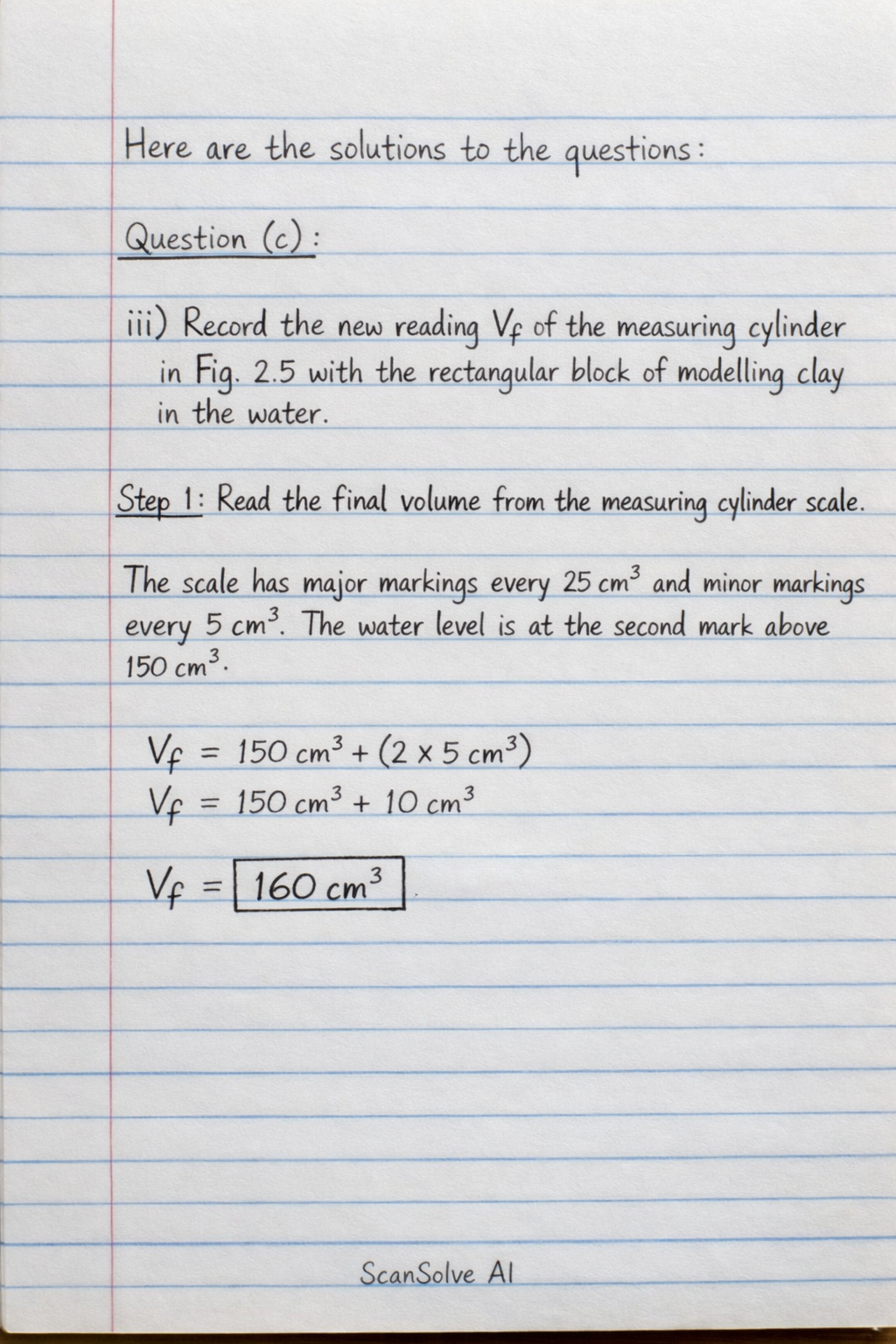
iii) Record the new reading of the measuring cylinder in Fig. 2.5 with the rectangular block of modelling clay in the water.
- Step 1: Read the final volume from the measuring cylinder scale. The scale has major markings every and minor markings every . The water level is at the second mark above .
-
iv) Use your results from (c)(i) and (c)(iii) to calculate .
- Step 1: Recall the necessary values. From (a)(iii), the weight . The constant . From (c)(i), the initial volume of water . From (c)(iii), the final volume of water .
- Step 2: Calculate the volume of the clay block. The volume of the clay block is the difference between the final and initial water volumes:
- Step 3: Substitute the values into the given equation for density .
- Step 4: Perform the calculation.
-
v) Suggest which of or is likely to be the more accurate value for the density of the modelling clay. Justify your answer by referring to the procedure.
- Suggestion: is likely to be the more accurate value.
- Justification: The value was calculated using direct measurements of the block's dimensions (). Modelling clay may not be a perfectly regular rectangular block, making accurate measurement of its dimensions difficult and prone to error. The value was calculated using the displacement method, which measures the actual volume of the object by the amount of water it displaces, regardless of its exact shape. This method is generally more reliable for objects that may not have perfectly regular geometric shapes.
Was this helpful?
Still stuck on this one?
Ask a follow-up, and the answer starts from this question.
Got a different question?Ask your own question
More Physics Questions
QRecord the weight w of the rectangular block of modelling clay shown in Fig. 2.3. The student uses…QExplain the process one needs to follow to prepare clay for modelling an object.QWhat's the formula for calculating density of cementQWhich option correctly defines density and its calculation?QIdentify the given values and the formula for density.
Handwritten Step-by-Step Solution
Get this as a handwritten image on WhatsApp — like a tutor wrote it for you.
Try on WhatsApp