
We read your photo as:
Record the weight w of the rectangular block of modelling clay shown in Fig. 2.3. The student uses the equation p1 = (w x k) / V1 to a value p1 for the density of the modelling clay, where k = 100 g/N. Use your results from (a)(ii) and (a)(iii) to calculate.
Physics
ScanSolve AI Answer
Here are the solutions to the questions:
Question 2 (a):
-
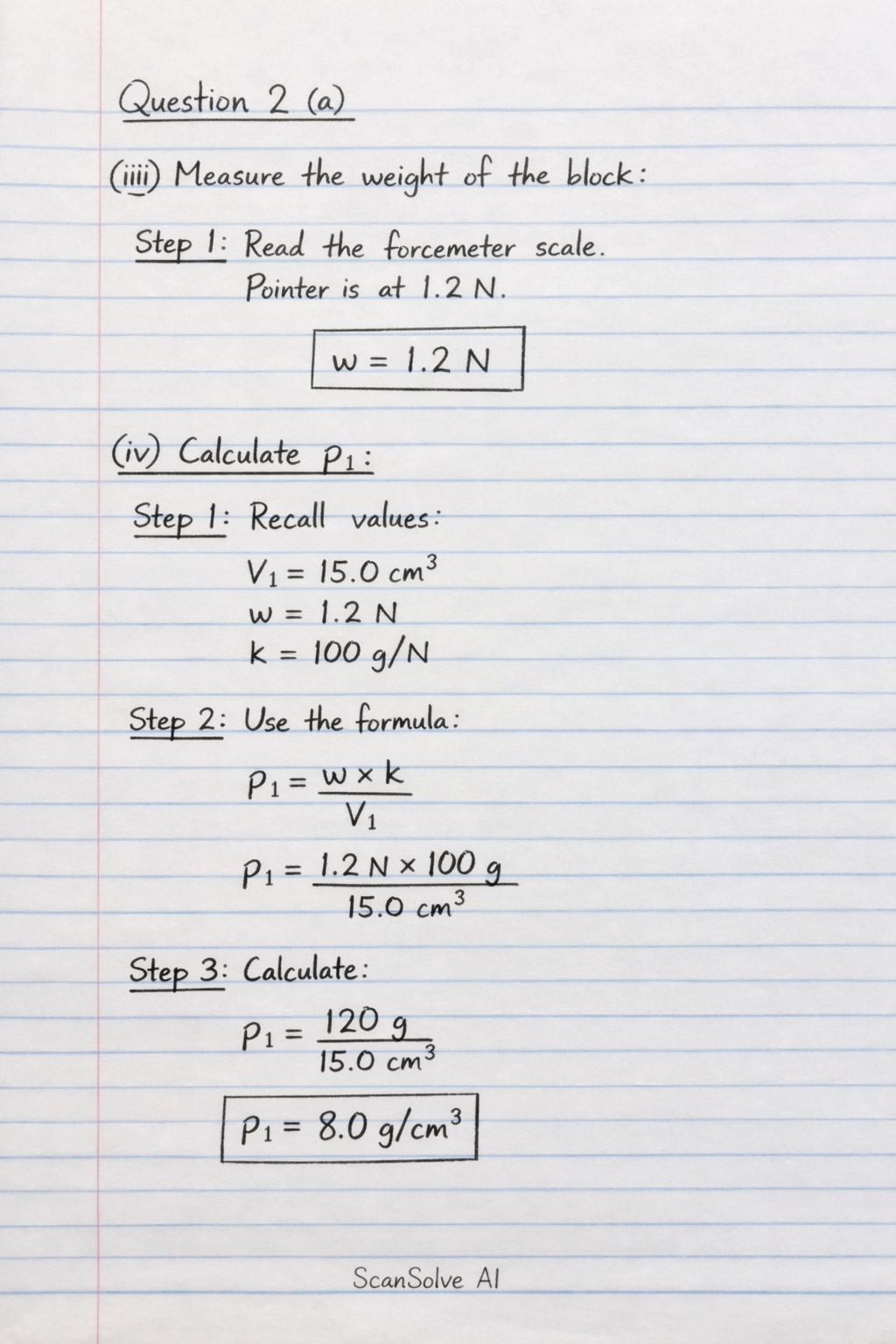
iii) Record the weight of the rectangular block of modelling clay shown in Fig. 2.3.
- Step 1: Read the value from the forcemeter scale. The forcemeter scale shows markings in Newtons (N). The pointer is aligned with the mark.
-
iv) Use your results from (a)(ii) and (a)(iii) to calculate .
- Step 1: Recall the values from previous parts. From (a)(ii), the volume . From (a)(iii), the weight . The given constant .
- Step 2: Substitute the values into the given equation for density .
- Step 3: Perform the calculation.
Was this helpful?
Still stuck on this one?
Ask a follow-up, and the answer starts from this question.
Got a different question?Ask your own question
More Physics Questions
QSuggest which of p, or p. is likely to be the more accurate value for the density of the modelling…QRecord the weight of the wooden block shown in Fig. 3.1. (b) Calculate the mass of the wooden block…QA cubic block of side 4 cm and density 750kg/m³, is attached to the base of a tank containing water…QCalculate the density of the blockQA cylindrical column of plasticine has a radius of 3 cm and a height of 20 cm. Its weight is 8.25 N…
Handwritten Step-by-Step Solution
Get this as a handwritten image on WhatsApp — like a tutor wrote it for you.
Try on WhatsApp