
We read your photo as:
Explain surface tension, capillarity, angle of contact, and the coefficient of surface tension, including its S.I. unit derivation.
ScanSolve AI Answer
Step-by-step solution
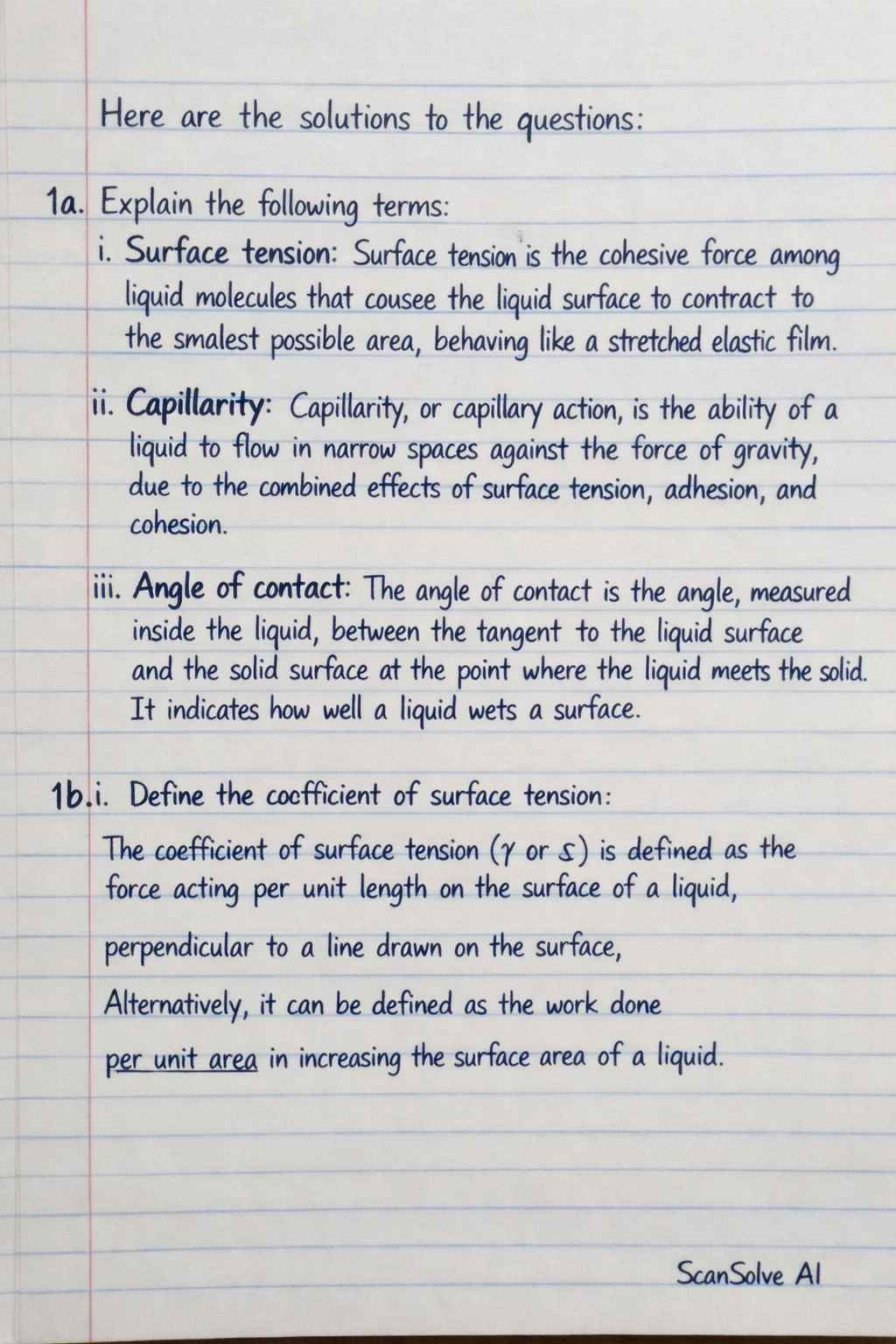
19 stepsHere are the solutions to the questions:
1a. Explain the following terms:
- i. Surface tension: Surface tension is the cohesive force among liquid molecules that causes the liquid surface to contract to the smallest possible area, behaving like a stretched elastic film.
- ii. Capillarity: Capillarity, or capillary action, is the ability of a liquid to flow in narrow spaces against the force of gravity, due to the combined effects of surface tension, adhesion, and cohesion.
- iii. Angle of contact: The angle of contact is the angle, measured inside the liquid, between the tangent to the liquid surface and the solid surface at the point where the liquid meets the solid. It indicates how well a liquid wets a surface.
1b.i. Define the coefficient of surface tension.
The coefficient of surface tension ( or ) is defined as the force acting per unit length on the surface of a liquid, perpendicular to a line drawn on the surface. Alternatively, it can be defined as the work done per unit area in increasing the surface area of a liquid.
1b.ii. Derive the S.I. unit of surface tension.
Start with the definition of surface tension as force per unit length.
Substitute the S.I.
units for force and length.
1b.iii. Derive the dimension of surface tension.
Start with the S.I.
unit of surface tension, N/m.
Express Newton (N) in terms of fundamental S.I.
units (kg, m, s). Force = mass acceleration, so .
Simplify the expression.
Express in terms of fundamental dimensions (Mass [M], Length [L], Time [T]).
2a. Deduce from the first principle, the following physical laws:
Define acceleration as the rate of change of velocity.
$$ a = \frac{V - u}{t} $$ where $V$ is final velocity, $u$ is initial velocity, and $t$ is time.Rearrange the equation to solve for .
$$ at = V - u $$ $$ V = u + at $$Define average velocity for uniform acceleration.
$$ V_{avg} = \frac{u + V}{2} $$Define displacement as average velocity multiplied by time.
$$ S = V_{avg} \cdot t = \left(\frac{u + V}{2}\right)t $$Substitute into the displacement equation.
$$ S = \left(\frac{u + (u + at)}{2}\right)t $$ $$ S = \left(\frac{2u + at}{2}\right)t $$ $$ S = \left(u + \frac{1}{2}at\right)t $$ $$ S = ut + \frac{1}{2}at^2 $$From , express time .
$$ t = \frac{V - u}{a} $$Substitute this expression for into the equation .
$$ S = u\left(\frac{V - u}{a}\right) + \frac{1}{2}a\left(\frac{V - u}{a}\right)^2 $$ $$ S = \frac{uV - u^2}{a} + \frac{1}{2}a\frac{(V - u)^2}{a^2} $$ $$ S = \frac{uV - u^2}{a} + \frac{(V - u)^2}{2a} $$Combine the terms with a common denominator.
$$ S = \frac{2(uV - u^2) + (V - u)^2}{2a} $$ $$ S = \frac{2uV - 2u^2 + V^2 - 2uV + u^2}{2a} $$Simplify the numerator.
$$ S = \frac{V^2 - u^2}{2a} $$Rearrange to solve for .
$$ 2aS = V^2 - u^2 $$ $$ V^2 = u^2 + 2aS $$2b. A car travels with a velocity of 18km/h, it then accelerated uniformly and travelled a distance of 50km, if the velocity reached is 54km/h, find the acceleration and time to travel this distance.
Convert given velocities and distance to S.I.
units (m/s and m).
Initial velocity
Final velocity
DistanceCalculate the acceleration () using the equation .
Calculate the time () using the equation .
3a. Explain what is meant by radius of gyration of an object.
The radius of gyration () of an object is the effective distance from the axis of rotation where the entire mass of the object could be considered to be concentrated to produce the same moment of inertia as its actual distribution. It is defined by the relationship , where is the moment of inertia and is the mass.3b. Calculate the radius of gyration of the following:
(Assuming "calculate" means to provide the formula for the radius of gyration, , as no specific dimensions or masses are given.)-
i. A uniform rod about an axis through one end. Moment of inertia .
-
ii. A sphere about its centre. Moment of inertia .
-
iii. A circular disc (about an axis through its center perpendicular to its plane). Moment of inertia .
-
iv. A ring (about an axis through its center perpendicular to its plane). Moment of inertia .
-
v. A uniform rod about axis through the middle. Moment of inertia $I = \frac{1}{12}ML^2
-
Still stuck on this one?
Ask a follow-up, and the answer starts from this question.
More Physics Questions
Handwritten Step-by-Step Solution
Get this as a handwritten image on WhatsApp — like a tutor wrote it for you.
Try on WhatsApp