
We read your photo as:
Calculate the tension T and list 3 ways to increase electromagnet strength and 2 applications of convex mirrors.
ScanSolve AI Answer
Answer
Step-by-step solution
3 stepsIdentify the forces and their perpendicular distances from the pivot.
The pivot is the point where the triangular support is located.
- The load acts downwards at a distance of from the pivot to the right. This creates a clockwise moment.
- The tension acts upwards at a distance of from the pivot to the right. This creates an anticlockwise moment.
Apply the principle of moments.
For the beam to be in equilibrium, the sum of clockwise moments about the pivot must equal the sum of anticlockwise moments about the pivot.
Solve for .
The tension in the string is .
-
Three ways of increasing the strength of an electromagnet are:
- Increasing the current flowing through the coil.
- Increasing the number of turns in the coil.
- Inserting a soft iron core into the coil.
-
Two applications of Convex Mirrors are:
- Rear-view mirrors on the passenger side of vehicles to provide a wider field of view.
- Security mirrors in shops or at blind corners to monitor a larger area.
-
Electric current is defined as the rate of flow of electric charge. It is measured in Amperes (A).
-
Two factors affecting the stability of a body are:
- The position of its center of gravity. A lower center of gravity generally increases stability.
- The area of its base of support. A wider base of support generally increases stability.
-
The two forces that determine the shape of a liquid drop on a solid surface are:
- Surface tension (cohesive forces within the liquid).
- Adhesive forces between the liquid and the solid surface.
-
Kinetic energy is the energy an object possesses due to its motion, while potential energy is the energy an object possesses due to its position or state.
-
Try one yourself
A new problem that tests the same skill.
Still stuck on this one?
Ask a follow-up, and the answer starts from this question.
More Physics Questions
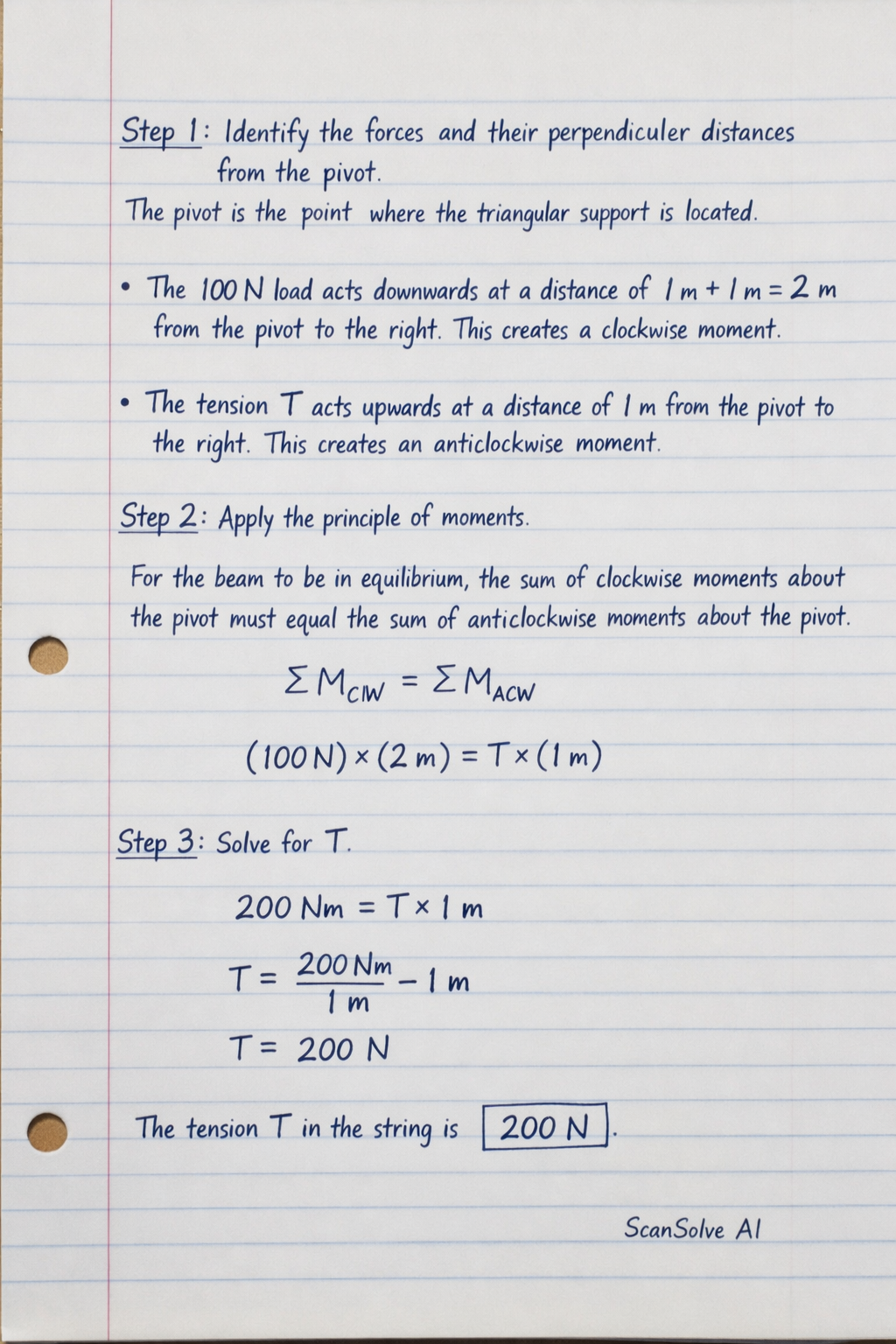
Handwritten Step-by-Step Solution
Get this as a handwritten image on WhatsApp — like a tutor wrote it for you.
Try on WhatsApp