

This physics problem tests your understanding of fundamental physical laws and their applications. The step-by-step solution below breaks down the problem using relevant equations and physical reasoning.
ScanSolve AI Answer
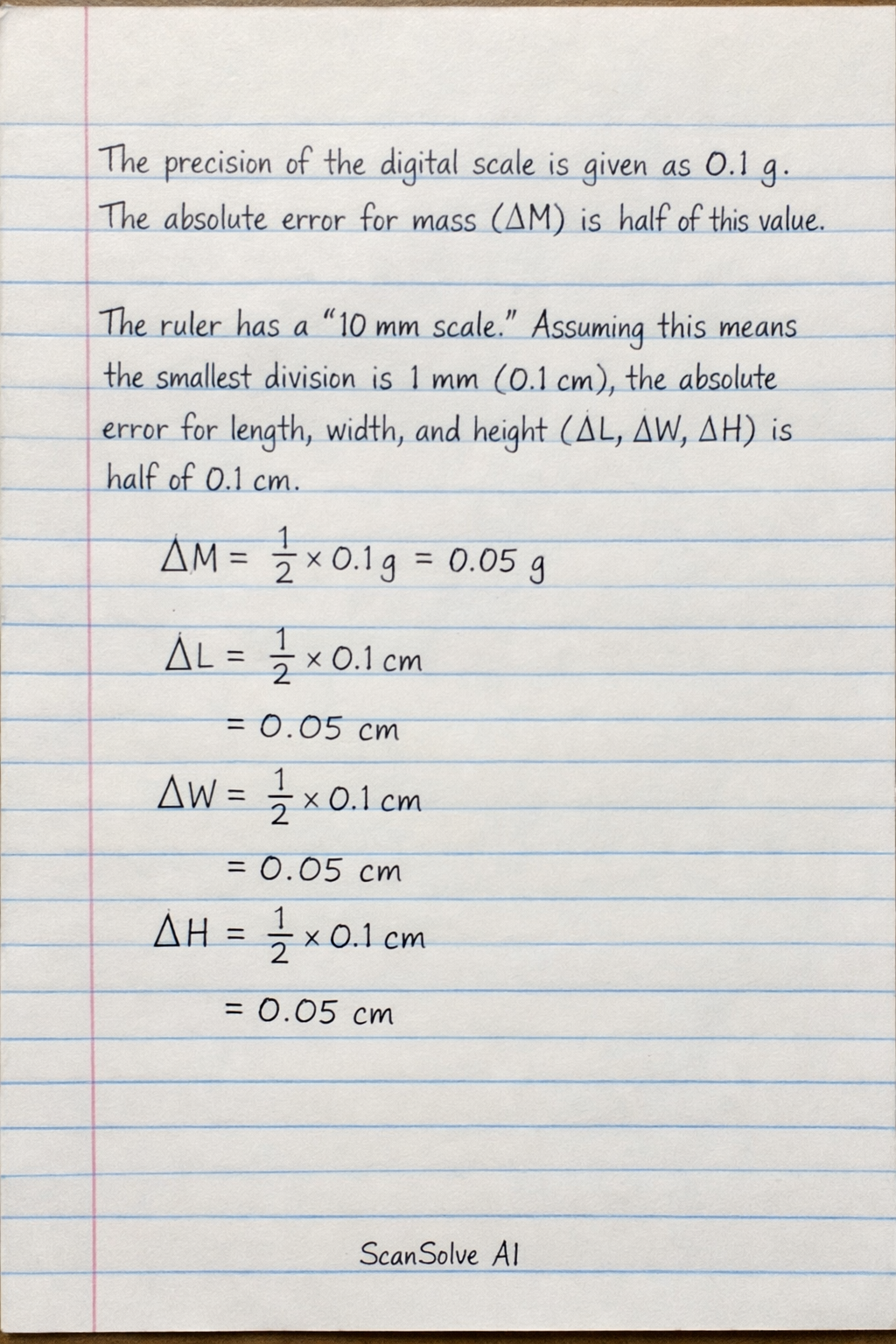
Here's the solution to the physics exercise: A. What is the average values for the mass, length, width and height including the residuals? The precision of the digital scale is given as 0.1 g. The absolute error for mass ( M) is half of this value. M = (1)/(2) × 0.1 \, g = 0.05 \, g The ruler has a "10 mm scale". Assuming this means the smallest division is 1 mm (0.1 cm), the absolute error for length, width, and height ( L, W, H) is half of 0.1 cm. $ L =