

This physics problem tests your understanding of fundamental physical laws and their applications. The step-by-step solution below breaks down the problem using relevant equations and physical reasoning.
ScanSolve AI Answer
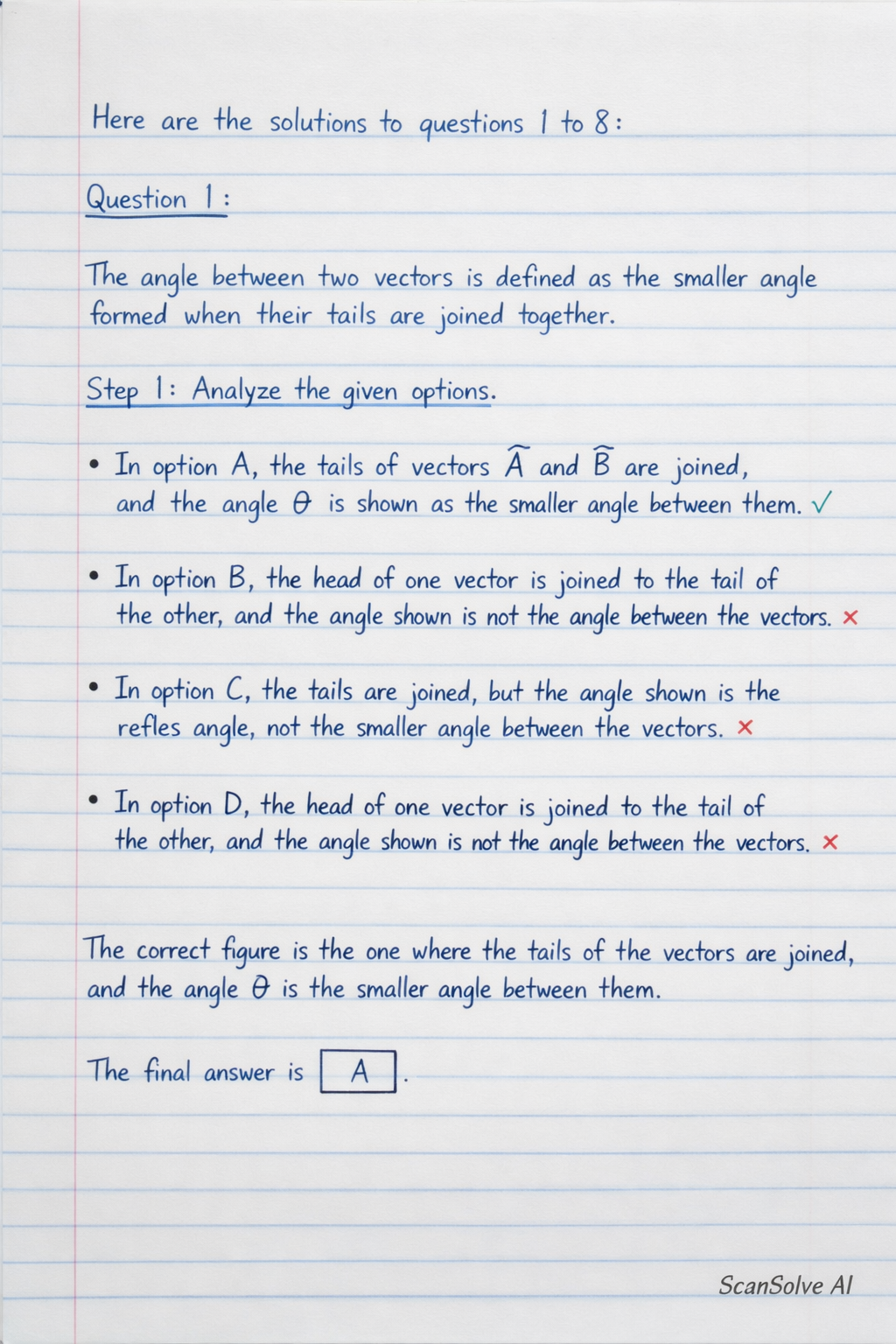
Here are the solutions to questions 1 to 8: Question 1: The angle between two vectors is defined as the smaller angle formed when their tails are joined together. Step 1: Analyze the given options. In option A, the tails of vectors A and B are joined, and the angle is shown as the smaller angle between them. This is the correct representation. In option B, the head of one vector is joined to the tail of the other, and the angle shown is not the angle between the vectors. In option C, the tails are joined, but the angle shown is the reflex angle, not the smaller angle between the vectors. In option D, the head of one vector is joined to the tail of the other, and the angle shown is not the angle between the vectors. The correct figure is the one where the tails of the vectors are joined, and the angle is the smaller angle between them. The final answer is A. Question 2: Let , , and be the angles a vector P makes with the X, Y, and Z axes, respectively. These are called direction angles. Step 1: Recall the property of direction cosines. The direction cosines are , , and . They satisfy the relation: ^2 + ^2 + ^2 = 1 Step 2: Use the trigonometric identity ^2 = 1 - ^2. We need to find ^2 + ^2 + ^2. Substitute the identity into the expression: ^2 + ^2 + ^2 = (1 - ^2) + (1 - ^2) + (1 - ^2) Step 3: Simplify the expression. ^2 + ^2 + ^2 = 3 - (^2 + ^2 + ^2) Substitute the relation from Step 1: ^2 + ^2 + ^2 = 3 - 1 ^2 + ^2 + ^2 = 2 The final answer is B. Question 3: This question refers to the resolution of a vector into its components. Step 1: Understand vector resolution. Any vector can be resolved into two or three component vectors whose vector sum is the original vector. The most common and useful way to do this is by resolving it into mutually perpendicular components. Step 2: Evaluate the options. A) Parallel vectors*: If a vector is replaced by parallel vectors, their resultant will also be parallel to them. This does not allow for resolving a vector in an arbitrary direction into components that are not parallel to the original vector. B) Perpendicular vectors*: A vector in a plane can be resolved into two perpendicular components (e.g., along X and Y axes). A vector in 3D space can be resolved into three mutually perpendicular components (e.g., along X, Y, and Z axes). The vector sum of these perpendicular components equals the original vector. This is the standard method of vector decomposition. C) Arbitrary vectors*: While a vector can be resolved into arbitrary vectors, the question implies a general method. Mutually perpendicular components are the most fundamental and universally applicable. D) It is not possible to resolve a vector*: This is incorrect. Therefore, a vector can always be replaced by two (in 2D) or three (in 3D) perpendicular vectors that sum up to the original vector. The final answer is B. Question 4: The question asks for the resultant of two forces, F_1 and F_2, acting at an angle to each other. Step 1: Recall the formula for the magnitude of the resultant of two vectors. If two vectors A and B have magnitudes A and B respectively, and the angle between them is , the magnitude of their resultant R is given by the law of cosines: R = sqrt(A^2 + B^2 + 2AB) In this case, the forces are F_1 and F_2, so their magnitudes are F_1 and F_2. The resultant force R will have a magnitude: R = sqrt(F_1^2 + F_2^2 + 2F_1F_2) Step 2: Compare this formula with the given options. A) sqrt(F_1^2 + F_2^2 + 2F_1F_2) - This matches the formula. B) sqrt(F_1^2 + F_2^2 - 2F_1F_2) - This formula is for the difference of two vectors. C) F_1 + F_2 - This is the resultant only if the vectors are parallel and in the same direction ( = 0^). D) F_1^2 + F_2^2 + 2F_1F_2 - This is the square of the resultant magnitude, not the magnitude itself. The correct formula for the magnitude of the resultant of two forces is given by option A. The final answer is A. Question 5: The question asks for the maximum number of components into which a vector can be resolved. Step 1: Understand vector resolution. Vector resolution involves breaking down a single vector into two or more component vectors whose sum is equal to the original vector. Step 2: Consider the theoretical limits. There is no theoretical upper limit to the number of components a vector can be resolved into, as long as their vector sum equals the original vector. For example, a vector V can be written as V = V_1 + V_2 + + V_n, where n can be any integer greater than or equal to 2. You can always add more components that cancel each other out (e.g., V = A + B + C - C). The final answer is D. Question 6: The question asks what can cause a change in a vector. Step 1: Consider the effect of "Rotation of frame of reference". If the coordinate system (frame of reference) rotates, the components of a vector, when expressed in that frame, will change. For example, a vector pointing along the X-axis in one frame will have both X and Y components in a frame rotated by 45^. Although the vector itself (its magnitude and direction in absolute space) remains unchanged, its representation (components) in the rotated frame changes. In many contexts, a change in components is considered a "change in a vector". Step 2: Consider the effect of "Rotation of vector". If the vector itself rotates, its direction changes. A vector is defined by both its magnitude and direction. If either of these changes, the vector itself changes. For example, if a vector pointing east rotates to point north, it is a different vector. Step 3: Conclude based on both effects. Both the rotation of the frame of reference (leading to a change in components) and the rotation of the vector itself (leading to a change in direction) result in a change in the vector. The final answer is D. Question 7: Given that the resultant of two vectors A and B is perpendicular to A and its magnitude is half of B. We need to find the angle between A and B. Step 1: Define the resultant vector and use the given conditions. Let R = A + B be the resultant vector. Given that R is perpendicular to A, their dot product is zero: R · A = 0 (A + B) · A = 0 A · A + B · A = 0 Let A = |A| and B = |B|. Let be the angle between A and B. A^2 + AB = 0 Since A 0, we can divide by A: A + B = 0 A = -B (1) Since A > 0, must be negative, so is an obtuse angle. Step 2: Use the given magnitude of the resultant. Given that the magnitude of the resultant is half of B: |R| = (1)/(2)|B| R = (B)/(2) The magnitude of the resultant of two vectors is given by: R^2 = A^2 + B^2 + 2AB Substitute R = B/2: ((B)/(2))^2 = A^2 + B^2 + 2AB (B^2)/(4) = A^2 + B^2 + 2AB (2) Step 3: Substitute equation (1) into equation (2) to solve for . From (1), A = -B. Substitute this into (2): (B^2)/(4) = (-B)^2 + B^2 + 2(-B)B (B^2)/(4) = B^2^2 + B^2 - 2B^2^2 (B^2)/(4) = B^2 - B^2^2 Assuming B 0, divide the entire equation by B^2: (1)/(4) = 1 - ^2 Rearrange to solve for ^2: ^2 = 1 - (1)/(4) ^2 = (3)/(4) Take the square root: = ±sqrt(3)2 From Step 1, we determined that must be negative. = -sqrt(3)2 The angle in the range [0, ] for which = -sqrt(3)2 is: = 150^ The final answer is D. Question 8: Given A = B + C and the magnitudes A=5, B=4, C=3. We need to find the angle between A and C. Step 1: Determine the relationship between B and C. We are given the magnitudes A=5, B=4, C=3. Notice that 3^2 + 4^2 = 9 + 16 = 25 = 5^2. This means C^2 + B^2 = A^2. For vector addition A = B + C, the magnitude is given by A^2 = B^2 + C^2 + 2BC, where is the angle between B and C. Substituting the magnitudes: 5^2 = 4^2 + 3^2