
We read your photo as:
The frequency of vibration of a given string is directly proportional to the square root of the tension T & inversely proportional to the length & to the diameter d. If T is increases by 50% & its halved, calc. the % change in the frequency.
ScanSolve AI Answer
Answer
Step-by-step solution
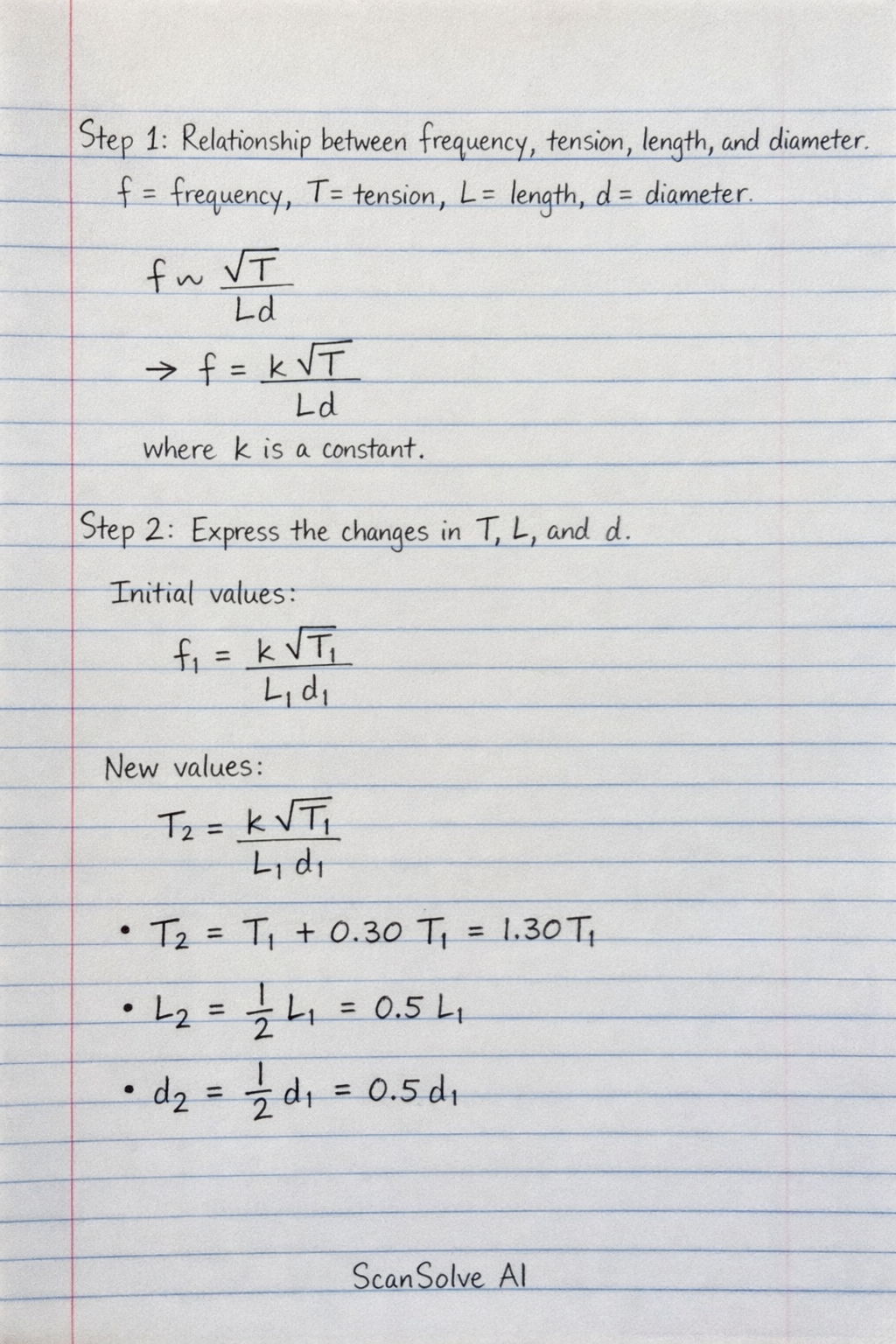
4 stepsEstablish the relationship between frequency, tension, length, and diameter.
Let be the frequency, be the tension, be the length, and be the diameter.
The problem states that the frequency is directly proportional to the square root of the tension , and inversely proportional to the length and the diameter . This can be written as:where is the constant of proportionality.
Express the changes in , , and .
Let the initial values be .
The initial frequency is:The new values are:
- Tension is increased by 30%:
- Length is halved:
- Diameter is halved:
Calculate the new frequency .
Substitute the new values into the relationship:
Rearrange the terms to relate to :
Since , we have:
Calculate the numerical factor:
So, .
Calculate the percentage change in frequency.
The percentage change is given by:
Substitute :
Since the value is positive, it is a percentage increase.
The percentage change in the frequency is approximately 356.1% increase.
Try one yourself
A new problem that tests the same skill.
Still stuck on this one?
Ask a follow-up, and the answer starts from this question.
More Physics Questions
Handwritten Step-by-Step Solution
Get this as a handwritten image on WhatsApp — like a tutor wrote it for you.
Try on WhatsApp