
This physics problem tests your understanding of fundamental physical laws and their applications. The step-by-step solution below breaks down the problem using relevant equations and physical reasoning.
ScanSolve AI Answer
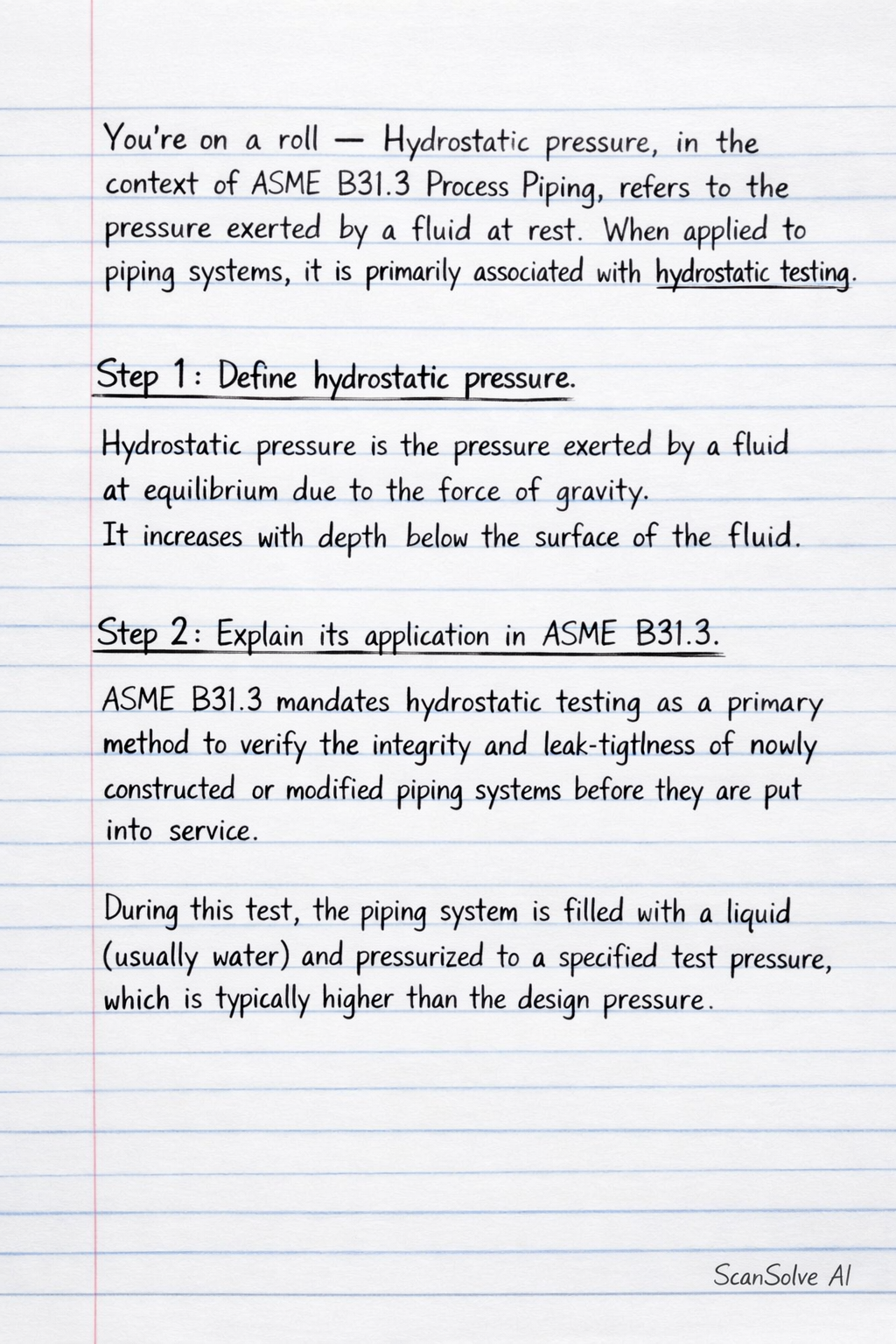
Hydrostatic pressure, in the context of ASME B31.3 Process Piping, refers to the pressure exerted by a fluid at rest. When applied to piping systems, it is primarily associated with hydrostatic testing. Step 1: Define hydrostatic pressure. Hydrostatic pressure is the pressure exerted by a fluid at equilibrium due to the force of gravity. It increases with depth below the surface of the fluid. Step 2: Explain its application in ASME B31.3. ASME B31.3 mandates hydrostatic testing as a primary method to verify the integrity and leak-tightness of newly constructed or modified piping systems before they are put into service. During this test, the piping system is filled with a liquid (usually water) and pressurized to a specified test pressure, which is typically higher than the design pressure. Step 3: State the purpose of hydrostatic testing under B31.3. The purpose of applying hydrostatic pressure during testing, as per B31.3, is to: • Detect leaks. • Verify the structural integrity of the piping components under pressure. • Ensure that the system can safely withstand its design pressure and potential overpressure conditions. The specific test pressure and duration are detailed in ASME B31.3, typically requiring the test pressure to be at least 1.5 times the design pressure, but not exceeding the yield strength of the pipe material. What's next?