
We read your photo as:
The quantity of heat required to raise the temperature of a unit mass of a substance by 1 K is called:
ScanSolve AI Answer
Answer
Step-by-step solution
3 stepsLet's knock this out.
- The quantity of heat required to raise the temperature of a unit mass of a substance by is called specific heat capacity.
The correct option is B.
State the principle of calorimetry.
According to the principle of calorimetry, heat lost by the hot object (copper ball) is equal to the heat gained by the cold object (water), assuming no heat loss to the surroundings.
Identify the given values and calculate temperature changes.
Given:
- Mass of copper () =
- Initial temperature of copper () =
- Mass of water () =
- Initial temperature of water () =
- Final steady temperature () =
- Specific heat capacity of water () =
Calculate the change in temperature for copper ():
Calculate the change in temperature for water ():
Substitute values into the calorimetry equation and solve for .
Rounding to a reasonable number of significant figures or checking the options, is the closest.
The correct option is A.
- The heat required to change of ice at to water at the same temperature is called specific latent heat of fusion. This is the energy required for a phase change from solid to liquid without a change in temperature.
The correct option is B.
- Radiation is the mode of heat transfer that does NOT require a material medium. It can transfer heat through a vacuum, such as the heat from the sun reaching Earth. Conduction and convection require a medium.
The correct option is C.
- According to the Kinetic Theory of gases, the pressure exerted by a gas is due to the collisions of the molecules with the walls of the container. As gas molecules move randomly, they frequently collide with the container walls, exerting a force that results in pressure.
The correct option is B.
Try one yourself
A new problem that tests the same skill.
Still stuck on this one?
Ask a follow-up, and the answer starts from this question.
More Physics Questions
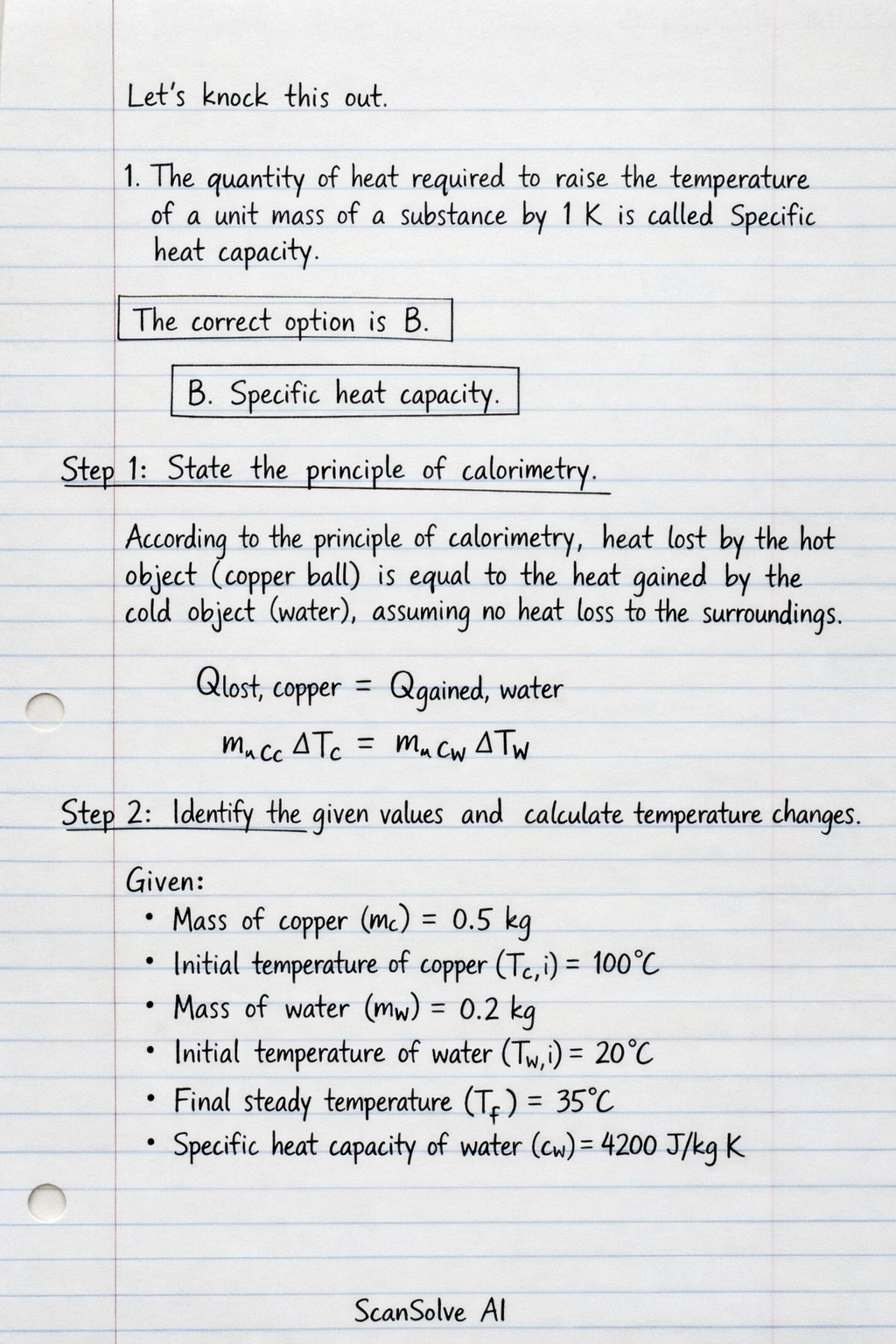
Handwritten Step-by-Step Solution
Get this as a handwritten image on WhatsApp — like a tutor wrote it for you.
Try on WhatsApp