Physics: The speed of a transverse wave on a stretched string is given by the formula v =... — Step-by-Step Solution | ScanSolve
The speed of a transverse wave on a stretched string is given by the formula v = sqrt((T)/(mu)), where T is the tension in the string and mu is the linear mass density (mass per unit leng
This physics problem tests your understanding of fundamental physical laws and their applications. The step-by-step solution below breaks down the problem using relevant equations and physical reasoning.
ScanSolve AI Answer
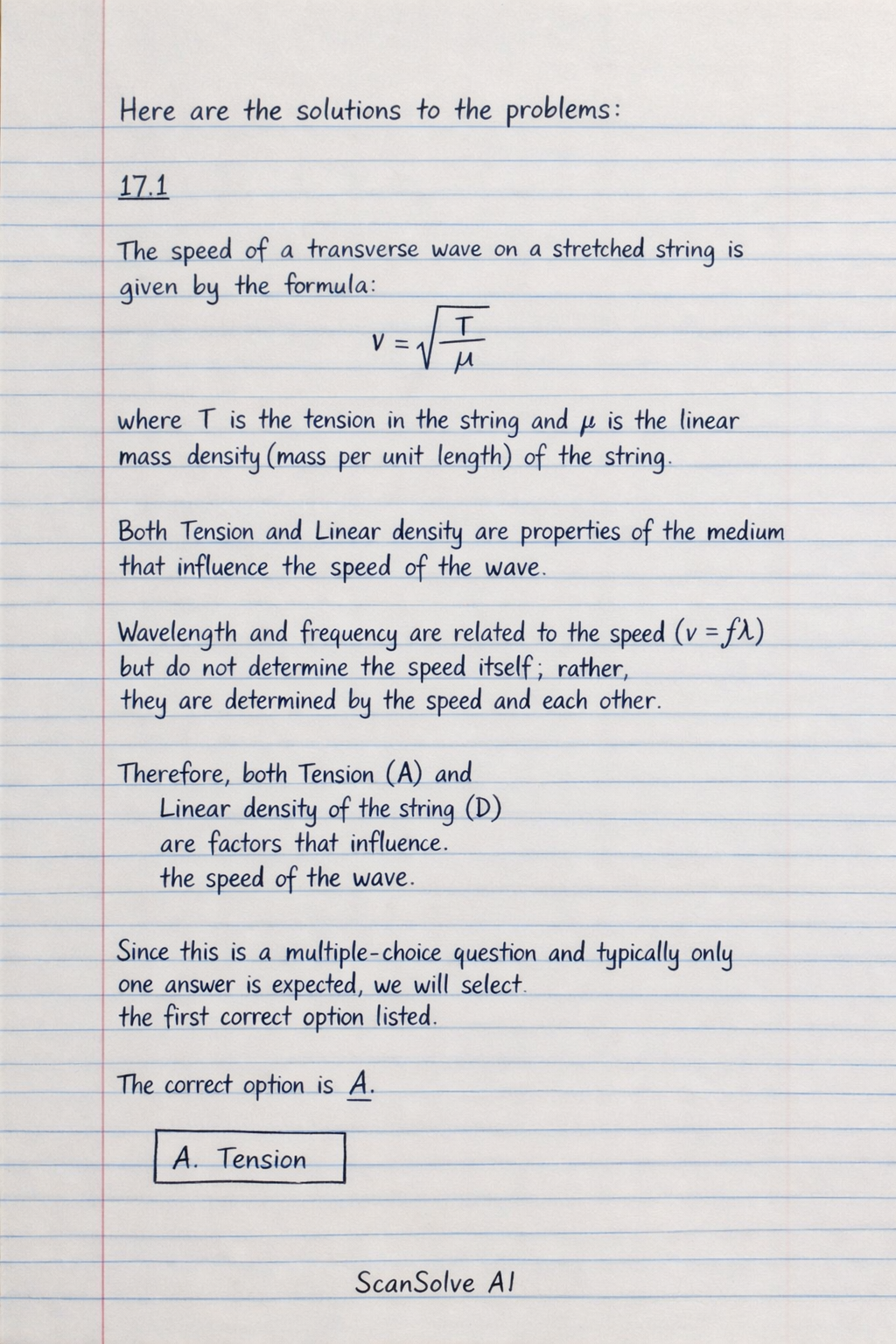
Here are the solutions to the problems:
17.1
The speed of a transverse wave on a stretched string is given by the formula $v = \sqrt{\frac{T}{\mu}}$, where $T$ is the tension in the string and $\mu$ is the linear mass density (mass per unit length) of the string. Both tension and linear density are properties of the medium that influence the speed of the wave. Wavelength and frequency are related to the speed ($v = f\lambda$) but do not determine the speed itself; rather, they are determined by the speed and each other.
Therefore, both Tension (A) and Linear density of the string (D) are factors that influence the speed of the wave. Since this is a multiple-choice question and typically only one answer is expected, we will select the first correct option listed.
The correct option is A.
$\boxed{\text{A. Tension}}$
17.2
The sound intensity level $\beta$ in decibels is related to the sound intensity $I$ by the formula:
$$\beta = 10 \log_{10}\left(\frac{I}{I_0}\right)$$
where $I_0$ is the reference intensity, which is the threshold of human hearing, $I_0 = 1.0 \times 10^{-12}\,W/m^2$.
Step 1: Set the given intensity level to 0 dB.
$$0\,dB = 10 \log_{10}\left(\frac{I}{I_0}\right)$$
Step 2: Divide by 10.
$$0 = \log_{10}\left(\frac{I}{I_0}\right)$$
Step 3: Convert the logarithmic equation to an exponential equation.
$$10^0 = \frac{I}{I_0}$$
$$1 = \frac{I}{I_0}$$
Step 4: Solve for $I$.
$$I = I_0$$
Step 5: Substitute the value of $I_0$.
$$I = 1.0 \times 10^{-12}\,W/m^2$$
The correct option is C.
$\boxed{\text{C. } 1.0 \times 10^{-12}\,W/m^2}$
17.3
The speed of sound in an ideal gas is given by the formula:
$$v = \sqrt{\frac{\gamma RT}{M}}$$
where $\gamma$ is the adiabatic index, $R$ is the ideal gas constant, $T$ is the absolute temperature, and $M$ is the molar mass of the gas.
From this formula, we can see that the speed of sound $v$ is directly proportional to the square root of the absolute temperature $T$:
$$v \propto \sqrt{T}$$
Step 1: Let the initial velocity be $v_1$ at an absolute temperature $T_1$.
$$v_1 = k\sqrt{T_1}$$
where $k = \sqrt{\frac{\gamma R}{M}}$ is a constant.
Step 2: If the absolute temperature is doubled, the new temperature $T_2 = 2T_1$.
Step 3: Calculate the new velocity $v_2$.
$$v_2 = k\sqrt{T_2} = k\sqrt{2T_1} = \sqrt{2} k\sqrt{T_1}$$
Step 4: Substitute $v_1 = k\sqrt{T_1}$ into the equation for $v_2$.
$$v_2 = \sqrt{2} v_1$$
Step 5: Approximate the value of $\sqrt{2}$.
$$\sqrt{2} \approx 1.414$$
So, $v_2 \approx 1.414 v_1$.
The velocity of sound increases to approximately 1.4 times its original value.
The correct option is A.
$\boxed{\text{A. It increases to 1.4 times its original value}}$
17.4
This problem involves the Doppler effect for sound. When an observer approaches a stationary source, the observed frequency $f'$ is given by the formula:
$$f' = f \left(\frac{v + v_o}{v}\right)$$
where $f$ is the source frequency, $v$ is the speed of sound in the medium, and $v_o$ is the speed of the observer.
Step 1: Identify the given values.
Source frequency $f = 444\,Hz$.
Observer speed $v_o = \frac{1}{2}v$ (one-half the speed of sound).
Step 2: Substitute the values into the Doppler effect formula.
$$f' = 444\,Hz \left(\frac{v + \frac{1}{2}v}{v}\right)$$
Step 3: Simplify the expression inside the parentheses.
$$f' = 444\,Hz \left(\frac{\frac{2v}{2} + \frac{v}{2}}{v}\right)$$
$$f' = 444\,Hz \left(\frac{\frac{3v}{2}}{v}\right)$$
$$f' = 444\,Hz \left(\frac{3}{2}\right)$$
Step 4: Calculate the observed frequency.
$$f' = 444\,Hz \times 1.5$$
$$f' = 666\,Hz$$
The correct option is A.
$\boxed{\text{A. } 666\,Hz}$
17.5
For a standing sound wave in a tube:
At a closed end*, the air molecules cannot move, so there is no displacement. This point is a displacement node.
At an open end*, the air molecules are free to move with maximum amplitude. This point is a displacement antinode.
Therefore, a standing sound wave in a tube opened at one end has a displacement node at the closed end and a displacement antinode at the open end.
The correct option is B.
$\boxed{\text{B. node, antinode}}$
The speed of a transverse wave on a stretched string is given by the formula v = sqrt((T)/(mu)), where T is the tension in the string and mu is the linear mass density (mass per unit leng
|Physics
The speed of a transverse wave on a stretched string is given by the formula v = sqrt((T)/(mu)), where T is the tension in the string and mu is the linear mass density (mass per unit leng
ScanSolve AI Answer
Here are the solutions to the problems:
17.1
The speed of a transverse wave on a stretched string is given by the formula v=μT, where T is the tension in the string and μ is the linear mass density (mass per unit length) of the string. Both tension and linear density are properties of the medium that influence the speed of the wave. Wavelength and frequency are related to the speed (v=fλ) but do not determine the speed itself; rather, they are determined by the speed and each other.
Therefore, both Tension (A) and Linear density of the string (D) are factors that influence the speed of the wave. Since this is a multiple-choice question and typically only one answer is expected, we will select the first correct option listed.
The correct option is A.
A.Tension
17.2
The sound intensity level β in decibels is related to the sound intensity I by the formula:
β=10log10(I0I)
where I0 is the reference intensity, which is the threshold of human hearing, I0=1.0×10⁻¹²W/m2.
Step 1: Set the given intensity level to 0 dB.
0dB=10log10(I0I)
Step 2: Divide by 10.
0=log10(I0I)
Step 3: Convert the logarithmic equation to an exponential equation.
100=I0I1=I0I
Step 4: Solve for I.
I=I0
Step 5: Substitute the value of I0.
I=1.0×10⁻¹²W/m2
The correct option is C.
C.1.0×10−12W/m2
17.3
The speed of sound in an ideal gas is given by the formula:
v=MγRT
where γ is the adiabatic index, R is the ideal gas constant, T is the absolute temperature, and M is the molar mass of the gas.
From this formula, we can see that the speed of sound v is directly proportional to the square root of the absolute temperature T:
v∝T
Step 1: Let the initial velocity be v1 at an absolute temperature T1.
v1=kT1
where k=MγR is a constant.
Step 2: If the absolute temperature is doubled, the new temperature T2=2T1.
Step 3: Calculate the new velocity v2.
v2=kT2=k2T1=2kT1
Step 4: Substitute v1=kT1 into the equation for v2.
v2=2v1
Step 5: Approximate the value of 2.
2≈1.414
So, v2≈1.414v1.
The velocity of sound increases to approximately 1.4 times its original value.
The correct option is A.
A.Itincreasesto1.4timesitsoriginalvalue
17.4
This problem involves the Doppler effect for sound. When an observer approaches a stationary source, the observed frequency f′ is given by the formula:
f′=f(vv+vo)
where f is the source frequency, v is the speed of sound in the medium, and vo is the speed of the observer.
Step 1: Identify the given values.
Source frequency f=444Hz.
Observer speed vo=21v (one-half the speed of sound).
Step 2: Substitute the values into the Doppler effect formula.
f′=444Hz(vv+21v)
Step 3: Simplify the expression inside the parentheses.
f′=444Hz(v22v+2v)f′=444Hz(v23v)f′=444Hz(23)
Step 4: Calculate the observed frequency.
f′=444Hz×1.5f′=666Hz
The correct option is A.
A.666Hz
17.5
For a standing sound wave in a tube:
At a closed end, the air molecules cannot move, so there is no displacement. This point is a displacement node.
At an open end, the air molecules are free to move with maximum amplitude. This point is a displacement antinode.
Therefore, a standing sound wave in a tube opened at one end has a displacement node at the closed end and a displacement antinode at the open end.
The correct option is B.
B.node,antinode
Need help with your own homework?
Get instant step-by-step solutions to any question. Free to start.