
We read your photo as:
The total pressure is the sum of the partial pressures: Ptotal = PA + P_B.
Physics
ScanSolve AI Answer
This answer stops before the end.
It was cut off when it was first written. Ask ScanSolve this question again for the full working.
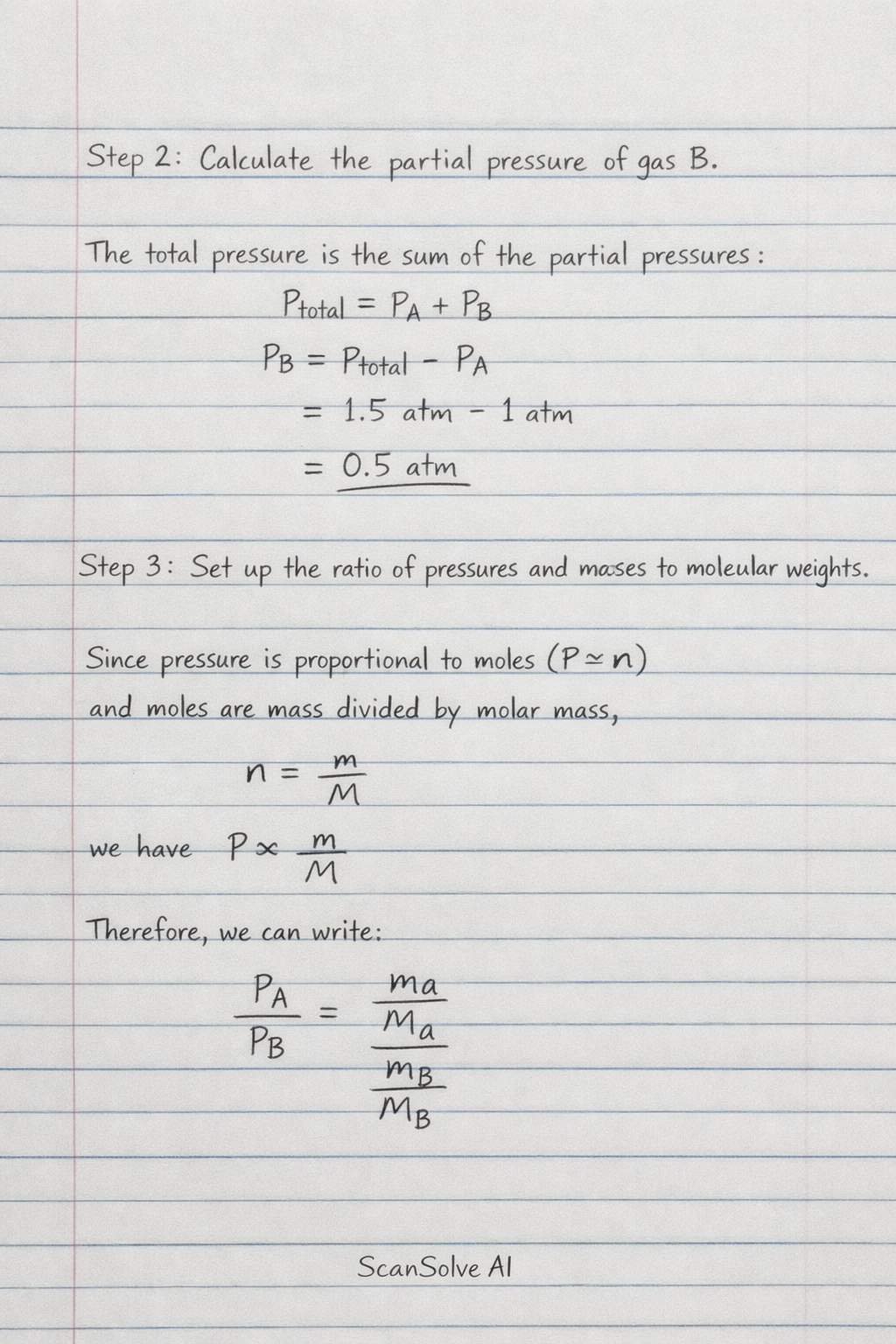
Step 2: Calculate the partial pressure of gas B.
The total pressure is the sum of the partial pressures: .
Step 3: Set up the ratio of pressures and masses to molecular weights.
Since pressure is proportional to moles () and moles are mass divided by molar mass (), we have .
Therefore, we can write:
Was this helpful?
Still stuck on this one?
Ask a follow-up, and the answer starts from this question.
Got a different question?Ask your own question
More Physics Questions
QCalculate the vapor pressure of pure B using Raoult's Law, given moles of A and B, total pressure…QA container has 2 g of gas A at 1 atm. 3 g of gas B is added. The total pressure becomes 1.5 atm…QLiquid A and B are mixed together. The vapor pressure of pure A is 1.30 atm at the normal boiling…QInitial pressure, P1 = 20 barQCalculate the pressure due to the water.
Handwritten Step-by-Step Solution
Get this as a handwritten image on WhatsApp — like a tutor wrote it for you.
Try on WhatsApp