
We read your photo as:
The velocity ratio (VR) of a machine is defined as the ratio of the distance moved by the effort to the distance moved by the load.
ScanSolve AI Answer
Answers
2 partsStep-by-step solution
4 stepsHere are the solutions to the questions:
Part a
The velocity ratio (VR) of a machine is defined as the ratio of the distance moved by the effort to the distance moved by the load.
Part b(i)
The work done on the load
Given:
Mass of load,
Effort force,
Vertical height,
Length of inclined plane (distance moved by effort),
Acceleration due to gravity, (assumed)
Calculate the weight of the load.
The weight of the load is the force of gravity acting on it.
Calculate the work done on the load.
Work done on the load is the product of its weight and the vertical height it is lifted.
The work done on the load is .
Part b(ii)
Work done by the effort
Identify the effort force and the distance moved by the effort.
Effort force,
Distance moved by effort (length of the inclined plane),Calculate the work done by the effort.
Work done by the effort is the product of the effort force and the distance it moves.
The work done by the effort is .
Try one yourself
A new problem that tests the same skill.
Still stuck on this one?
Ask a follow-up, and the answer starts from this question.
More Physics Questions
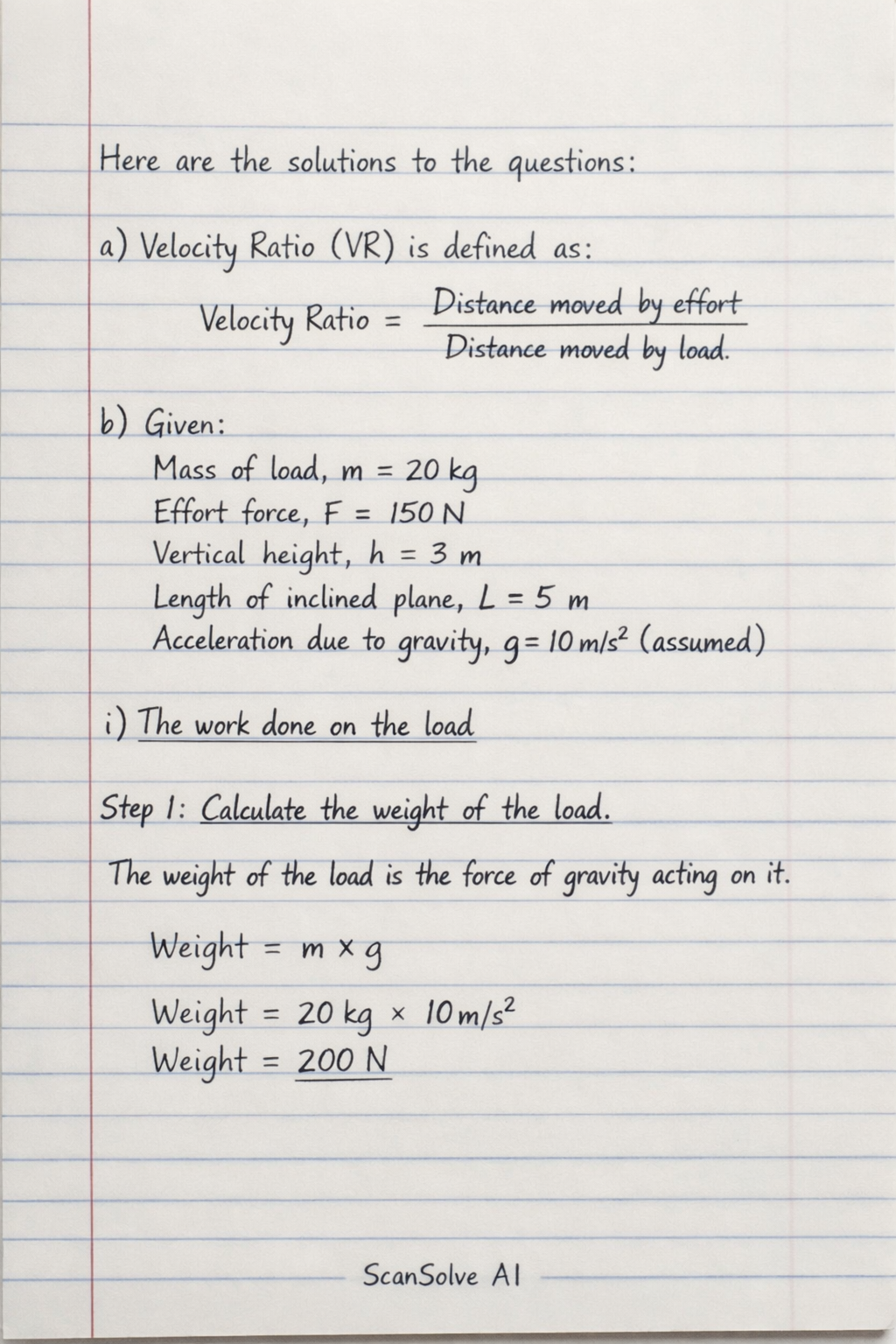
Handwritten Step-by-Step Solution
Get this as a handwritten image on WhatsApp — like a tutor wrote it for you.
Try on WhatsApp