
We read your photo as:
The walls of arteries are thicker and more muscular than those of veins because arteries carry blood away from the heart under high pressure. This thick, elastic wall helps them withstand the
ScanSolve AI Answer
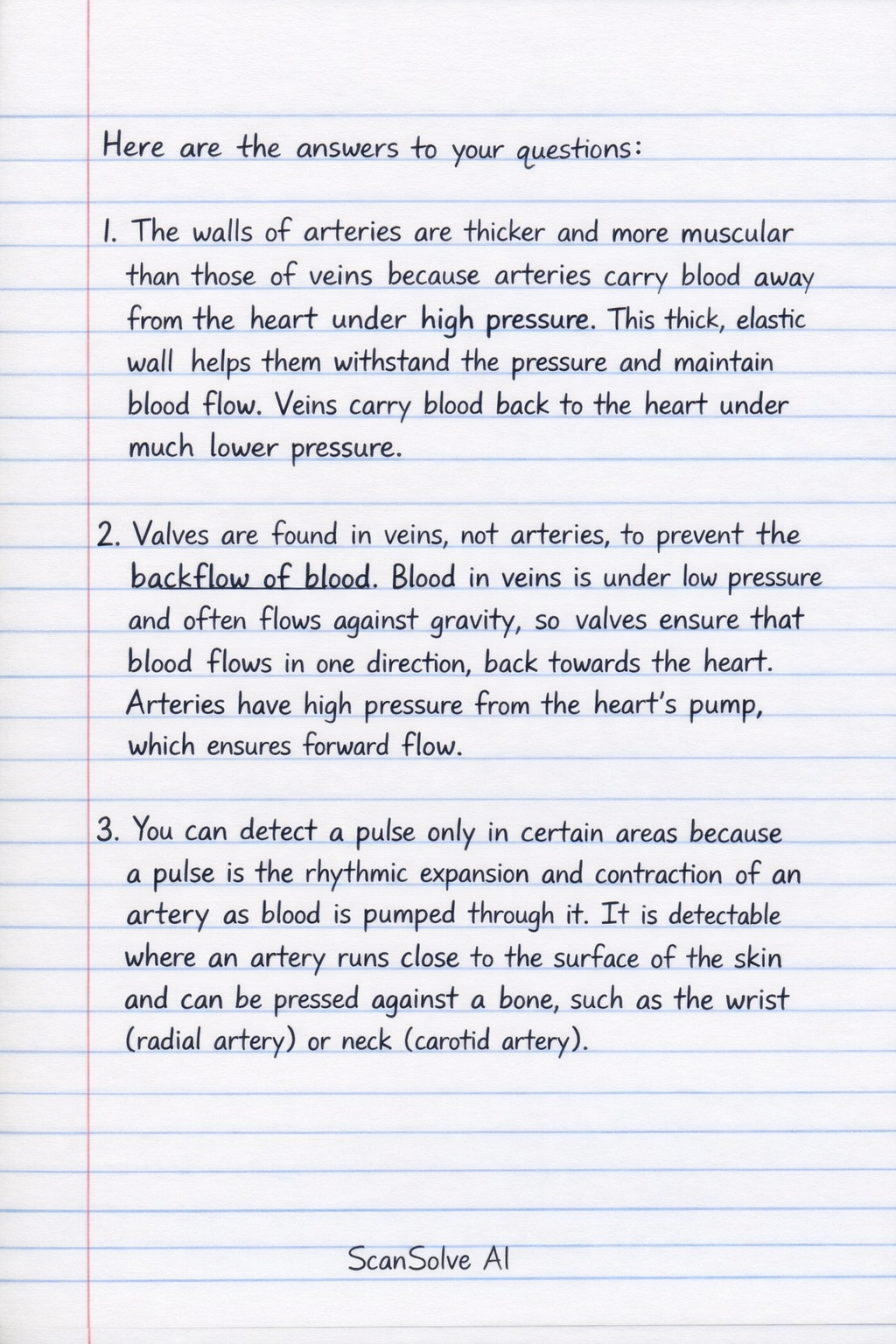
Here are the answers to your questions:
-
The walls of arteries are thicker and more muscular than those of veins because arteries carry blood away from the heart under high pressure. This thick, elastic wall helps them withstand the pressure and maintain blood flow. Veins carry blood back to the heart under much lower pressure.
-
Valves are found in veins, not arteries, to prevent the backflow of blood. Blood in veins is under low pressure and often flows against gravity, so valves ensure that blood flows in one direction, back towards the heart. Arteries have high pressure from the heart's pump, which ensures forward flow.
-
You can detect a pulse only in certain areas because a pulse is the rhythmic expansion and contraction of an artery as blood is pumped through it. It is detectable where an artery runs close to the surface of the skin and can be pressed against a bone, such as the wrist (radial artery) or neck (carotid artery).
-
All blood is red due to hemoglobin, but you cannot give or receive blood from anyone due to blood types. Blood types are determined by specific antigens on the surface of red blood cells. If incompatible blood types are mixed, the recipient's immune system will produce antibodies that attack the donor's red blood cells, leading to a potentially fatal reaction called agglutination.
-
The universal donor is an individual with Type O negative blood. This blood type lacks A, B, and Rh antigens, meaning it is unlikely to trigger an immune response in recipients of any blood type. The universal receiver is an individual with Type AB positive blood. This blood type has A, B, and Rh antigens, and therefore does not produce antibodies against them, allowing it to receive blood from any other blood type without an adverse reaction.
-
The main functions of the following systems are:
- a) Skeleton: Provides structural support for the body, protects vital organs, allows for movement (in conjunction with muscles), and produces blood cells.
- b) Circulatory: Transports oxygen, nutrients, hormones, and waste products throughout the body.
- c) Respiratory: Facilitates gas exchange, taking in oxygen and expelling carbon dioxide.
- d) Nervous: Controls and coordinates all body functions, receives and interprets sensory information, and sends motor commands.
- e) Urinary: Filters blood to remove waste products, maintains water and electrolyte balance, and produces urine.
- f) Reproductive: Produces gametes (sperm and eggs) and hormones necessary for reproduction, ensuring the continuation of the species.
- g) Digestive: Breaks down food into absorbable nutrients, absorbs nutrients into the bloodstream, and eliminates undigested waste.
Still stuck on this one?
Ask a follow-up, and the answer starts from this question.
More Physics Questions
Handwritten Step-by-Step Solution
Get this as a handwritten image on WhatsApp — like a tutor wrote it for you.
Try on WhatsApp