

This physics problem tests your understanding of fundamental physical laws and their applications. The step-by-step solution below breaks down the problem using relevant equations and physical reasoning.
ScanSolve AI Answer
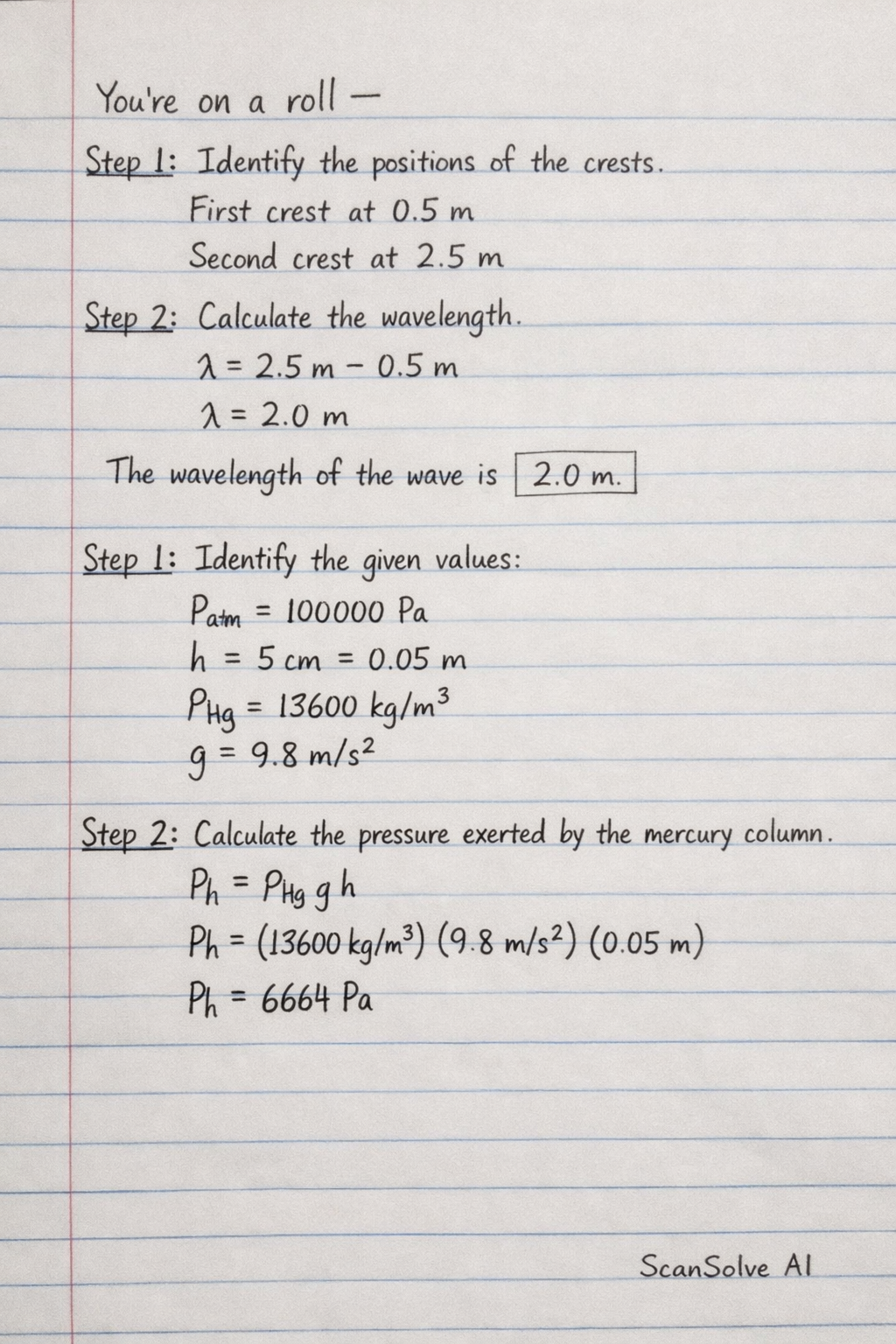
You're on a roll — Step 1: Identify the positions of the crests. From the figure, the first crest is at 0.5 m and the second crest is at 2.5 m. Step 2: Calculate the wavelength. The wavelength () is the distance between two consecutive crests. = 2.5 m - 0.5 m = 2.0 m The wavelength of the wave is 2.0 m. Step 1: Identify the given values. Atmospheric pressure, P_atm = 100000 Pa. Height difference in mercury, h = 5 cm = 0.05 m. Density of mercury, _Hg = 13600 kg/m^3. Acceleration due to gravity, g = 9.8 m/s^2. Step 2: Calculate the pressure exerted by the mercury column. P_h = _Hg g h P_h = (13600 kg/m^3) × (9.8 m/s^2) × (0.05 m) P_h = 6664 Pa Step 3: Determine the pressure of the trapped gas. Since the mercury level in the sealed arm (trapped gas side) is higher, the pressure of the trapped gas is less than the atmospheric pressure. P_gas = P_atm - P_h P_gas = 100000 Pa - 6664 Pa P_gas = 93336 Pa The pressure of the gas is 93336 Pa. a) Streamline flow: This is a type of fluid flow where the fluid particles move in smooth, parallel layers without mixing. The velocity of the fluid at any given point remains constant over time, and the paths of individual fluid particles do not cross each other. b) Turbulent flow: This is a type of fluid flow characterized by irregular, chaotic, and unpredictable motion of fluid particles. It involves the formation of eddies and vortices, leading to significant mixing and rapid variations in velocity and pressure at any given point. Step 1: Apply the principle of continuity. As air flows through the pipe, its speed changes with the cross-sectional area. According to the principle of continuity, where the cross-sectional area is smaller (at pipe B), the speed of the air is higher. Conversely, where the cross-sectional area is larger (at pipe A), the speed of the air is lower. Step 2: Apply Bernoulli's principle. Bernoulli's principle states that for a horizontal flow, an increase in fluid speed is accompanied by a decrease in pressure. Therefore, the pressure of the air at pipe B (higher speed) is lower than the pressure of the air at pipe A (lower speed). Step 3: Explain the water levels. The lower air pressure at pipe B causes the atmospheric pressure acting on the surface of the water in the container to push the water higher into pipe B. Conversely, the higher air pressure at pipe A exerts more downward force, resulting in a lower water level in pipe A. This difference in pressure causes the observed difference in water levels. Got more? Send 'em.