Three charges are placed on a straight line: Q1=+3 microcoulomb Q2=-4 microcoulomb Q3=+6 microcoulomb The distance between Q1 and Q2 is 15 cm, while the distance between Q2 and Q3 is 25 cm. calculate the resultant electrostatic force acting on Q2, stating both its magnitude and direction.

Physics

ScanSolve AI Answer

Answer

1.34 N to the left\text{1.34 N to the left}

Step-by-step solution

3 steps

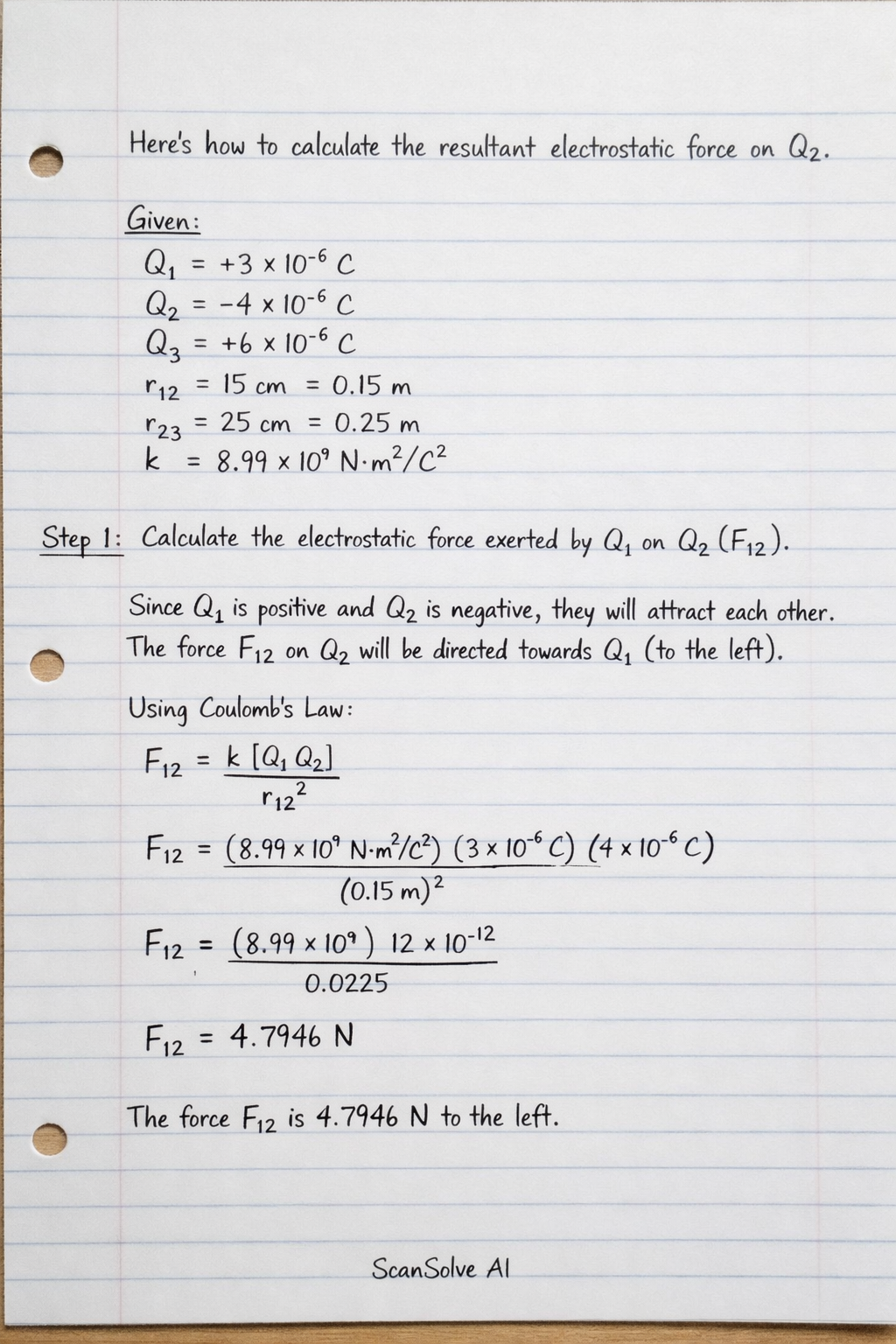
Here's how to calculate the resultant electrostatic force on Q2.

Given:
Q1=+3×10⁻⁶ CQ_1 = +3 \times 10^{-6} \text{ C}
Q2=−4×10⁻⁶ CQ_2 = -4 \times 10^{-6} \text{ C}
Q3=+6×10⁻⁶ CQ_3 = +6 \times 10^{-6} \text{ C}
r12=15 cm=0.15 mr_{12} = 15 \text{ cm} = 0.15 \text{ m}
r23=25 cm=0.25 mr_{23} = 25 \text{ cm} = 0.25 \text{ m}
Coulomb's constant k=8.99×10⁹ N⋅m2/C2k = 8.99 \times 10^9 \text{ N}\cdot\text{m}^2/\text{C}^2

  1. Calculate the electrostatic force exerted by Q1Q_1 on Q2Q_2 (F12F_{12}).

    Since Q1Q_1 is positive and Q2Q_2 is negative, they will attract each other. The force F12F_{12} on Q2Q_2 will be directed towards Q1Q_1 (to the left).
    Using Coulomb's Law:

    F12=k∣Q1Q2∣r122F_{12} = k \frac{|Q_1 Q_2|}{r_{12}^2} F12=(8.99×10⁹ N⋅m2/C2)∣(3×10−6 C)(−4×10⁻⁶ C)∣(0.15 m)2F_{12} = (8.99 \times 10^9 \text{ N}\cdot\text{m}^2/\text{C}^2) \frac{|(3 \times 10^{-6} \text{ C})(-4 \times 10^{-6} \text{ C})|}{(0.15 \text{ m})^2} F12=(8.99×10⁹)12×10−120.0225F_{12} = (8.99 \times 10^9) \frac{12 \times 10^{-12}}{0.0225} F12=4.7946 NF_{12} = 4.7946 \text{ N}

    The force F12F_{12} is 4.7946 N4.7946 \text{ N} to the left.

  2. Calculate the electrostatic force exerted by Q3Q_3 on Q2Q_2 (F32F_{32}).

    Since Q3Q_3 is positive and Q2Q_2 is negative, they will attract each other. The force F32F_{32} on Q2Q_2 will be directed towards Q3Q_3 (to the right).
    Using Coulomb's Law:

    F32=k∣Q3Q2∣r232F_{32} = k \frac{|Q_3 Q_2|}{r_{23}^2} F32=(8.99×10⁹ N⋅m2/C2)∣(6×10−6 C)(−4×10⁻⁶ C)∣(0.25 m)2F_{32} = (8.99 \times 10^9 \text{ N}\cdot\text{m}^2/\text{C}^2) \frac{|(6 \times 10^{-6} \text{ C})(-4 \times 10^{-6} \text{ C})|}{(0.25 \text{ m})^2} F32=(8.99×10⁹)24×10−120.0625F_{32} = (8.99 \times 10^9) \frac{24 \times 10^{-12}}{0.0625} F32=3.45216 NF_{32} = 3.45216 \text{ N}

    The force F32F_{32} is 3.45216 N3.45216 \text{ N} to the right.

  3. Calculate the resultant electrostatic force on Q2Q_2.

    The forces F12F_{12} and F32F_{32} act in opposite directions on Q2Q_2. Let's define the direction to the right as positive.

    Fnet=F32−F12F_{\text{net}} = F_{32} - F_{12} Fnet=3.45216 N−4.7946 NF_{\text{net}} = 3.45216 \text{ N} - 4.7946 \text{ N} Fnet=−1.34244 NF_{\text{net}} = -1.34244 \text{ N}

    The negative sign indicates that the resultant force is directed to the left.

    The magnitude of the resultant force is 1.34 N1.34 \text{ N} (rounded to two decimal places).
    The direction of the resultant force is towards Q1Q_1 (to the left).

    The resultant electrostatic force acting on Q2Q_2 is 1.34 N to the left\boxed{\text{1.34 N to the left}}.

Was this helpful?

Try one yourself

A new problem that tests the same skill.

Still stuck on this one?

Ask a follow-up, and the answer starts from this question.

Got a different question?Ask your own question
Handwritten step-by-step solution preview

Handwritten Step-by-Step Solution

Get this as a handwritten image on WhatsApp — like a tutor wrote it for you.

Try on WhatsApp