
We read your photo as:
Explain how to determine the wavelength of light using a laser and a diffraction grating, including a labeled diagram.
ScanSolve AI Answer
Step-by-step solution
4 stepsHere's how to determine the wavelength of light using a laser and a diffraction grating:
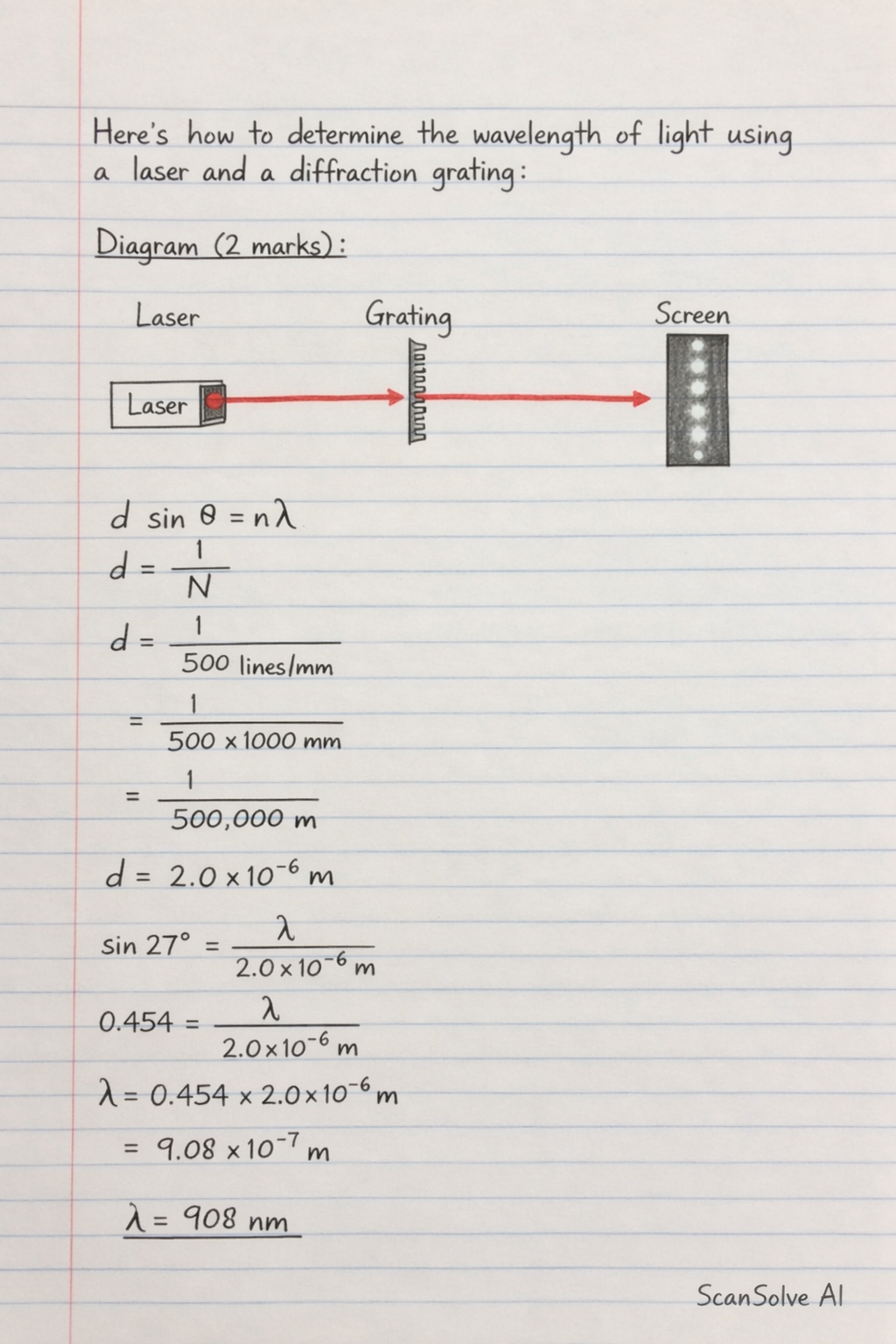
Diagram (2 marks)
\text{
    \begin{tikzpicture}[
        thick,
        laser/.pic={
            \draw (0,0) rectangle (1,0.5);
            \draw[fill=red] (0.8,0.25) circle (0.1);
            \draw[red,->] (1,0.25) -- (2,0.25);
            \node at (0.5,0.7) {Laser};
        },
        grating/.pic={
            \draw (0,0) -- (0,1);
            \foreach \y in {0.1,0.2,...,0.9} \draw (0,\y) -- (0.2,\y);
            \node at (0.1,1.2) {Grating};
        },
        screen/.pic={
            \draw (0,0) rectangle (0.2,3);
            \node at (0.1,3.2) {Screen};
        }
    ]
        % Laser
        \pic at (0,1.5) {laser};

        % Diffraction Grating
        \pic at (3,1.5) {grating};

        % Screen
        \pic at (8,0) {screen};

        % Laser beam path
        \draw[red,->] (2,1.75) -- (3,1.75); % From laser to grating

        % Diffracted beams
        \draw[red,->] (3.2,1.75) -- (8,1.75); % Central maximum (n=0)
        \draw[red,->] (3.2,1.75) -- (8,2.5); % First order (n=1)
        \draw[red,->] (3.2,1.75) -- (8,1.0); % First order (n=1)

        % Labels for maxima
        \node at (8.5,1.75) {$n=0$};
        \node at (8.5,2.5) {$n=1$};
        \node at (8.5,1.0) {$n=1$};

        % Distances
        \draw[<->] (3.1,0.5) -- (8.1,0.5);
        \node at (5.6,0.7) {L}; % Distance from grating to screen

        \draw[<->] (8.3,1.75) -- (8.3,2.5);
        \node at (8.6,2.125) {$x$}; % Distance from central to first order

        % Angle
        \draw (3.2,1.75) -- (8,1.75);
        \draw (3.2,1.75) -- (8,2.5);
        \pic[draw, angle radius=1cm, "$\theta$"] {angle = 8-1.75-3.2 -- 8-1.75-8 -- 8-2.5-8};
    \end{tikzpicture}
}
Observation (2 marks)
- When the laser beam passes through the diffraction grating, a pattern of bright spots (maxima) is observed on the screen.
- There is a very bright central spot (the central maximum, ).
- Symmetrically on either side of the central maximum, there are other bright spots (first-order maxima, ; second-order maxima, , etc.).
- The intensity of the bright spots decreases as the order () increases, moving away from the central maximum.
Calculations (4 marks)
Determine grating spacing ()
The diffraction grating is usually labeled with the number of lines per millimeter (e.g., 300 lines/mm). Convert this to lines per meter, then find the spacing between adjacent lines:
For example, if it's 300 lines/mm:
Measure distances
- Measure the distance from the diffraction grating to the screen.
- Measure the distance between the two first-order maxima (the bright spots on either side of the central maximum). Then, .
Calculate the angle of diffraction ()
Use trigonometry:
Then, calculate .
For small angles, .Calculate the wavelength ()
Use the diffraction grating formula:
For the first-order maximum, . Rearrange to find :
Substitute the values of , , and to obtain the wavelength of the laser light.
Precaution (2 marks)
- Laser Safety: Never look directly into the laser beam as it can cause permanent eye damage. Ensure the beam is directed away from people's eyes.
- Dark Room: Conduct the experiment in a darkened room to clearly observe the diffraction pattern and accurately measure the positions of the maxima.
- Perpendicular Alignment: Ensure the laser beam is perpendicular to the diffraction grating to avoid errors in the angle measurement.
- Accurate Measurements: Take multiple readings for and and calculate their averages to minimize random errors.
Still stuck on this one?
Ask a follow-up, and the answer starts from this question.
More Physics Questions
Handwritten Step-by-Step Solution
Get this as a handwritten image on WhatsApp — like a tutor wrote it for you.
Try on WhatsApp