We read your photo as:

Explain X-ray diffraction and Hess's Law, and calculate the lattice spacing using Bragg's Law for a given wavelength and diffraction angle.

Physics

ScanSolve AI Answer

Answers

3 parts
e(ii)

1.0×10⁻⁷ cm1.0 \times 10^{-7} \text{ cm}

f(i)
0.528
0.472
f(ii)

16.9 kPa16.9 \text{ kPa}

9.44 kPa9.44 \text{ kPa}

Step-by-step solution

5 steps

Part e(ii)· 2 steps

Step 1: Identify the given values.

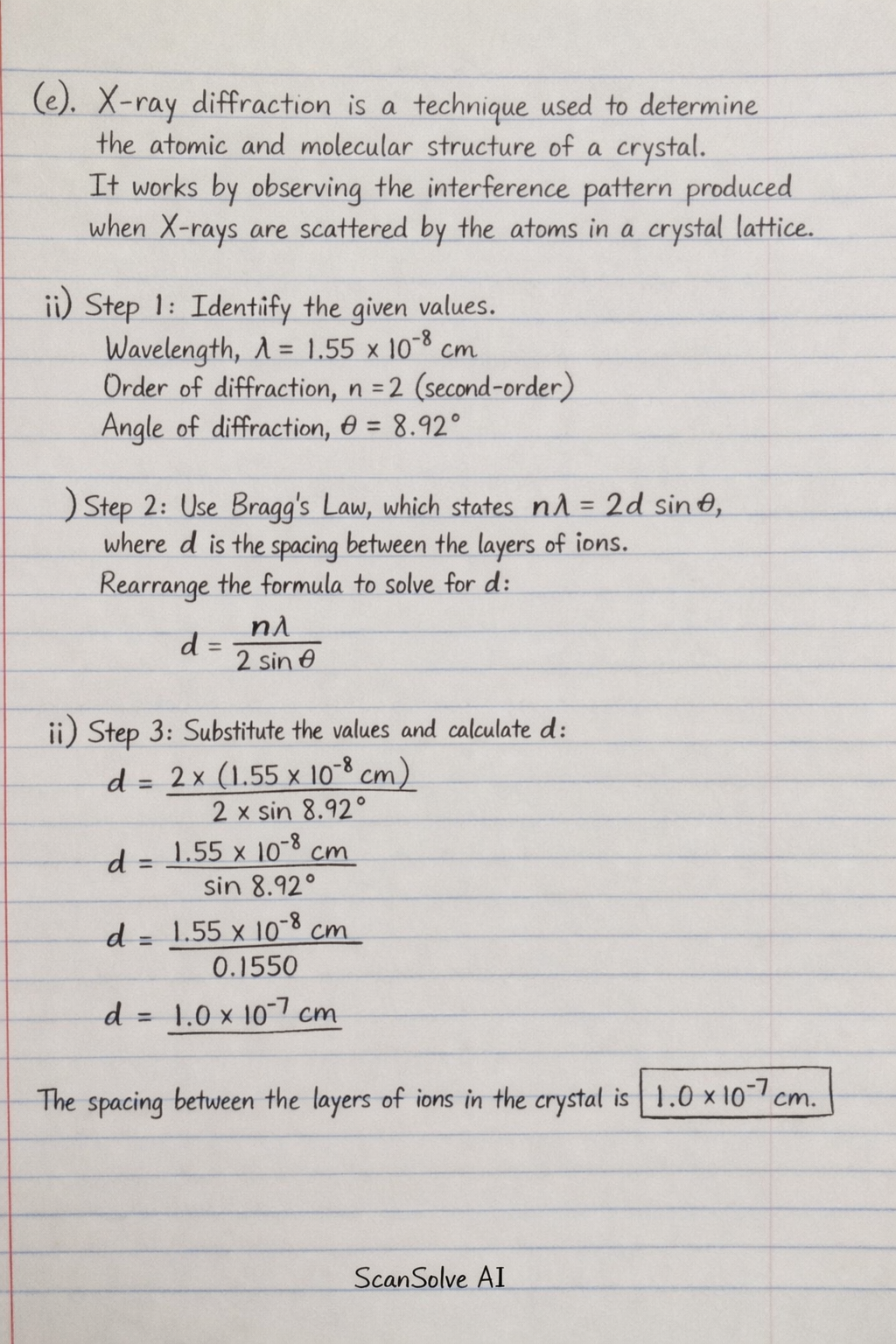
i) X-ray diffraction is a technique used to determine the atomic and molecular structure of a crystal. It works by observing the interference pattern produced when X-rays are scattered by the atoms in a crystal lattice.

Wavelength, λ=1.55×10⁻⁸ cm\lambda = 1.55 \times 10^{-8} \text{ cm}
Order of diffraction, n=2n = 2 (second-order cone)
Angle of diffraction, θ=8.92∘\theta = 8.92^\circ

  1. Use Bragg's Law, which states nλ=2dsin⁡θn\lambda = 2d\sin\theta, where dd is the spacing between the layers of ions.

    Rearrange the formula to solve for dd:

    d=nλ2sin⁡θd = \frac{n\lambda}{2\sin\theta}
  2. Substitute the values and calculate dd.

    d=2×(1.55×10−8 cm)2×sin⁡(8.92∘)d = \frac{2 \times (1.55 \times 10^{-8} \text{ cm})}{2 \times \sin(8.92^\circ)} d=1.55×10⁻⁸ cmsin⁡(8.92∘)d = \frac{1.55 \times 10^{-8} \text{ cm}}{\sin(8.92^\circ)} d=1.55×10⁻⁸ cm0.1550d = \frac{1.55 \times 10^{-8} \text{ cm}}{0.1550} d=1.0×10⁻⁷ cmd = 1.0 \times 10^{-7} \text{ cm}

    The spacing between the layers of ions in the crystal is 1.0×10⁻⁷ cm\boxed{1.0 \times 10^{-7} \text{ cm}}.

    iii) Hess's Law states that the total enthalpy change for a chemical reaction is independent of the pathway taken, provided the initial and final conditions are the same. It means that if a reaction can occur in several steps, the sum of the enthalpy changes for the individual steps is equal to the enthalpy change for the overall reaction.

Part f· 1 step

Given:
Mass of methanol (CH3OHCH_3OH) = 28 g28 \text{ g}
Mass of ethanol (C2H5OHC_2H_5OH) = 36 g36 \text{ g}
Vapour pressure of pure methanol (Pmethanol∘P^\circ_{methanol}) = 32 kPa32 \text{ kPa}
Vapour pressure of pure ethanol (Pethanol∘P^\circ_{ethanol}) = 20 kPa20 \text{ kPa}

  1. Calculate the molar masses of methanol and ethanol.

    Molar mass of CH3OH=(1×12.01)+(4×1.01)+(1×16.00)=32.05 g/molCH_3OH = (1 \times 12.01) + (4 \times 1.01) + (1 \times 16.00) = 32.05 \text{ g/mol}
    Molar mass of C2H5OH=(2×12.01)+(6×1.01)+(1×16.00)=46.08 g/molC_2H_5OH = (2 \times 12.01) + (6 \times 1.01) + (1 \times 16.00) = 46.08 \text{ g/mol}
    (Using approximate integer atomic masses: CH3OH=32 g/molCH_3OH = 32 \text{ g/mol}, C2H5OH=46 g/molC_2H_5OH = 46 \text{ g/mol})

Part f(i)0.528

Step 2: Calculate the number of moles of each component.

Moles of methanol (nmethanoln_{methanol}) = mass of methanolmolar mass of methanol=28 g32.05 g/mol≈0.8736 mol\frac{\text{mass of methanol}}{\text{molar mass of methanol}} = \frac{28 \text{ g}}{32.05 \text{ g/mol}} \approx 0.8736 \text{ mol}
Moles of ethanol (nethanoln_{ethanol}) = mass of ethanolmolar mass of ethanol=36 g46.08 g/mol≈0.7812 mol\frac{\text{mass of ethanol}}{\text{molar mass of ethanol}} = \frac{36 \text{ g}}{46.08 \text{ g/mol}} \approx 0.7812 \text{ mol}

  1. Calculate the total number of moles.

    Total moles (ntotaln_{total}) = nmethanol+nethanol=0.8736 mol+0.7812 mol=1.6548 moln_{methanol} + n_{ethanol} = 0.8736 \text{ mol} + 0.7812 \text{ mol} = 1.6548 \text{ mol}

  2. Calculate the mole fraction of each component.

    Mole fraction of methanol (XmethanolX_{methanol}) = nmethanolntotal=0.8736 mol1.6548 mol≈0.5279\frac{n_{methanol}}{n_{total}} = \frac{0.8736 \text{ mol}}{1.6548 \text{ mol}} \approx 0.5279
    Mole fraction of ethanol (XethanolX_{ethanol}) = nethanolntotal=0.7812 mol1.6548 mol≈0.4721\frac{n_{ethanol}}{n_{total}} = \frac{0.7812 \text{ mol}}{1.6548 \text{ mol}} \approx 0.4721

    Mole fraction of methanol: 0.528\boxed{0.528}
    Mole fraction of ethanol: 0.472\boxed{0.472}

Part f(ii)

16.9 kPa16.9 \text{ kPa}

Step 5: Calculate the partial vapour pressure of each component using Raoult's Law (PA=XAPA∘P_A = X_A P^\circ_A).

Partial vapour pressure of methanol (PmethanolP_{methanol}) = Xmethanol×Pmethanol∘X_{methanol} \times P^\circ_{methanol}

Pmethanol=0.5279×32 kPa≈16.8928 kPaP_{methanol} = 0.5279 \times 32 \text{ kPa} \approx 16.8928 \text{ kPa}

Partial vapour pressure of ethanol (PethanolP_{ethanol}) = Xethanol×Pethanol∘X_{ethanol} \times P^\circ_{ethanol}

Pethanol=0.4721×20 kPa≈9.442 kPaP_{ethanol} = 0.4721 \times 20 \text{ kPa} \approx 9.442 \text{ kPa}

Partial vapour pressure of methanol: 16.9 kPa\boxed{16.9 \text{ kPa}}
Partial vapour pressure of ethanol: 9.44 kPa\boxed{9.44 \text{ kPa}}

Was this helpful?

Try one yourself

A new problem that tests the same skill.

Still stuck on this one?

Ask a follow-up, and the answer starts from this question.

Got a different question?Ask your own question
Handwritten step-by-step solution preview

Handwritten Step-by-Step Solution

Get this as a handwritten image on WhatsApp — like a tutor wrote it for you.

Try on WhatsApp