
We read your photo as:
Describe how to identify wood, steel, and another bar magnet from three given objects using a known bar magnet.
Physics
ScanSolve AI Answer
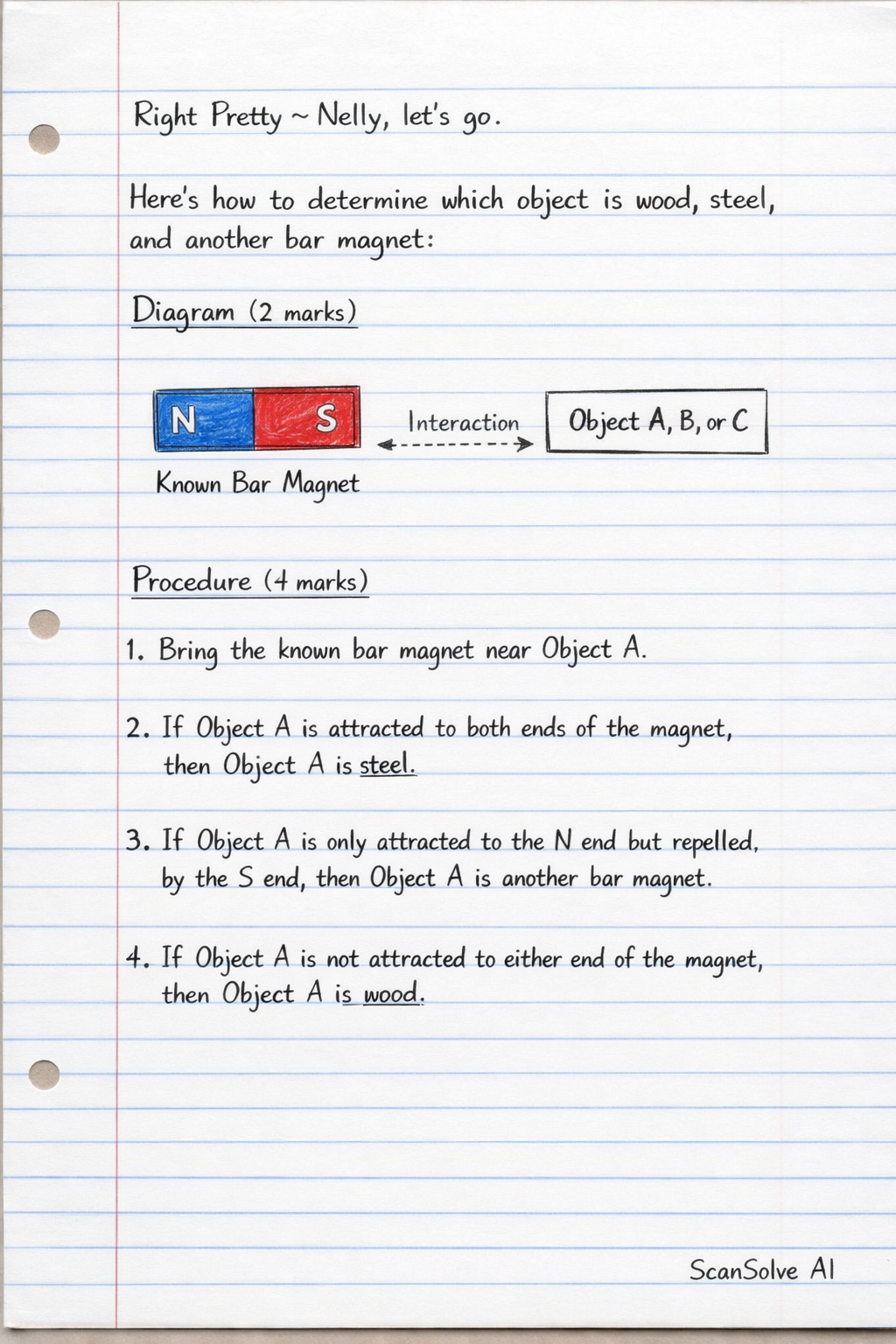
Here's how to determine which object is wood, steel, and another bar magnet:
Diagram (2 marks)
\text{
    \begin{tikzpicture}[
        thick,
        bar_magnet/.pic={
            \draw (0,0) rectangle (2,0.5);
            \fill[blue] (0,0) rectangle (0.5,0.5);
            \fill[red] (1.5,0) rectangle (2,0.5);
            \node at (0.25,0.25) {N};
            \node at (1.75,0.25) {S};
        },
        object/.pic={
            \draw (0,0) rectangle (1.5,0.5);
            \node at (0.75,0.25) {Object};
        }
    ]
        % Known Bar Magnet
        \pic at (0,1) {bar_magnet};
        \node at (1,1.7) {Known Bar Magnet};

        % Unknown Object
        \pic at (3,1) {object};
        \node at (3.75,1.7) {Object A, B, or C};

        % Interaction arrow
        \draw[->, dashed] (2,1.25) -- (3,1.25);
        \node at (2.5,1.4) {Interaction};
    \end{tikzpicture}
}
Procedure (4 marks)
- Initial Test: Take the given bar magnet and bring one of its poles (e.g., North pole) close to one end of each object (A, B, and C) one at a time. Observe if there is any attraction or repulsion.
- Identify Wood: Any object that shows no interaction (neither attraction nor repulsion) with the bar magnet is wood.
- Distinguish Steel from Magnet: For the objects that show attraction, perform the following test:
- Bring one pole of the known bar magnet near the middle of the unknown object. If there is no attraction at the middle, it is likely another bar magnet.
- To confirm, bring the same pole of the known bar magnet near both ends of the unknown object. If one end attracts and the other end repels, then the unknown object is another bar magnet.
- If the unknown object attracts the known bar magnet at all points (ends and middle), and never repels, then it is steel.
Observation (2 marks)
- Wood: Will show no attraction or repulsion when the bar magnet is brought near it.
- Steel: Will be attracted to the bar magnet, regardless of which pole of the bar magnet is used or which part of the steel object is tested. It will never repel.
- Bar Magnet: Will show attraction to the bar magnet at its poles, but crucially, it will also show repulsion when like poles are brought close together. The middle of the bar magnet will show very weak or no attraction.
Conclusion (2 marks)
- The object that shows no interaction with the bar magnet is wood.
- The object that shows only attraction to the bar magnet (at all points) is steel.
- The object that shows both attraction and repulsion with the bar magnet (depending on the poles brought together) is the other bar magnet.
Precaution (1 mark)
- Ensure the known bar magnet is strong enough to clearly demonstrate attraction and repulsion.
- Perform the repulsion test carefully, as repulsion is the definitive test for magnetism.
You're all done for today!
Was this helpful?
Still stuck on this one?
Ask a follow-up, and the answer starts from this question.
Got a different question?Ask your own question
More Physics Questions
QWhat method of making magnets is illustrated in setups A and B? Give the names of the parts of the…QA) Explain how the plotting compasses show that bar AB is a magnet. b) Draw the magnetic field lines…QMagnets are materials that attract pieces of iron or steel. In ancient times, people first…QThe diagrams below are of two methods used in making magnets. Study them and use them to answer the…
Browse by topic:Electromagnetism
Handwritten Step-by-Step Solution
Get this as a handwritten image on WhatsApp — like a tutor wrote it for you.
Try on WhatsApp