
We read your photo as:
Calculate the total distance travelled by an object, given its velocity-time graph divided into four sections: a triangle, a rectangle, a trapezium, and another triangle.
ScanSolve AI Answer
Answer
Step-by-step solution
3 stepsTo calculate the total distance travelled by the object, we need to find the area under the velocity-time graph. The graph can be divided into four distinct geometric shapes:
Divide the graph into sections and identify the shapes.
- Section 1 (0 s to 6 s): A triangle.
- Section 2 (6 s to 9 s): A rectangle.
- Section 3 (9 s to 12 s): A trapezium.
- Section 4 (12 s to 18 s): A triangle.
Calculate the area for each section.
-
Section 1: Triangle (0 s to 6 s) Base () = Height () = (velocity at s) Area
-
Section 2: Rectangle (6 s to 9 s) Width () = Height () = (constant velocity) Area
-
Section 3: Trapezium (9 s to 12 s) Parallel side 1 () = (velocity at s) Parallel side 2 () = (velocity at s) Height () = Area Area
-
Section 4: Triangle (12 s to 18 s) Base () = Height () = (velocity at s) Area
-
Sum the areas of all sections to find the total distance.
Total Distance = Area + Area + Area + Area
Total Distance =
Total Distance =
Try one yourself
A new problem that tests the same skill.
Still stuck on this one?
Ask a follow-up, and the answer starts from this question.
More Physics Questions
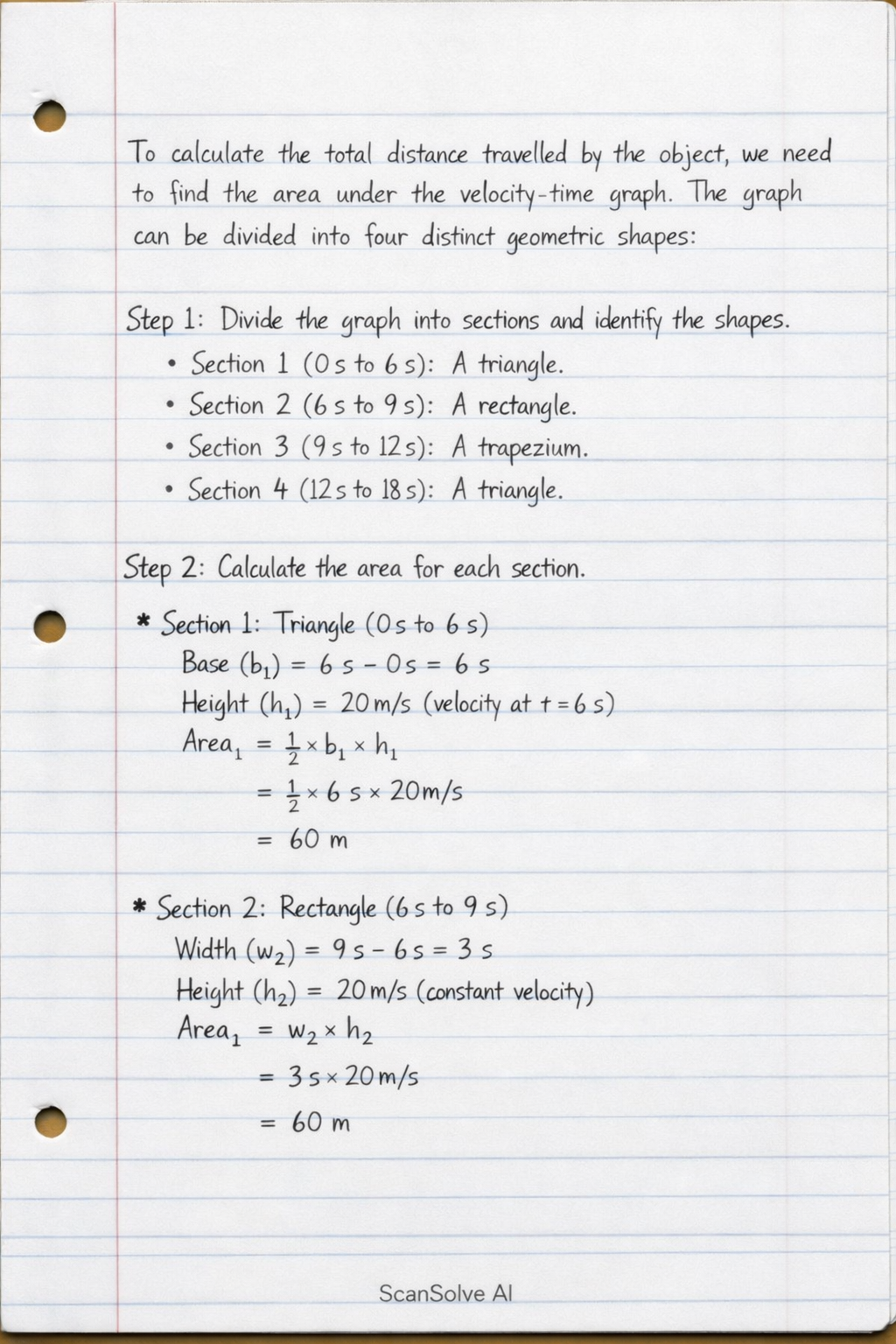
Handwritten Step-by-Step Solution
Get this as a handwritten image on WhatsApp — like a tutor wrote it for you.
Try on WhatsApp