

This physics problem tests your understanding of fundamental physical laws and their applications. The step-by-step solution below breaks down the problem using relevant equations and physical reasoning.
ScanSolve AI Answer
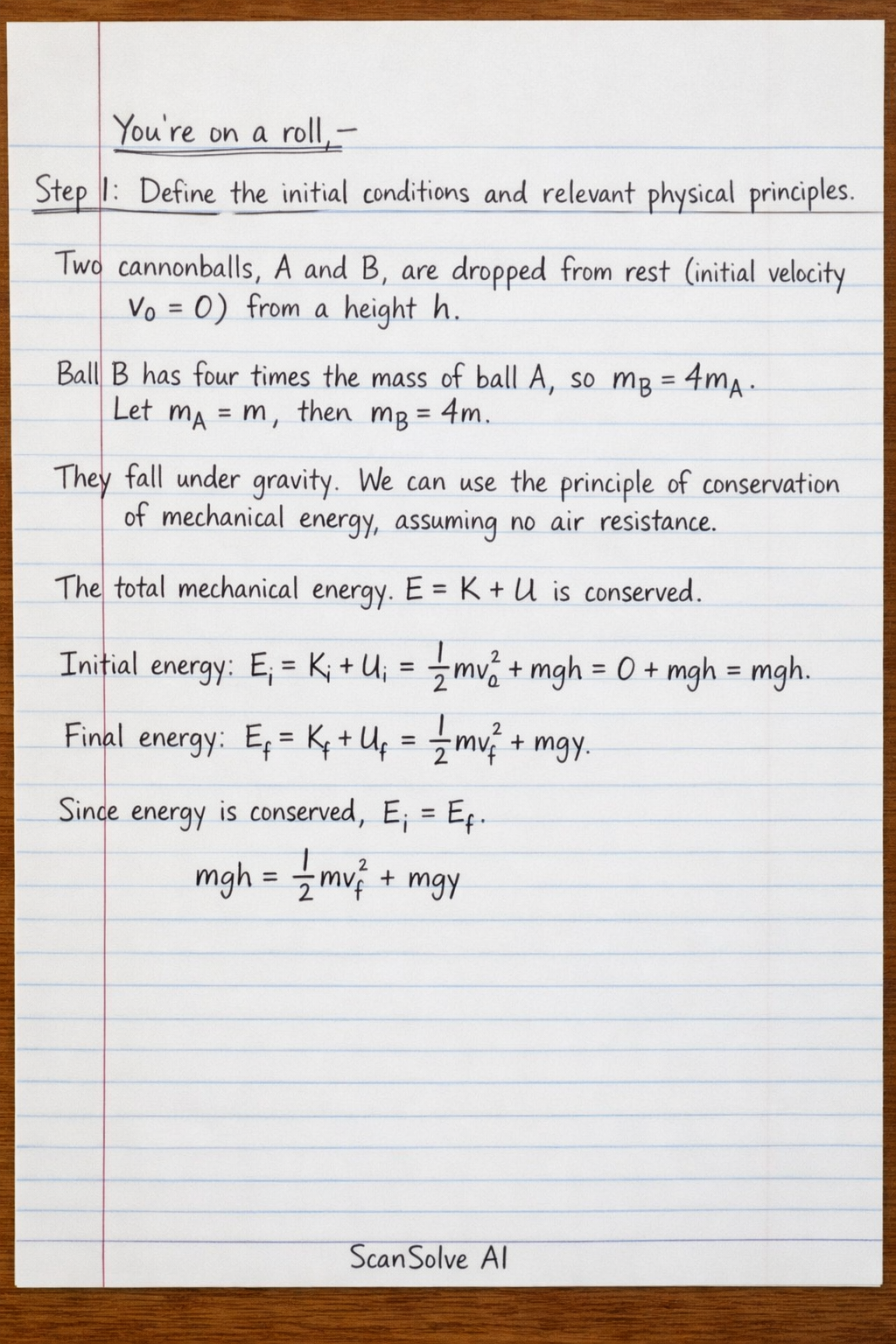
You're on a roll — Step 1: Define the initial conditions and relevant physical principles. Two cannonballs, A and B, are dropped from rest (initial velocity v_0 = 0) from a height h. Ball B has four times the mass of ball A, so m_B = 4m_A. Let m_A = m, then m_B = 4m. They fall under gravity. We can use the principle of conservation of mechanical energy, assuming no air resistance. The total mechanical energy E = K + U is conserved. Initial energy E_i = K_i + U_i = (1)/(2)mv_0^2 + mgh = 0 + mgh = mgh. Final energy E_f = K_f + U_f = (1)/(2)mv_f^2 + mgy. Since energy is conserved, E_i = E_f. mgh = (1)/(2)mv_f^2 + mgy Step 2: Determine the velocity of the balls at height h/4. The balls are at a height y = h/4 above the ground. The distance fallen is d = h - y = h - h/4 = (3)/(4)h. Using the kinematic equation v_f^2 = v_0^2 + 2ad, where a=g and v_0=0: v_f^2 = 0^2 + 2g((3)/(4)h) v_f^2 = (3)/(2)gh The final velocity v_f is the same for both balls because it only depends on the height fallen and g, not on mass. So, v_A = v_B = sqrt((3)/(2)gh). Step 3: Calculate the kinetic energies of ball A and ball B at height h/4. The kinetic energy K = (1)/(2)mv^2. For ball A: K_A = (1)/(2)m_A v_A^2 K_A = (1)/(2)m ((3)/(2)gh) K_A = (3)/(4)mgh For ball B: K_B = (1)/(2)m_B v_B^2 K_B = (1)/(2)(4m) ((3)/(2)gh) K_B = 4 × (1)/(2)m ((3)/(2)gh) K_B = 4 K_A Step 4: Compare the kinetic energies and select the correct option. From Step 3, we found K_B = 4K_A. The final answer is d. K_B = 4K_A. Got more? Send 'em.