
We read your photo as:
State two evidence that validate the molecular nature of matter and In a p-type semi-conductor, identify the majority carrier.
ScanSolve AI Answer
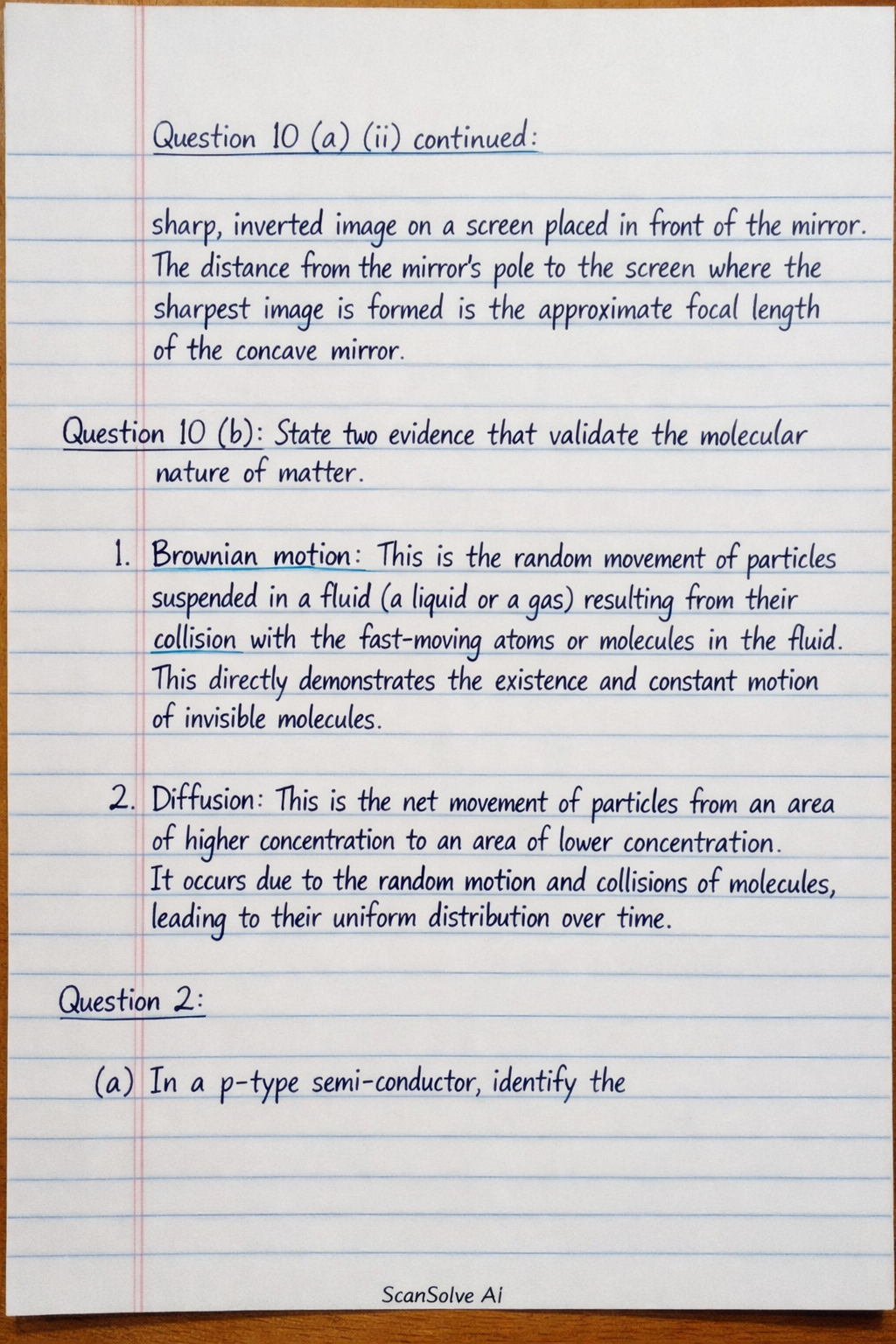
Question 10 (a) (ii) continued:
sharp, inverted image on a screen placed in front of the mirror. The distance from the mirror's pole to the screen where the sharpest image is formed is the approximate focal length of the concave mirror.
Question 10 (b): State two evidence that validate the molecular nature of matter.
- Brownian motion: This is the random movement of particles suspended in a fluid (a liquid or a gas) resulting from their collision with the fast-moving atoms or molecules in the fluid. This directly demonstrates the existence and constant motion of invisible molecules.
- Diffusion: This is the net movement of particles from an area of higher concentration to an area of lower concentration. It occurs due to the random motion and collisions of molecules, leading to their uniform distribution over time.
Question 2:
(a) In a p-type semi-conductor, identify the
(i) majority carrier.
In a p-type semiconductor, the majority carriers are holes. These are created when a trivalent impurity (like boron) is added to a pure semiconductor (like silicon), creating a deficiency of electrons in the covalent bonds.
(ii) minority carrier.
In a p-type semiconductor, the minority carriers are electrons. These are present due to thermal excitation, where some covalent bonds break, releasing electrons and creating electron-hole pairs.
(b) State one advantage of a p-n junction diode over thermionic diode.
One advantage of a p-n junction diode over a thermionic diode is that it does not require a filament to be heated, making it more energy-efficient, smaller in size, and having a longer lifespan.
Still stuck on this one?
Ask a follow-up, and the answer starts from this question.
More Physics Questions
Handwritten Step-by-Step Solution
Get this as a handwritten image on WhatsApp — like a tutor wrote it for you.
Try on WhatsApp