
👇👇👇👇👇 Two forces of 10 N and 15 N act at a point, O. If the angle between the two forces is 120°, calculate the magnitude of the resultant force, R, using the parallelogram law of vector addition.
Physics
ScanSolve AI Answer
Answer
Step-by-step solution
6 stepsIdentify the given values.
The magnitudes of the two forces are and .
The angle between the forces is .Use the formula for the resultant force from the parallelogram law of vector addition.
Substitute the given values into the formula.
Calculate the value of .
We know that .
Perform the calculations.
Round the result to two decimal places.
The magnitude of the resultant force is:
Was this helpful?
Try one yourself
A new problem that tests the same skill.
Still stuck on this one?
Ask a follow-up, and the answer starts from this question.
Got a different question?Ask your own question
More Physics Questions
QTwo forces of magnitudes 10 N and 6 N act at an angle of 60 degrees to each other. Find the…QTwo forces, 30 N and 40 N, act at right angles to each other. Using a scale of 1 cm = 5 N, find the…QTwo equal forces each of magnitude 34N act on a body. Calculate the magnitude and direction of the…QThe angle between two forces of magnitude 7N and 4N is 120°. Find in N, the magnitude of their…QThree forces act on a particle at a point, as shown in diagram. Two of the forces have magnitude 12…
Browse by topic:Mechanics
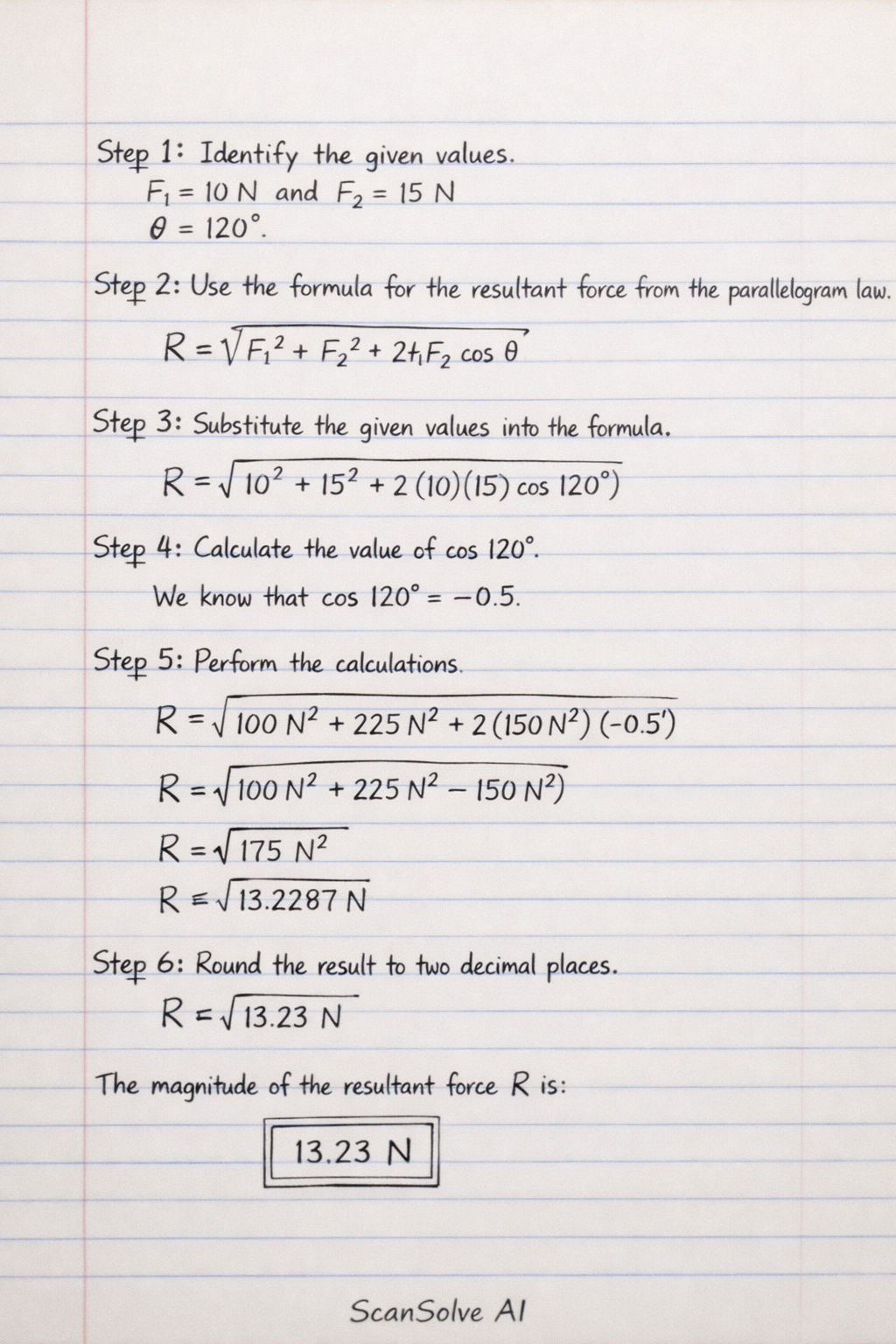
Handwritten Step-by-Step Solution
Get this as a handwritten image on WhatsApp — like a tutor wrote it for you.
Try on WhatsApp