
We read your photo as:
The angle between two forces of magnitude 7N and 4N is 120°. Find in N, the magnitude of their resultant.
Physics
ScanSolve AI Answer
Answer
Step-by-step solution
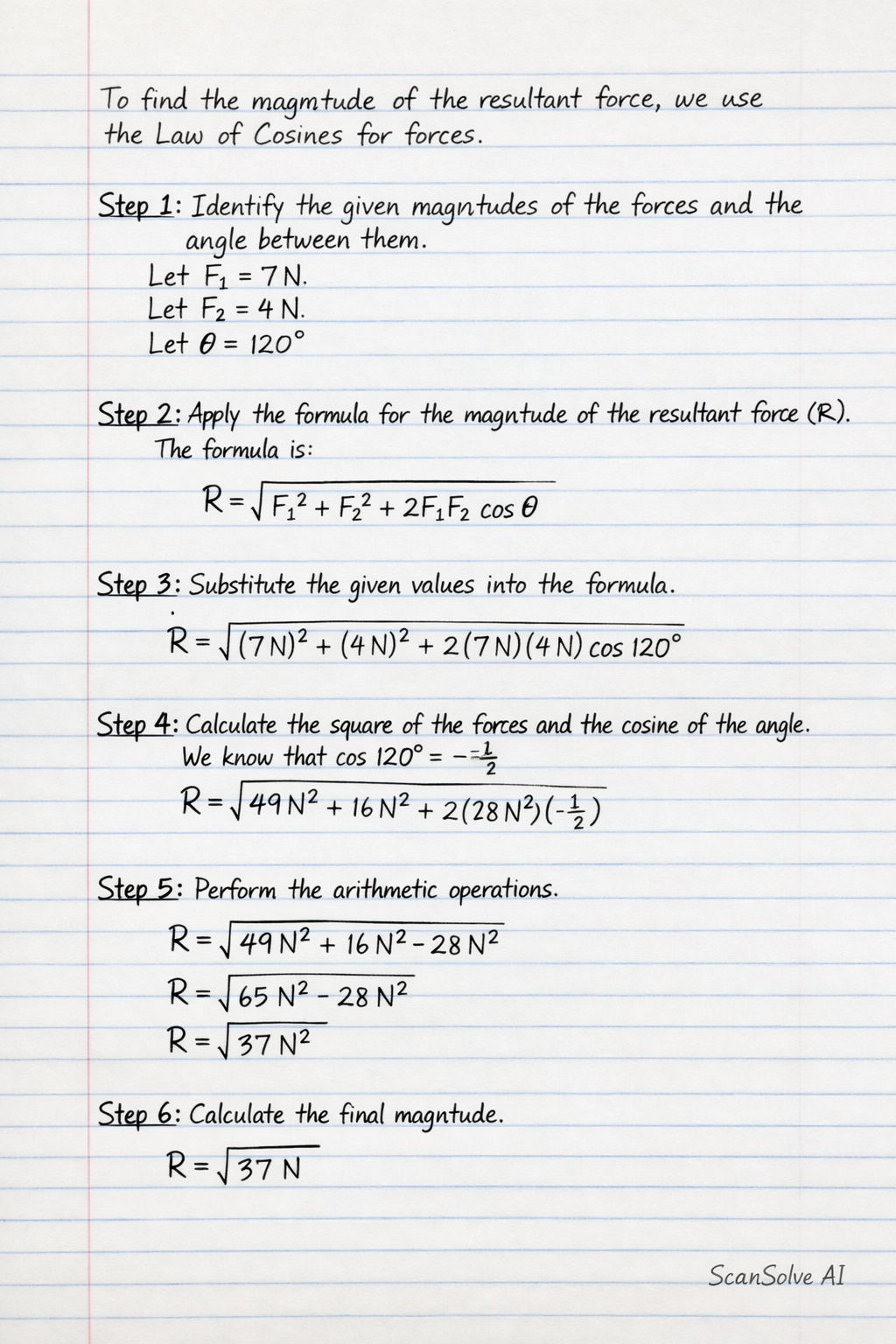
6 stepsTo find the magnitude of the resultant force, we use the Law of Cosines for forces.
Identify the given magnitudes of the forces and the angle between them.
Let
Let
LetApply the formula for the magnitude of the resultant force ().
The formula is:
Substitute the given values into the formula.
Calculate the square of the forces and the cosine of the angle.
We know that .
Perform the arithmetic operations.
Calculate the final magnitude.
The magnitude of their resultant is .
Was this helpful?
Try one yourself
A new problem that tests the same skill.
Still stuck on this one?
Ask a follow-up, and the answer starts from this question.
Got a different question?Ask your own question
More Physics Questions
QTwo forces of magnitudes 10 N and 6 N act at an angle of 60 degrees to each other. Find the…QTwo forces, 30 N and 40 N, act at right angles to each other. Using a scale of 1 cm = 5 N, find the…QCalculate the magnitude and direction of the resultant force of two forces: an 8 N horizontal force…QTwo forces, 3 N due North and 4 N due East, act on an object. Calculate the resultant force and the…QFind out magnitude and direction of resultant force.
Browse by topic:Mechanics
Handwritten Step-by-Step Solution
Get this as a handwritten image on WhatsApp — like a tutor wrote it for you.
Try on WhatsApp