
We read your photo as:
Understand the objective of energy content calculation.
ScanSolve AI Answer
Answer
Step-by-step solution
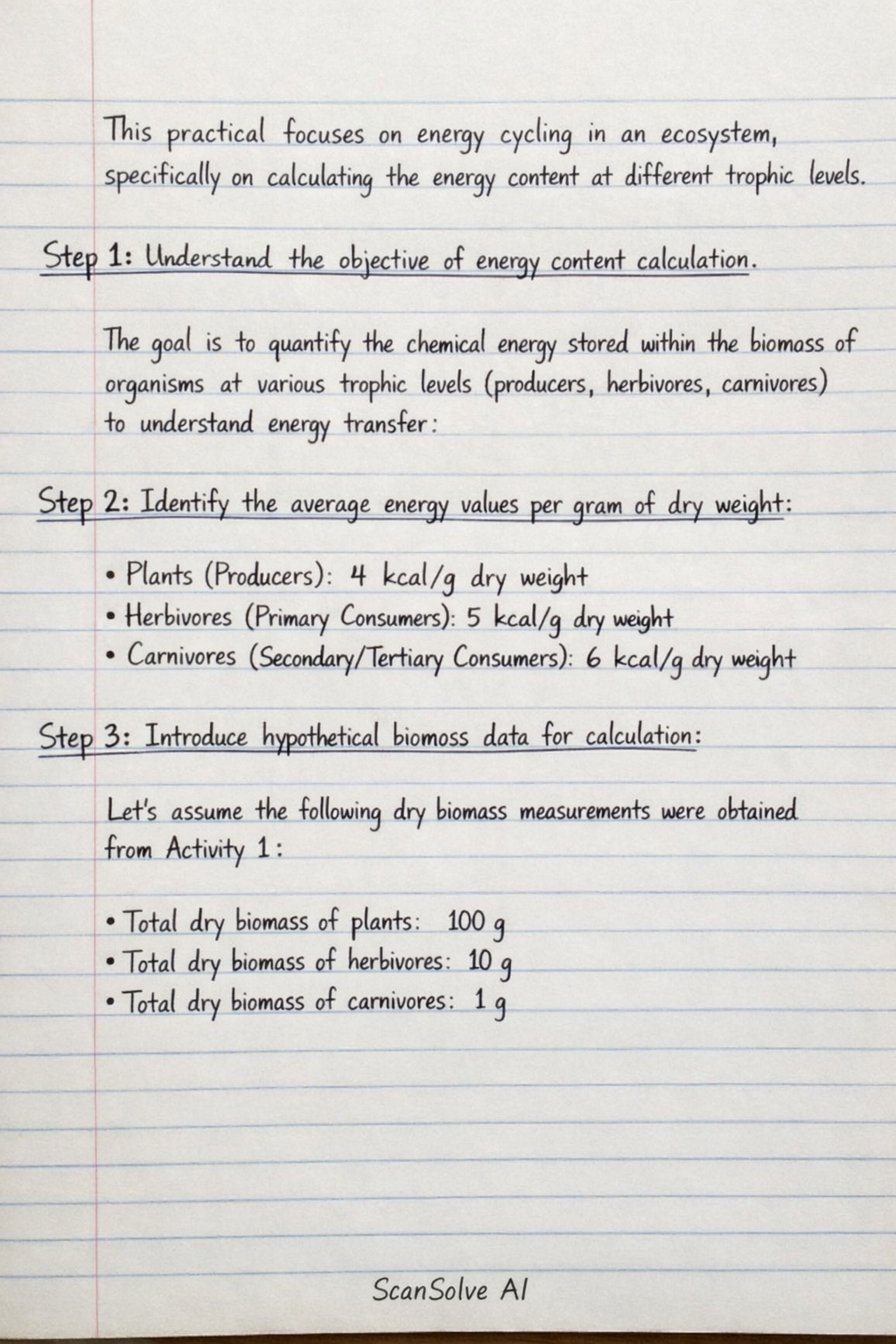
5 stepsThis practical focuses on energy cycling in an ecosystem, specifically on calculating the energy content at different trophic levels.
Understand the objective of energy content calculation.
The goal is to quantify the chemical energy stored within the biomass of organisms at various trophic levels (producers, herbivores, carnivores) to understand energy transfer.
Identify the average energy values per gram of dry weight.
According to the practical manual, the average energy values are:
- Plants (Producers): dry weight
- Herbivores (Primary Consumers): dry weight
- Carnivores (Secondary/Tertiary Consumers): dry weight
Introduce hypothetical biomass data for calculation.
Let's assume the following dry biomass measurements were obtained from Activity 1:
- Total dry biomass of plants:
- Total dry biomass of herbivores:
- Total dry biomass of carnivores:
Calculate the total energy content for each trophic level.
The total energy content is calculated by multiplying the dry biomass by the average energy value per gram.
For Plants:
For Herbivores:
For Carnivores:
Summarize the calculated energy content.
The calculated total energy content for each trophic level based on the hypothetical data is:
- Plants:
- Herbivores:
- Carnivores:
Try one yourself
A new problem that tests the same skill.
Still stuck on this one?
Ask a follow-up, and the answer starts from this question.
More Physics Questions
Handwritten Step-by-Step Solution
Get this as a handwritten image on WhatsApp — like a tutor wrote it for you.
Try on WhatsApp