

This physics problem tests your understanding of fundamental physical laws and their applications. The step-by-step solution below breaks down the problem using relevant equations and physical reasoning.
ScanSolve AI Answer
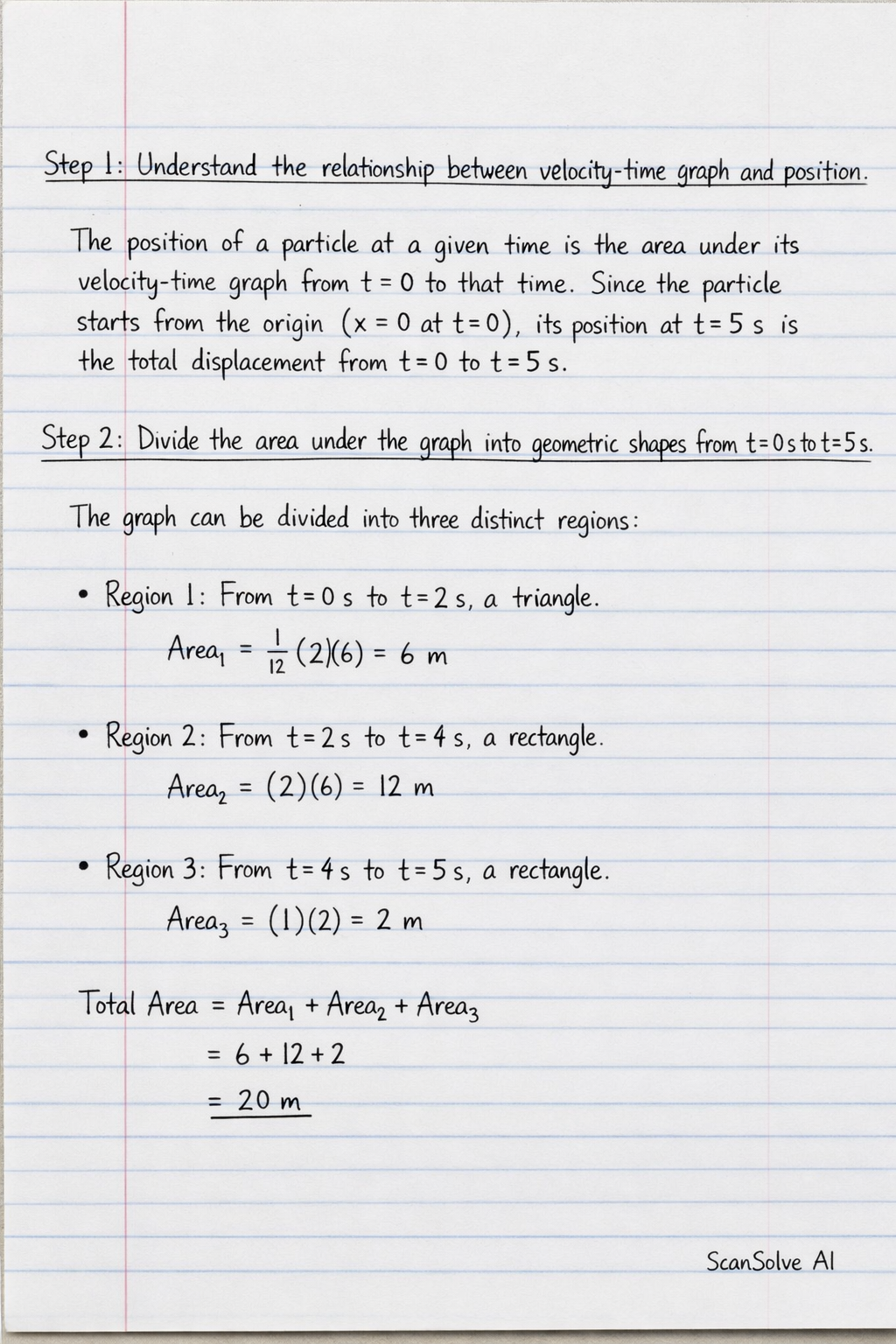
Step 1: Understand the relationship between velocity-time graph and position. The position of a particle at a given time is the area under its velocity-time graph from t=0 to that time. Since the particle starts from the origin (x=0 at t=0), its position at t=5 s is the total displacement from t=0 to t=5 s. Step 2: Divide the area under the graph into geometric shapes from t=0 s to t=5 s. The graph can be divided into three distinct regions: • Region 1: From t=0 s to t=2 s, a triangle. • Region 2: From t=2 s to t=4 s, a rectangle. • Region 3: From t=4 s to t=5 s, a rectangle. Step 3: Calculate the area of each region. Region 1 (0 s to 2 s): This is a triangle with base 2 s and height 2 m/s. Area_1 = (1)/(2) × base × height = (1)/(2) × (2 s) × (2 m/s) = 2 m Region 2 (2 s to 4 s): This is a rectangle with width (4-2) = 2 s and height 2 m/s. Area_2 = width × height = (2 s) × (2 m/s) = 4 m Region 3 (4 s to 5 s): This is a rectangle with width (5-4) = 1 s and height 3 m/s. Area_3 = width × height = (1 s) × (3 m/s) = 3 m Step 4: Sum the areas to find the total position at t=5 s. The total position x(5) is the sum of the areas of these three regions: x(5) = Area_1 + Area_2 + Area_3 x(5) = 2 m + 4 m + 3 m = 9 m The position of the particle at t=5 s is 9 m. The final answer is 9 m.