We read your photo as:

Using the information below, (i) Calculate the angular momentum for the particles. (ii) Find the momentum vectors and then angle between the position.

Physics

ScanSolve AI Answer

Answers

3 parts
a

L⃗=(−22,11,11)\vec{L} = (-22, 11, 11)

θ≈56.26∘\theta \approx 56.26^\circ

b

L⃗=(1,20,13)\vec{L} = (1, 20, 13)

θ≈63.27∘\theta \approx 63.27^\circ

c

L⃗=(0,0,−2)\vec{L} = (0, 0, -2)

θ=90∘\theta = 90^\circ

Step-by-step solution

6 steps

Here are the calculations for each part:

Part a· 2 steps

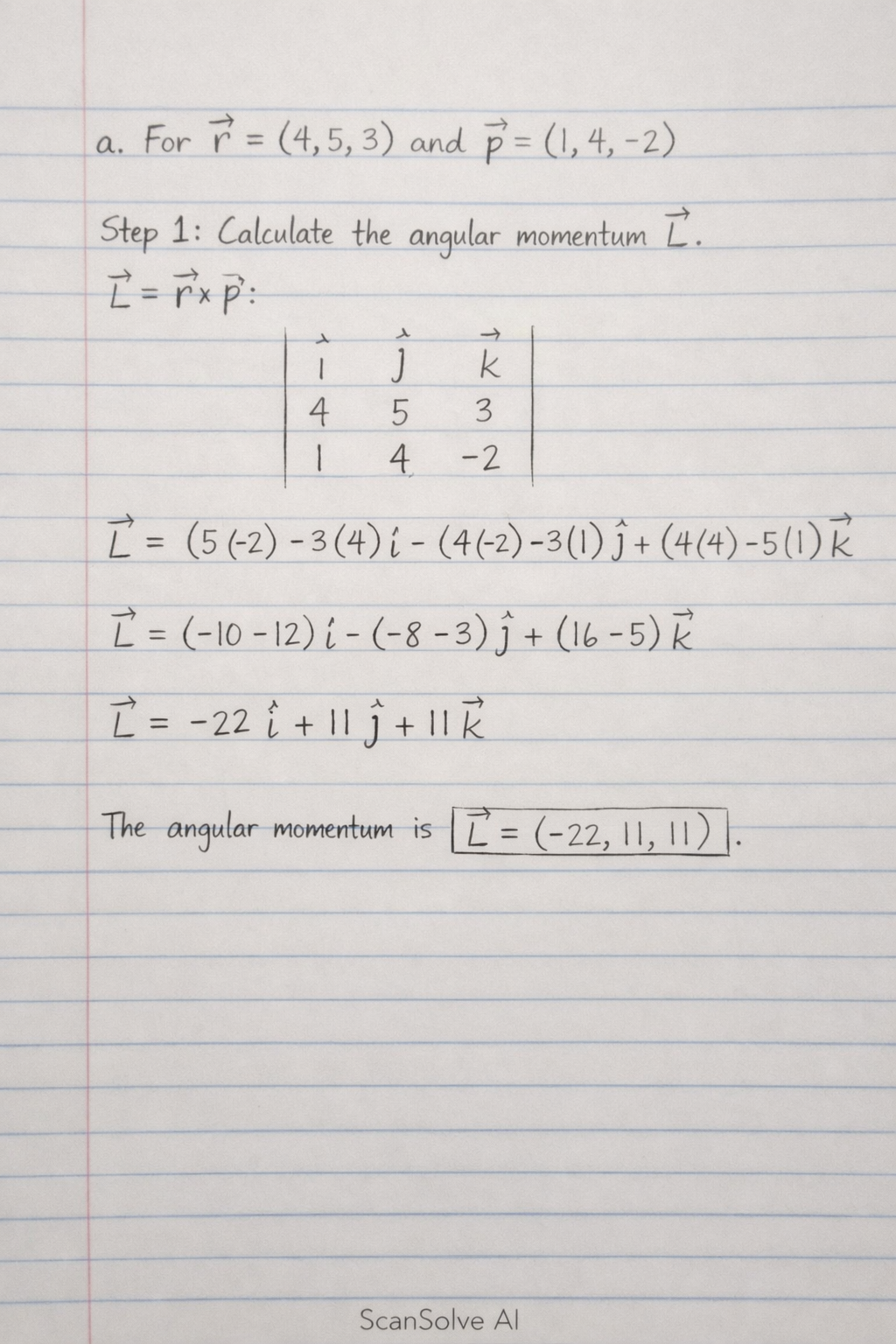
For r⃗=(4,5,3)\vec{r} = (4,5,3) and p⃗=(1,4,−2)\vec{p} = (1,4,-2)

  1. Calculate the angular momentum L⃗\vec{L}.

    The angular momentum L⃗\vec{L} is given by the cross product of the position vector r⃗\vec{r} and the linear momentum vector p⃗\vec{p}:

    L⃗=r⃗×p⃗=∣i^j^k^45314−2∣\vec{L} = \vec{r} \times \vec{p} = \begin{vmatrix} \hat{i} & \hat{j} & \hat{k} \\ 4 & 5 & 3 \\ 1 & 4 & -2 \end{vmatrix} L⃗=(5(−2)−3(4))i^−(4(−2)−3(1))j^+(4(4)−5(1))k^\vec{L} = (5(-2) - 3(4))\hat{i} - (4(-2) - 3(1))\hat{j} + (4(4) - 5(1))\hat{k} L⃗=(−10−12)i^−(−8−3)j^+(16−5)k^\vec{L} = (-10 - 12)\hat{i} - (-8 - 3)\hat{j} + (16 - 5)\hat{k} L⃗=−22i^+11j^+11k^\vec{L} = -22\hat{i} + 11\hat{j} + 11\hat{k}

    The angular momentum is L⃗=(−22,11,11)\boxed{\vec{L} = (-22, 11, 11)}.

  2. Find the momentum vector and the angle between r⃗\vec{r} and p⃗\vec{p}.

    The momentum vector is given as p⃗=(1,4,−2)\vec{p} = (1,4,-2).
    To find the angle θ\theta between r⃗\vec{r} and p⃗\vec{p}, we use the dot product formula:

    cos⁡θ=r⃗⋅p⃗∣r⃗∣∣p⃗∣\cos \theta = \frac{\vec{r} \cdot \vec{p}}{|\vec{r}| |\vec{p}|}

    First, calculate the dot product:

    r⃗⋅p⃗=(4)(1)+(5)(4)+(3)(−2)=4+20−6=18\vec{r} \cdot \vec{p} = (4)(1) + (5)(4) + (3)(-2) = 4 + 20 - 6 = 18

    Next, calculate the magnitudes of r⃗\vec{r} and p⃗\vec{p}:

    ∣r⃗∣=42+52+32=16+25+9=50|\vec{r}| = \sqrt{4^2 + 5^2 + 3^2} = \sqrt{16 + 25 + 9} = \sqrt{50} ∣p⃗∣=12+42+(−2)2=1+16+4=21|\vec{p}| = \sqrt{1^2 + 4^2 + (-2)^2} = \sqrt{1 + 16 + 4} = \sqrt{21}

    Now, substitute these values into the cosine formula:

    cos⁡θ=185021=181050\cos \theta = \frac{18}{\sqrt{50} \sqrt{21}} = \frac{18}{\sqrt{1050}} θ=arccos⁡(181050)≈arccos⁡(0.55549)≈56.26∘\theta = \arccos\left(\frac{18}{\sqrt{1050}}\right) \approx \arccos(0.55549) \approx 56.26^\circ

    The angle between the position and momentum vectors is θ≈56.26∘\boxed{\theta \approx 56.26^\circ}.

Part b

L⃗=(1,20,13)\vec{L} = (1, 20, 13)

For r⃗=(1,−2,3)\vec{r} = (1,-2,3) and p⃗=(7,−1,1)\vec{p} = (7,-1,1)

  1. Calculate the angular momentum L⃗\vec{L}.

    L⃗=r⃗×p⃗=∣i^j^k^1−237−11∣\vec{L} = \vec{r} \times \vec{p} = \begin{vmatrix} \hat{i} & \hat{j} & \hat{k} \\ 1 & -2 & 3 \\ 7 & -1 & 1 \end{vmatrix} L⃗=((−2)(1)−3(−1))i^−(1(1)−3(7))j^+(1(−1)−(−2)(7))k^\vec{L} = ((-2)(1) - 3(-1))\hat{i} - (1(1) - 3(7))\hat{j} + (1(-1) - (-2)(7))\hat{k} L⃗=(−2+3)i^−(1−21)j^+(−1+14)k^\vec{L} = (-2 + 3)\hat{i} - (1 - 21)\hat{j} + (-1 + 14)\hat{k} L⃗=1i^+20j^+13k^\vec{L} = 1\hat{i} + 20\hat{j} + 13\hat{k}

    The angular momentum is L⃗=(1,20,13)\boxed{\vec{L} = (1, 20, 13)}.

  2. Find the momentum vector and the angle between r⃗\vec{r} and p⃗\vec{p}.

    The momentum vector is given as p⃗=(7,−1,1)\vec{p} = (7,-1,1).
    First, calculate the dot product:

    r⃗⋅p⃗=(1)(7)+(−2)(−1)+(3)(1)=7+2+3=12\vec{r} \cdot \vec{p} = (1)(7) + (-2)(-1) + (3)(1) = 7 + 2 + 3 = 12

    Next, calculate the magnitudes of r⃗\vec{r} and p⃗\vec{p}:

    ∣r⃗∣=12+(−2)2+32=1+4+9=14|\vec{r}| = \sqrt{1^2 + (-2)^2 + 3^2} = \sqrt{1 + 4 + 9} = \sqrt{14} ∣p⃗∣=72+(−1)2+12=49+1+1=51|\vec{p}| = \sqrt{7^2 + (-1)^2 + 1^2} = \sqrt{49 + 1 + 1} = \sqrt{51}

    Now, substitute these values into the cosine formula:

    cos⁡θ=121451=12714\cos \theta = \frac{12}{\sqrt{14} \sqrt{51}} = \frac{12}{\sqrt{714}} θ=arccos⁡(12714)≈arccos⁡(0.44983)≈63.27∘\theta = \arccos\left(\frac{12}{\sqrt{714}}\right) \approx \arccos(0.44983) \approx 63.27^\circ

    The angle between the position and momentum vectors is θ≈63.27∘\boxed{\theta \approx 63.27^\circ}.

Part c

L⃗=(0,0,−2)\vec{L} = (0, 0, -2)

For r⃗=(0,2,0)\vec{r} = (0,2,0) and p⃗=(1,0,0)\vec{p} = (1,0,0)

  1. Calculate the angular momentum L⃗\vec{L}.

    L⃗=r⃗×p⃗=∣i^j^k^020100∣\vec{L} = \vec{r} \times \vec{p} = \begin{vmatrix} \hat{i} & \hat{j} & \hat{k} \\ 0 & 2 & 0 \\ 1 & 0 & 0 \end{vmatrix} L⃗=(2(0)−0(0))i^−(0(0)−0(1))j^+(0(0)−2(1))k^\vec{L} = (2(0) - 0(0))\hat{i} - (0(0) - 0(1))\hat{j} + (0(0) - 2(1))\hat{k} L⃗=(0−0)i^−(0−0)j^+(0−2)k^\vec{L} = (0 - 0)\hat{i} - (0 - 0)\hat{j} + (0 - 2)\hat{k} L⃗=0i^+0j^−2k^\vec{L} = 0\hat{i} + 0\hat{j} - 2\hat{k}

    The angular momentum is L⃗=(0,0,−2)\boxed{\vec{L} = (0, 0, -2)}.

  2. Find the momentum vector and the angle between r⃗\vec{r} and p⃗\vec{p}.

    The momentum vector is given as p⃗=(1,0,0)\vec{p} = (1,0,0).
    First, calculate the dot product:

    r⃗⋅p⃗=(0)(1)+(2)(0)+(0)(0)=0+0+0=0\vec{r} \cdot \vec{p} = (0)(1) + (2)(0) + (0)(0) = 0 + 0 + 0 = 0

    Since the dot product is 0, the vectors r⃗\vec{r} and p⃗\vec{p} are orthogonal.

    cos⁡θ=0∣r⃗∣∣p⃗∣=0\cos \theta = \frac{0}{|\vec{r}| |\vec{p}|} = 0 θ=arccos⁡(0)=90∘\theta = \arccos(0) = 90^\circ

    The angle between the position and momentum vectors is θ=90∘\boxed{\theta = 90^\circ}.

Was this helpful?

Try one yourself

A new problem that tests the same skill.

Still stuck on this one?

Ask a follow-up, and the answer starts from this question.

Got a different question?Ask your own question
Handwritten step-by-step solution preview

Handwritten Step-by-Step Solution

Get this as a handwritten image on WhatsApp — like a tutor wrote it for you.

Try on WhatsApp