Using the information below, solve; (I). Calculate the angular momentum for the particles (II). Find the momentum vectors and their angle between the particles. a. r = (4,5,3) and p = (1,4,-2) b. r = (1,-2,3) and p = (7,-1,1) c. r = (0,2,0) and p = (1,0,0).
|Physics
ScanSolve AI Answer
Answer
\vec{L} = (-22, 11, 11)
Here are the calculations for each part:
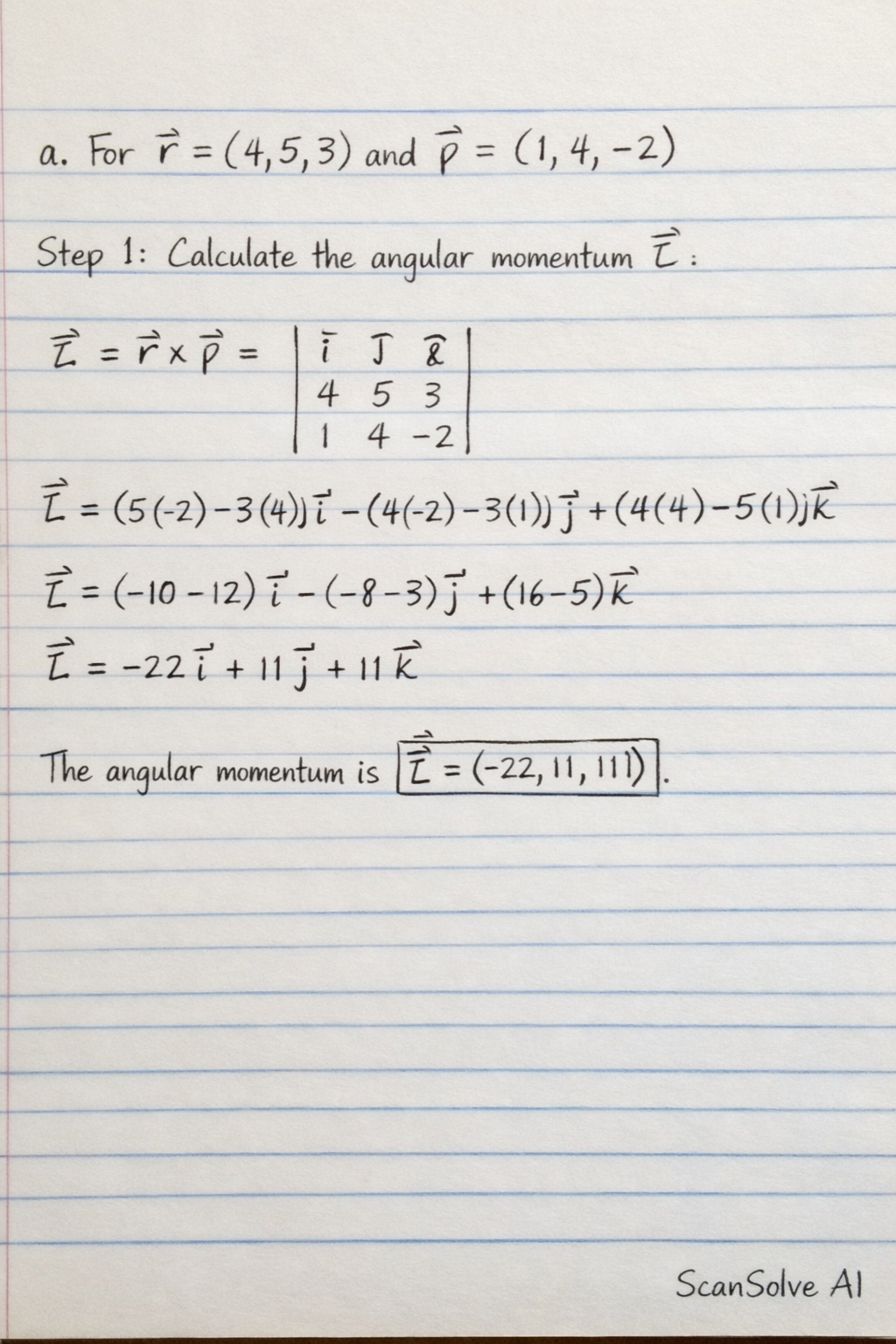
a. For r=(4,5,3) and p=(1,4,−2)
Step 1: Calculate the angular momentum L.
The angular momentum L is given by the cross product of the position vector r and the linear momentum vector p:
L=r×p=i^41j^54k^3−2L=(5(−2)−3(4))i^−(4(−2)−3(1))j^+(4(4)−5(1))k^L=(−10−12)i^−(−8−3)j^+(16−5)k^L=−22i^+11j^+11k^
The angular momentum is L=(−22,11,11).
Step 2: Find the momentum vector and the angle between r and p.
The momentum vector is given as p=(1,4,−2).
To find the angle θ between r and p, we use the dot product formula:
cosθ=∣r∣∣p∣r⋅p
First, calculate the dot product:
r⋅p=(4)(1)+(5)(4)+(3)(−2)=4+20−6=18
Next, calculate the magnitudes of r and p:
∣r∣=42+52+32=16+25+9=50∣p∣=12+42+(−2)2=1+16+4=21
Now, substitute these values into the cosine formula:
cosθ=502118=105018θ=arccos(105018)≈arccos(0.55549)≈56.26∘
The angle between the position and momentum vectors is θ≈56.26∘.
b. For r=(1,−2,3) and p=(7,−1,1)
Step 1: Calculate the angular momentum L.
L=r×p=i^17j^−2−1k^31L=((−2)(1)−3(−1))i^−(1(1)−3(7))j^+(1(−1)−(−2)(7))k^L=(−2+3)i^−(1−21)j^+(−1+14)k^L=1i^+20j^+13k^
The angular momentum is L=(1,20,13).
Step 2: Find the momentum vector and the angle between r and p.
The momentum vector is given as p=(7,−1,1).
First, calculate the dot product:
r⋅p=(1)(7)+(−2)(−1)+(3)(1)=7+2+3=12
Next, calculate the magnitudes of r and p:
∣r∣=12+(−2)2+32=1+4+9=14∣p∣=72+(−1)2+12=49+1+1=51
Now, substitute these values into the cosine formula:
cosθ=145112=71412θ=arccos(71412)≈arccos(0.44983)≈63.27∘
The angle between the position and momentum vectors is θ≈63.27∘.
c. For r=(0,2,0) and p=(1,0,0)
Step 1: Calculate the angular momentum L.
L=r×p=i^01j^20k^00L=(2(0)−0(0))i^−(0(0)−0(1))j^+(0(0)−2(1))k^L=(0−0)i^−(0−0)j^+(0−2)k^L=0i^+0j^−2k^
The angular momentum is L=(0,0,−2).
Step 2: Find the momentum vector and the angle between r and p.
The momentum vector is given as p=(1,0,0).
First, calculate the dot product:
r⋅p=(0)(1)+(2)(0)+(0)(0)=0+0+0=0
Since the dot product is 0, the vectors r and p are orthogonal.
cosθ=∣r∣∣p∣0=0θ=arccos(0)=90∘
The angle between the position and momentum vectors is θ=90∘.
That's 2 down. 3 left today — send the next one.
Was this helpful?
Need help with your own homework?
Get instant step-by-step solutions to any question. Free to start.
a. For r = (4,5,3) and p = (1,4,-2) Step 1: Calculate the angular momentum L.
Using the information below, solve; (I). Calculate the angular momentum for the particles (II). Find the momentum vectors and their angle between the particles. a. r = (4,5,3) and p = (1,4,-2) b. r = (1,-2,3) and p = (7,-1,1) c. r = (0,2,0) and p = (1,0,0).
This physics problem tests your understanding of fundamental physical laws and their applications. The step-by-step solution below breaks down the problem using relevant equations and physical reasoning.
ScanSolve AI Answer
Here are the calculations for each part: a. For r = (4,5,3) and p = (1,4,-2) Step 1: Calculate the angular momentum L. The angular momentum L is given by the cross product of the position vector r and the linear momentum vector p: L = r × p = i & j & k \\ 4 & 5 & 3 \\ 1 & 4 & -2 L = (5(-2) - 3(4))i - (4(-2) - 3(1))j + (4(4) - 5(1))k L = (-10 - 12)i - (-8 - 3)j + (16 - 5)k L = -22i + 11j + 11k The angular momentum is L = (-22, 11, 11). Step 2: Find the momentum vector and the angle between r and p. The momentum vector is given as p = (1,4,-2). To find the angle between r and p, we use the dot product formula: = r · p|r| |p| First, calculate the dot product: r · p = (4)(1) + (5)(4) + (3)(-2) = 4 + 20 - 6 = 18 Next, calculate the magnitudes of r and p: |r| = sqrt(4^2 + 5^2 + 3^2) = sqrt(16 + 25 + 9) = sqrt(50) |p| = sqrt(1^2 + 4^2 + (-2)^2) = sqrt(1 + 16 + 4) = sqrt(21) Now, substitute these values into the cosine formula: = (18)/(sqrt(50) 21) = (18)/(sqrt(1050)) = ((18)/(sqrt(1050))) ≈ (0.55549) ≈ 56.26^ The angle between the position and momentum vectors is ≈ 56.26^. b. For r = (1,-2,3) and p = (7,-1,1) Step 1: Calculate the angular momentum L. L = r × p = i & j & k \\ 1 & -2 & 3 \\ 7 & -1 & 1 L = ((-2)(1) - 3(-1))i - (1(1) - 3(7))j + (1(-1) - (-2)(7))k L = (-2 + 3)i - (1 - 21)j + (-1 + 14)k L = 1i + 20j + 13k The angular momentum is L = (1, 20, 13). Step 2: Find the momentum vector and the angle between r and p. The momentum vector is given as p = (7,-1,1). First, calculate the dot product: r · p = (1)(7) + (-2)(-1) + (3)(1) = 7 + 2 + 3 = 12 Next, calculate the magnitudes of r and p: |r| = sqrt(1^2 + (-2)^2 + 3^2) = sqrt(1 + 4 + 9) = sqrt(14) |p| = sqrt(7^2 + (-1)^2 + 1^2) = sqrt(49 + 1 + 1) = sqrt(51) Now, substitute these values into the cosine formula: = (12)/(sqrt(14) 51) = (12)/(sqrt(714)) = ((12)/(sqrt(714))) ≈ (0.44983) ≈ 63.27^ The angle between the position and momentum vectors is ≈ 63.27^. c. For r = (0,2,0) and p = (1,0,0) Step 1: Calculate the angular momentum L. L = r × p = i & j & k \\ 0 & 2 & 0 \\ 1 & 0 & 0 L = (2(0) - 0(0))i - (0(0) - 0(1))j + (0(0) - 2(1))k L = (0 - 0)i - (0 - 0)j + (0 - 2)k L = 0i + 0j - 2k The angular momentum is L = (0, 0, -2). Step 2: Find the momentum vector and the angle between r and p. The momentum vector is given as p = (1,0,0). First, calculate the dot product: r · p = (0)(1) + (2)(0) + (0)(0) = 0 + 0 + 0 = 0 Since the dot product is 0, the vectors r and p are orthogonal. = (0)/(|r)| |p| = 0 = (0) = 90^ The angle between the position and momentum vectors is = 90^. That's 2 down. 3 left today — send the next one.