

This physics problem tests your understanding of fundamental physical laws and their applications. The step-by-step solution below breaks down the problem using relevant equations and physical reasoning.
ScanSolve AI Answer
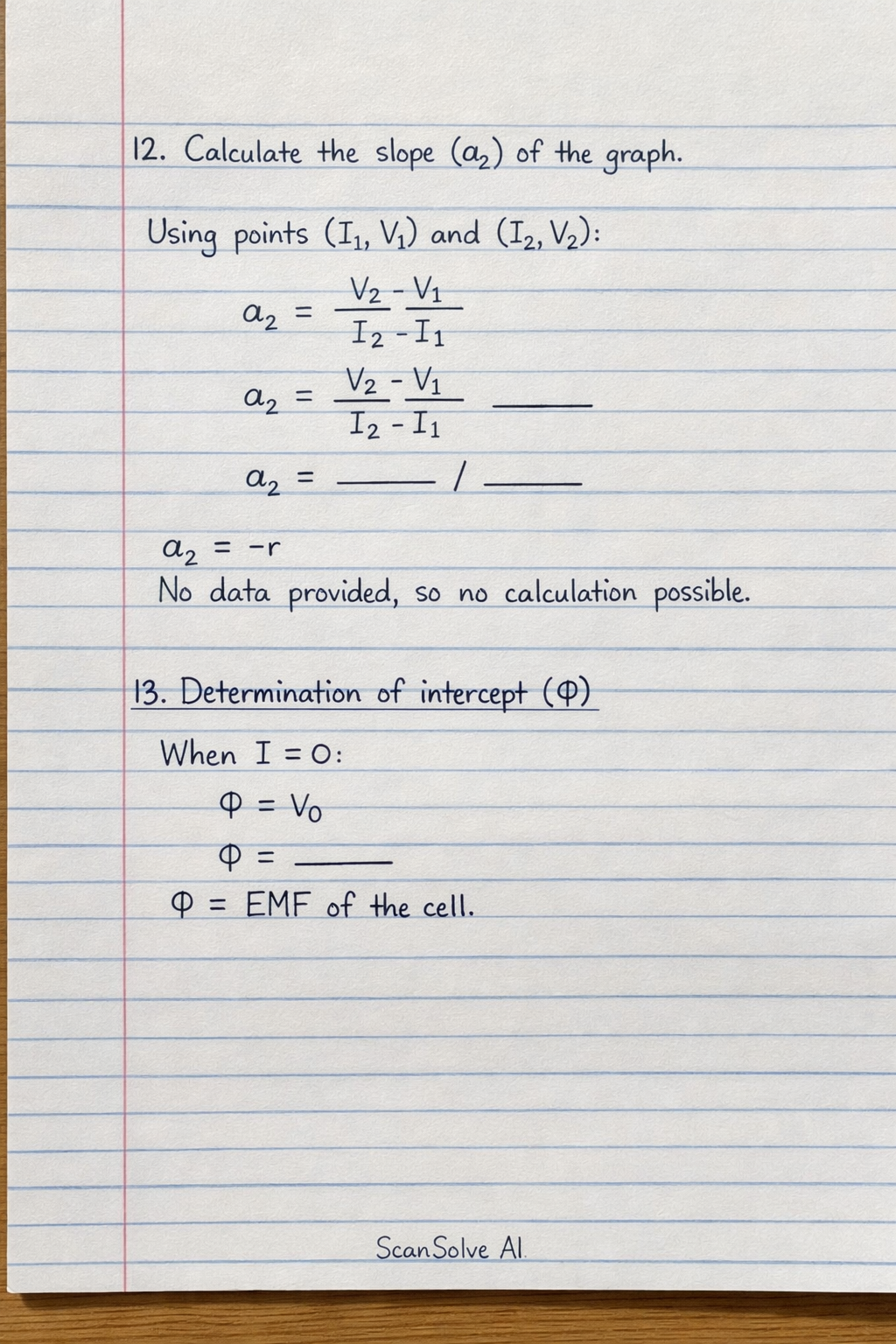
You're on a roll — Here are the answers to the questions based on the provided image, continuing from the previous turn: 12. Calculate the slope (_2) of the graph. The slope (_2) of the V versus I graph is calculated using two distinct points (I_1, V_1) and (I_2, V_2) from the straight line portion of the graph. _2 = (V_2 - V_1)/(I_2 - I_1) The slope _2 represents the negative of the internal resistance (r) of the cell. Therefore, _2 = -r. Since no data is provided, a numerical calculation cannot be performed. 13. Determination of intercept () The intercept () is the value of the terminal voltage (V) when the current (I) is zero. This is found by extrapolating the straight line graph to the point where it crosses the V-axis (the y-axis). = V when I = 0 The intercept represents the electromotive force (EMF) of the cell. 14. Physical significance of _2 and _2: The slope _2 represents the internal resistance* (r) of the cell. It indicates the opposition to the flow of current within the cell itself. Its value is negative, so _2 = -r. : The intercept represents the electromotive force (EMF)* (E) of the cell. It is the maximum potential difference across the terminals of the cell when no current is drawn from it (i.e., in an open circuit). 15. Comparison of and E_0 is the EMF of the cell determined graphically from the V-I plot. E_0 is likely the nominal or actual EMF of the cell. Ideally, should be equal to E_0. Any difference between and E_0 would be due to experimental errors, such as inaccuracies in reading instruments, temperature changes affecting the cell's internal resistance, or limitations of the experimental setup. A close agreement indicates a successful experiment. 16. Precautions Ensure all connections are clean and tight to minimize contact resistance. Avoid prolonged current flow to prevent the cell from heating up, which can alter its internal resistance and EMF. Read the ammeter and voltmeter accurately, ensuring your eye is perpendicular to the scale to avoid parallax error. Use appropriate ranges for the ammeter and voltmeter to get precise readings. Switch off the circuit between readings to conserve the cell's energy and prevent overheating of components. Ensure the variable resistor is connected correctly to allow for a smooth variation of current. What's next? Send 'em 📸