

This physics problem tests your understanding of fundamental physical laws and their applications. The step-by-step solution below breaks down the problem using relevant equations and physical reasoning.
ScanSolve AI Answer
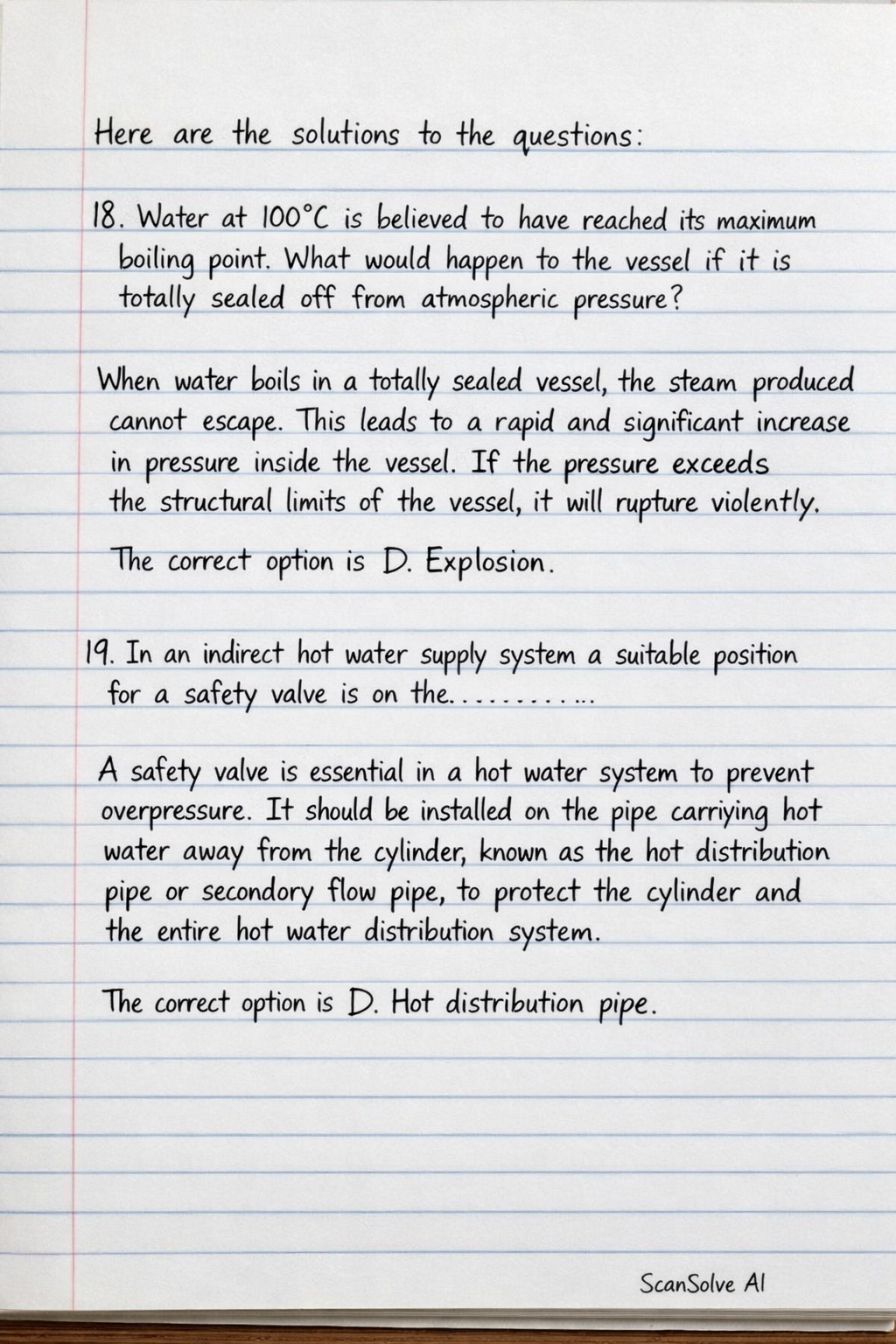
Here are the solutions to the questions: 18. Water at 100^ is believed to have reached its maximum boiling point. What would happen to the vessel if it is totally sealed off from atmospheric pressure? When water boils in a totally sealed vessel, the steam produced cannot escape. This leads to a rapid and significant increase in pressure inside the vessel. If the pressure exceeds the structural limits of the vessel, it will rupture violently. The correct option is D. Explosion. 19. In an indirect hot water supply system a suitable position for a safety valve is on the................... A safety valve is essential in a hot water system to prevent overpressure. It should be installed on the pipe carrying hot water away from the cylinder, known as the hot distribution pipe or secondary flow pipe, to protect the cylinder and the entire hot water distribution system. The correct option is D. Hot distribution pipe. 20. All these get their water supply from the impervious striation EXCEPT? An impervious striation is a layer of rock or soil that does not allow water to pass through. Artesian wells, artesian springs, and deep wells typically draw water from aquifers that are confined by such impervious layers. A fissure is a crack in rock; while water can flow through a fissure, the fissure itself is a conduit and not a source of water from an impervious layer in the same way the other options describe tapping into confined groundwater. The correct option is D. Fissure. 3 done, 2 left today. You're making progress.