
We read your photo as:
Within a population of microorganisms, there is natural variation, and some individuals may possess random genetic mutations that confer resistance to the drug.
ScanSolve AI Answer
Step-by-step solution
3 stepsPart a· 3 steps
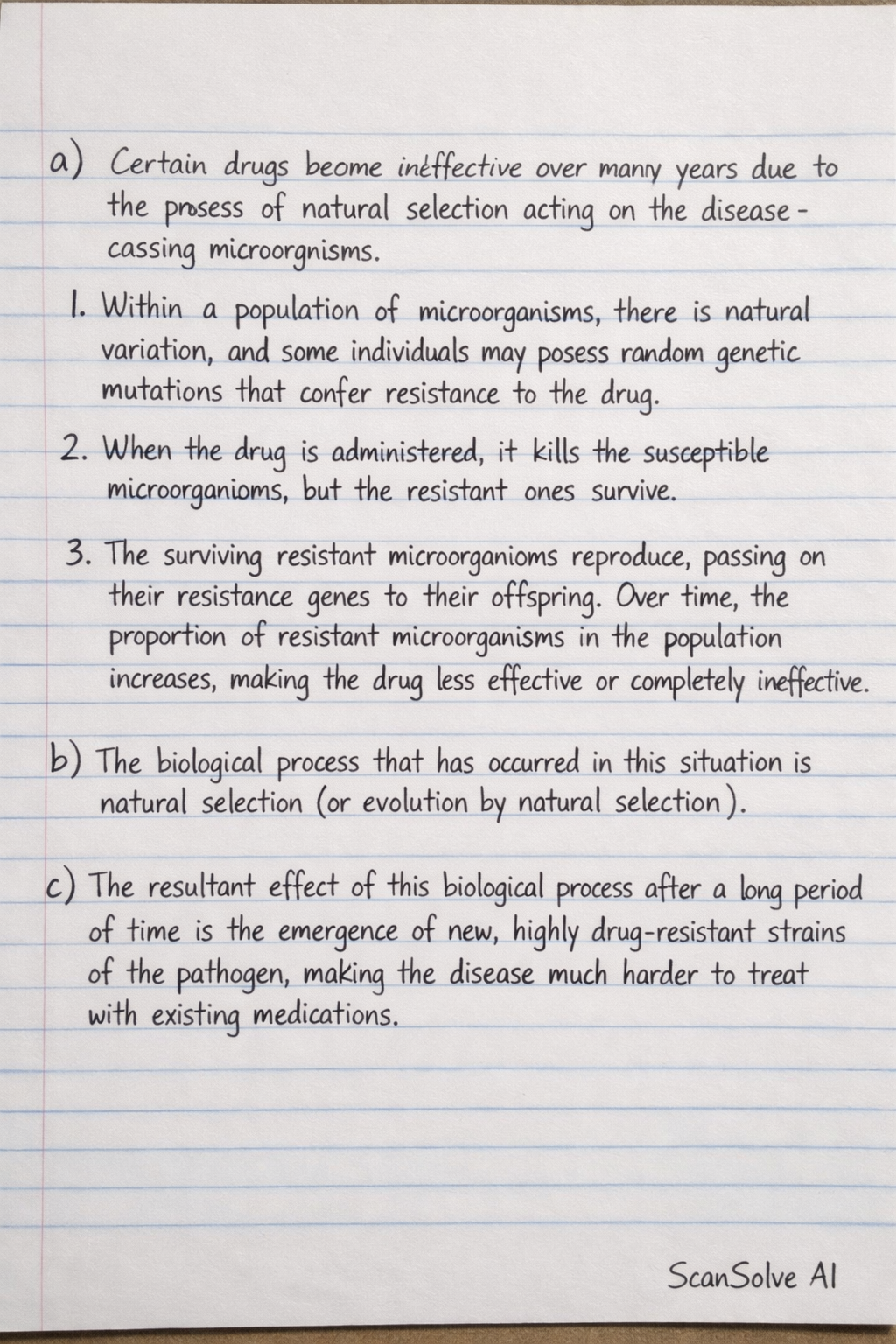
Certain drugs become ineffective over many years due to the process of natural selection acting on the disease-causing microorganisms.
Within a population of microorganisms, there is natural variation, and some individuals may possess random genetic mutations that confer resistance to the drug.
When the drug is administered, it kills the susceptible microorganisms, but the resistant ones survive.
The surviving resistant microorganisms reproduce, passing on their resistance genes to their offspring.
Over time, the proportion of resistant microorganisms in the population increases, making the drug less effective or completely ineffective.
Part b
The biological process that has occurred in this situation is natural selection (or evolution by natural selection).
c) The resultant effect of this biological process after a long period of time is the emergence of new, highly drug-resistant strains of the pathogen, making the disease much harder to treat with existing medications.
Still stuck on this one?
Ask a follow-up, and the answer starts from this question.
More Physics Questions
Handwritten Step-by-Step Solution
Get this as a handwritten image on WhatsApp — like a tutor wrote it for you.
Try on WhatsApp