
We read your photo as:
State the work-energy theorem in words and apply it to calculate the kinetic energy of a crate. Also, draw a free-body diagram for the crate on an incline.
ScanSolve AI Answer
Answers
2 partsStep-by-step solution
4 stepsHere is the solution to your problem:
Part 5.1
State the work-energy theorem in words.
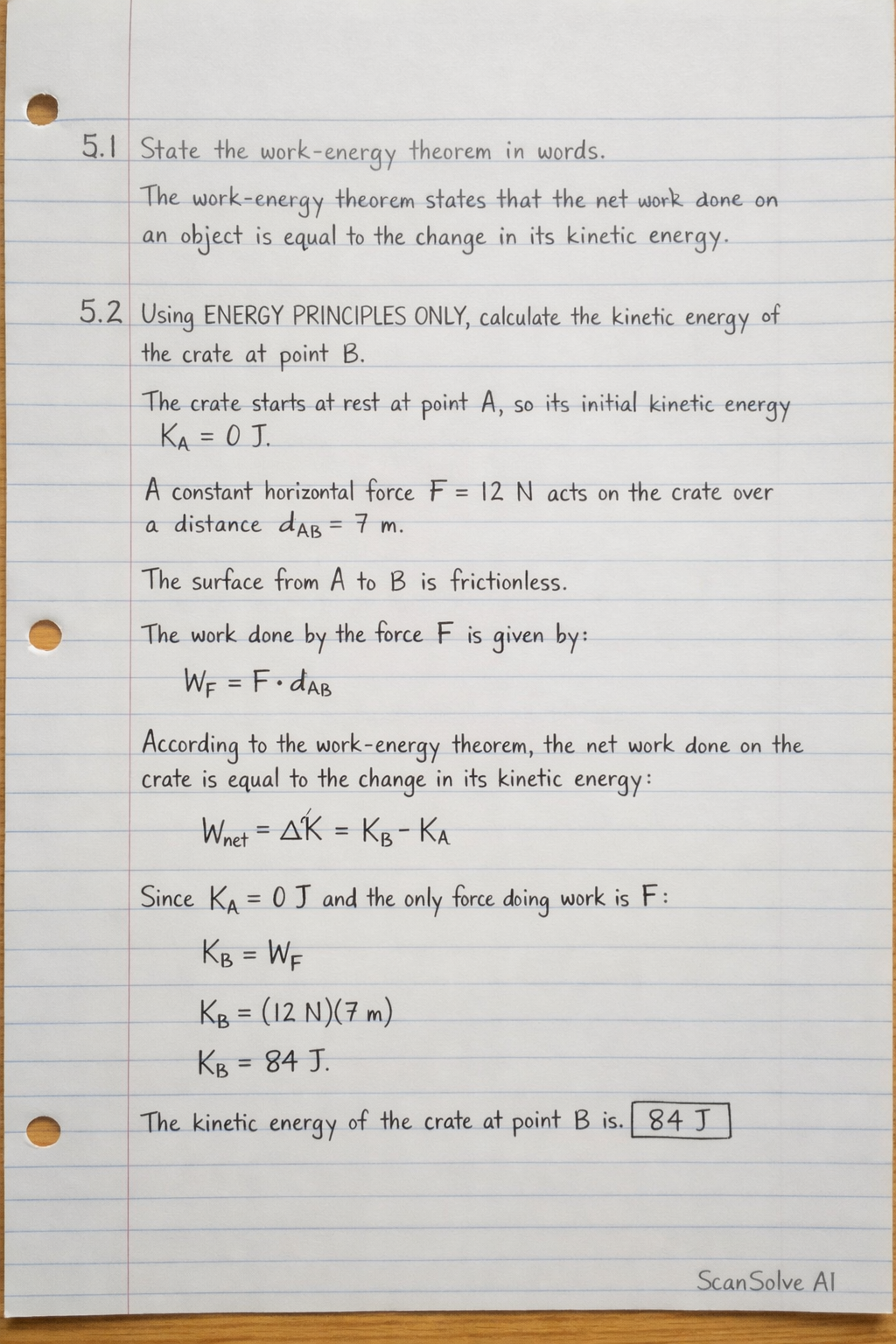
The work-energy theorem states that the net work done on an object is equal to the change in its kinetic energy.
Part 5.2
Using ENERGY PRINCIPLES ONLY, calculate the kinetic energy of the crate at point B.
The crate starts at rest at point A, so its initial kinetic energy .
A constant horizontal force acts on the crate over a distance .
The surface from A to B is frictionless.
The work done by the force is given by:
According to the work-energy theorem, the net work done on the crate is equal to the change in its kinetic energy:
Since and the only force doing work is :
The kinetic energy of the crate at point B is .
Part 5.3
Draw a free-body diagram showing ALL the forces acting on the crate as it moves down the incline.
As the crate moves down the incline, the forces acting on it are:
- Gravitational force (Weight): Acts vertically downwards from the center of mass of the crate.
- Normal force: Acts perpendicular to the inclined surface, pointing away from the surface.
- Kinetic frictional force: Acts parallel to the inclined surface, pointing upwards along the incline (opposite to the direction of motion).
Part 5.4
Using ENERGY PRINCIPLES ONLY, determine whether the crate will pass point C.
From point B to C, the crate moves down an incline.
Initial kinetic energy at B:
Mass of the crate:
Distance from B to C:
Angle of inclination:
Constant frictional force:
Acceleration due to gravity:
We use the work-energy theorem from B to C: .
The forces doing work are gravity and friction.
Calculate the work done by gravity ().
The component of gravity parallel to the incline is . This component acts in the direction of motion.
Calculate the work done by friction ().
Friction opposes the motion, so the work done by friction is negative.
Calculate the net work done from B to C ().
Calculate the kinetic energy at C ().
Using the work-energy theorem:
Since the kinetic energy at point C () is positive, the crate still has kinetic energy when it reaches point C. Therefore, the crate will pass point C.
The crate will .
Try one yourself
A new problem that tests the same skill.
Still stuck on this one?
Ask a follow-up, and the answer starts from this question.
More Physics Questions
Handwritten Step-by-Step Solution
Get this as a handwritten image on WhatsApp — like a tutor wrote it for you.
Try on WhatsApp