ScanSolve logoScanSolve
Toggle sidebar
  • Homework
  • Tutor
  • Humanizer
  • AI Detector
  • Questions
  • Blog
  • History
  • Mobile App

  • Homework
  • Tutor
  • Humanizer
  • AI Detector

  • Questions
  • Math homework helpMath
    Physics homework helpPhysics
    Chemistry homework helpChemistry
    Biology homework helpBiology
    Computer Science homework helpComputer Science
    History homework helpHistory
    More homework helpMore
  • Blog
  • History

  • Mobile App
ScanSolvePLUS
  • Unlimited answers
  • ScanSolve AI Pro
Start Free Trial →
Try on WhatsApp

Scan it, Solve it

support@getscansolve.com

© 2026 ScanSolve. All rights reserved.

Company

About UsCareersContact Us

Resources

Questions HubAI HumanizerAI Detector

Support

FAQTerms of ServicePrivacy PolicyDo Not Sell My Data

Download App

Download ScanSolve on App StoreGet ScanSolve on Google PlayChat on WhatsApp
Home > Mathematics Homework Help > Solution

If a:b=c:d=e:f then shows that (a^4+a^2e^2-e^4)/(b^6+b^2f^2-f^5) = a^4/b^4

Asked on March 26, 2026|Mathematics

This mathematics problem involves applying core mathematical principles and formulas. Below you will find a complete step-by-step solution with detailed explanations for each step, helping you understand not just the answer but the method behind it.

ScanSolve AI AnswerAnswered on March 26, 2026
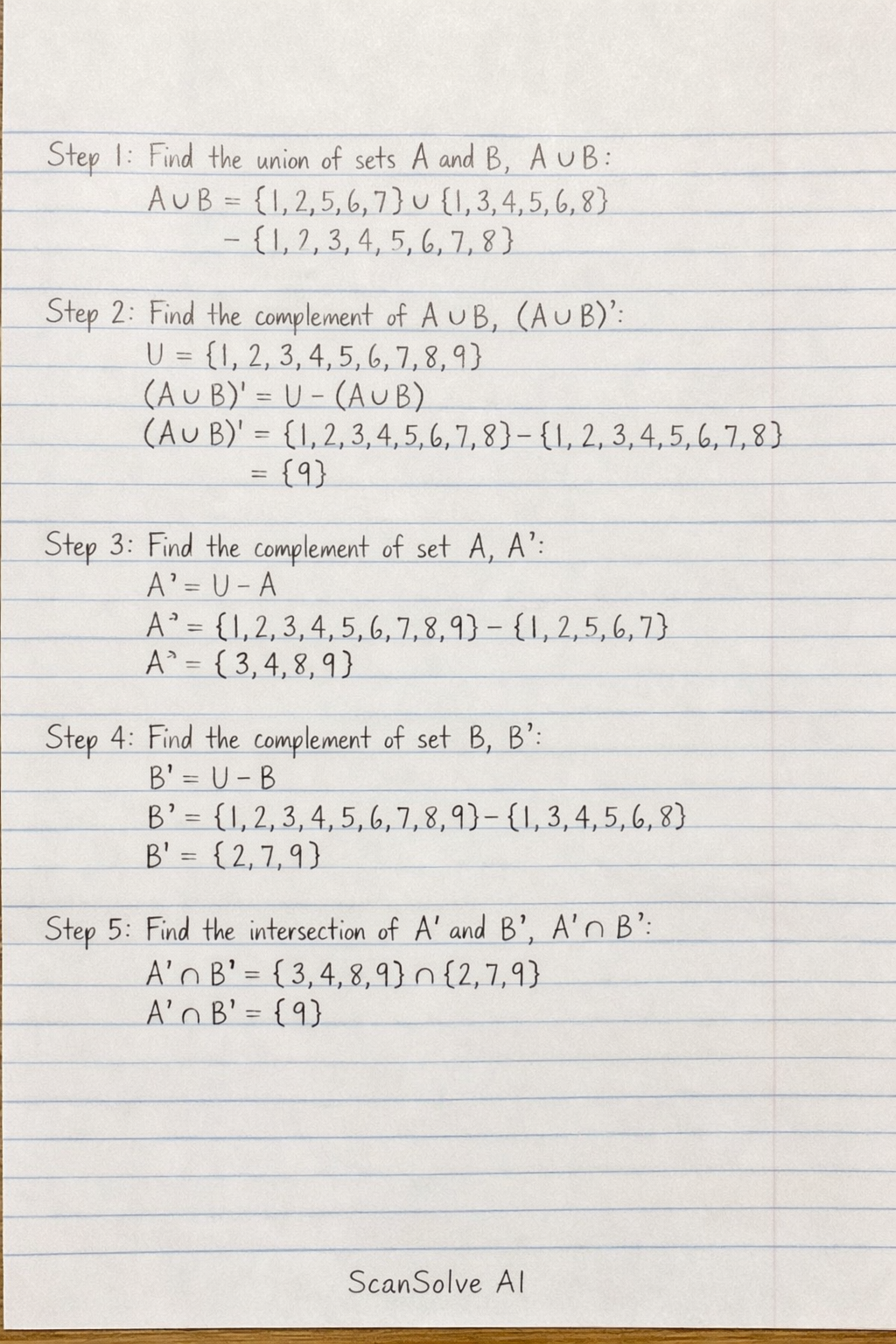
Step 1: Find the union of sets $A$ and $B$, $A \cup B$. $$A \cup B = \{1,2,5,6,7\} \cup \{1,3,4,5,6,8\}$$ $$A \cup B = \{1,2,3,4,5,6,7,8\}$$ Step 2: Find the complement of $A \cup B$, denoted as $(A \cup B)'$. This includes all elements in the universal set $U$ that are not in $A \cup B$. $$U = \{1,2,3,4,5,6,7,8,9\}$$ $$(A \cup B)' = U - (A \cup B)$$ $$(A \cup B)' = \{1,2,3,4,5,6,7,8,9\} - \{1,2,3,4,5,6,7,8\}$$ $$(A \cup B)' = \{9\}$$ Step 3: Find the complement of set $A$, denoted as $A'$. This includes all elements in $U$ that are not in $A$. $$A' = U - A$$ $$A' = \{1,2,3,4,5,6,7,8,9\} - \{1,2,5,6,7\}$$ $$A' = \{3,4,8,9\}$$ Step 4: Find the complement of set $B$, denoted as $B'$. This includes all elements in $U$ that are not in $B$. $$B' = U - B$$ $$B' = \{1,2,3,4,5,6,7,8,9\} - \{1,3,4,5,6,8\}$$ $$B' = \{2,7,9\}$$ Step 5: Find the intersection of $A'$ and $B'$, denoted as $A' \cap B'$. This includes all elements common to both $A'$ and $B'$. $$A' \cap B' = \{3,4,8,9\} \cap \{2,7,9\}$$ $$A' \cap B' = \{9\}$$ Step 6: Compare the results from Step 2 and Step 5. We found $(A \cup B)' = \{9\}$ and $A' \cap B' = \{9\}$. Since both sides are equal, the statement is proven. $$\boxed{(A \cup B)' = A' \cap B'}$$

Related Mathematics Questions

  • Simplify the numerator of the fraction.
  • Solve number 12-15
  • Solve number 9-11
  • Find the first three terms in ascending powers of y in the expansion of (1-y)^(1)/(2).
  • Find the binomial expansion of (x-2y)^3.
  • V_3 = 1.2\,A x 2
See all Mathematics questions

This step-by-step solution was generated by ScanSolve AI. Need help with more mathematics problems? Browse Mathematics solutions or ask your own question.

Home›Mathematics Homework Help›If a:b=c:d=e:f then shows that (a^4+a^2e^2-e^4)/(b^6+b^2f^2-…
Q

If a:b=c:d=e:f then shows that (a^4+a^2e^2-e^4)/(b^6+b^2f^2-f^5) = a^4/b^4

March 26, 2026|Mathematics
If a:b=c:d=e:f then shows that (a^4+a^2e^2-e^4)/(b^6+b^2f^2-f^5) = a^4/b^4

If a:b=c:d=e:f then shows that (a^4+a^2e^2-e^4)/(b^6+b^2f^2-f^5) = a^4/b^4

ScanSolve AI

ScanSolve AI Answer

Answered on March 26, 2026

Step 1: Find the union of sets AAA and BBB, A∪BA \cup BA∪B. A∪B={1,2,5,6,7}∪{1,3,4,5,6,8}A \cup B = \{1,2,5,6,7\} \cup \{1,3,4,5,6,8\}A∪B={1,2,5,6,7}∪{1,3,4,5,6,8} A∪B={1,2,3,4,5,6,7,8}A \cup B = \{1,2,3,4,5,6,7,8\}A∪B={1,2,3,4,5,6,7,8}

Step 2: Find the complement of A∪BA \cup BA∪B, denoted as (A∪B)′(A \cup B)'(A∪B)′. This includes all elements in the universal set UUU that are not in A∪BA \cup BA∪B. U={1,2,3,4,5,6,7,8,9}U = \{1,2,3,4,5,6,7,8,9\}U={1,2,3,4,5,6,7,8,9} (A∪B)′=U−(A∪B)(A \cup B)' = U - (A \cup B)(A∪B)′=U−(A∪B) (A∪B)′={1,2,3,4,5,6,7,8,9}−{1,2,3,4,5,6,7,8}(A \cup B)' = \{1,2,3,4,5,6,7,8,9\} - \{1,2,3,4,5,6,7,8\}(A∪B)′={1,2,3,4,5,6,7,8,9}−{1,2,3,4,5,6,7,8} (A∪B)′={9}(A \cup B)' = \{9\}(A∪B)′={9}

Step 3: Find the complement of set AAA, denoted as A′A'A′. This includes all elements in UUU that are not in AAA. A′=U−AA' = U - AA′=U−A A′={1,2,3,4,5,6,7,8,9}−{1,2,5,6,7}A' = \{1,2,3,4,5,6,7,8,9\} - \{1,2,5,6,7\}A′={1,2,3,4,5,6,7,8,9}−{1,2,5,6,7} A′={3,4,8,9}A' = \{3,4,8,9\}A′={3,4,8,9}

Step 4: Find the complement of set BBB, denoted as B′B'B′. This includes all elements in UUU that are not in BBB. B′=U−BB' = U - BB′=U−B B′={1,2,3,4,5,6,7,8,9}−{1,3,4,5,6,8}B' = \{1,2,3,4,5,6,7,8,9\} - \{1,3,4,5,6,8\}B′={1,2,3,4,5,6,7,8,9}−{1,3,4,5,6,8} B′={2,7,9}B' = \{2,7,9\}B′={2,7,9}

Step 5: Find the intersection of A′A'A′ and B′B'B′, denoted as A′∩B′A' \cap B'A′∩B′. This includes all elements common to both A′A'A′ and B′B'B′. A′∩B′={3,4,8,9}∩{2,7,9}A' \cap B' = \{3,4,8,9\} \cap \{2,7,9\}A′∩B′={3,4,8,9}∩{2,7,9} A′∩B′={9}A' \cap B' = \{9\}A′∩B′={9}

Step 6: Compare the results from Step 2 and Step 5. We found (A∪B)′={9}(A \cup B)' = \{9\}(A∪B)′={9} and A′∩B′={9}A' \cap B' = \{9\}A′∩B′={9}. Since both sides are equal, the statement is proven. (A∪B)′=A′∩B′\boxed{(A \cup B)' = A' \cap B'}(A∪B)′=A′∩B′​

Need help with your own homework?

Get instant step-by-step solutions to any question. Free to start.

Ask Your Question
Handwritten step-by-step solution

Handwritten Step-by-Step Solution

Get this solution as a handwritten image on WhatsApp — just like a tutor wrote it for you.

Try on WhatsApp

More Mathematics Questions

Simplify the numerator of the fraction.Solve number 12-15Solve number 9-11Find the first three terms in ascending powers of y in the expansion of (1-y)^(1)/(2).Find the binomial expansion of (x-2y)^3.V_3 = 1.2\,A x 2
See all Mathematicsquestions →
Mathematics: If a:b=c:d=e:f then shows that (a^4+a^2e^2-e^4)/(b^6+b^2f^2-f^5) = a^4/b^4 — Step-by-Step Solution | ScanSolve