

This mathematics problem involves applying core mathematical principles and formulas. Below you will find a complete step-by-step solution with detailed explanations for each step, helping you understand not just the answer but the method behind it.
ScanSolve AI Answer
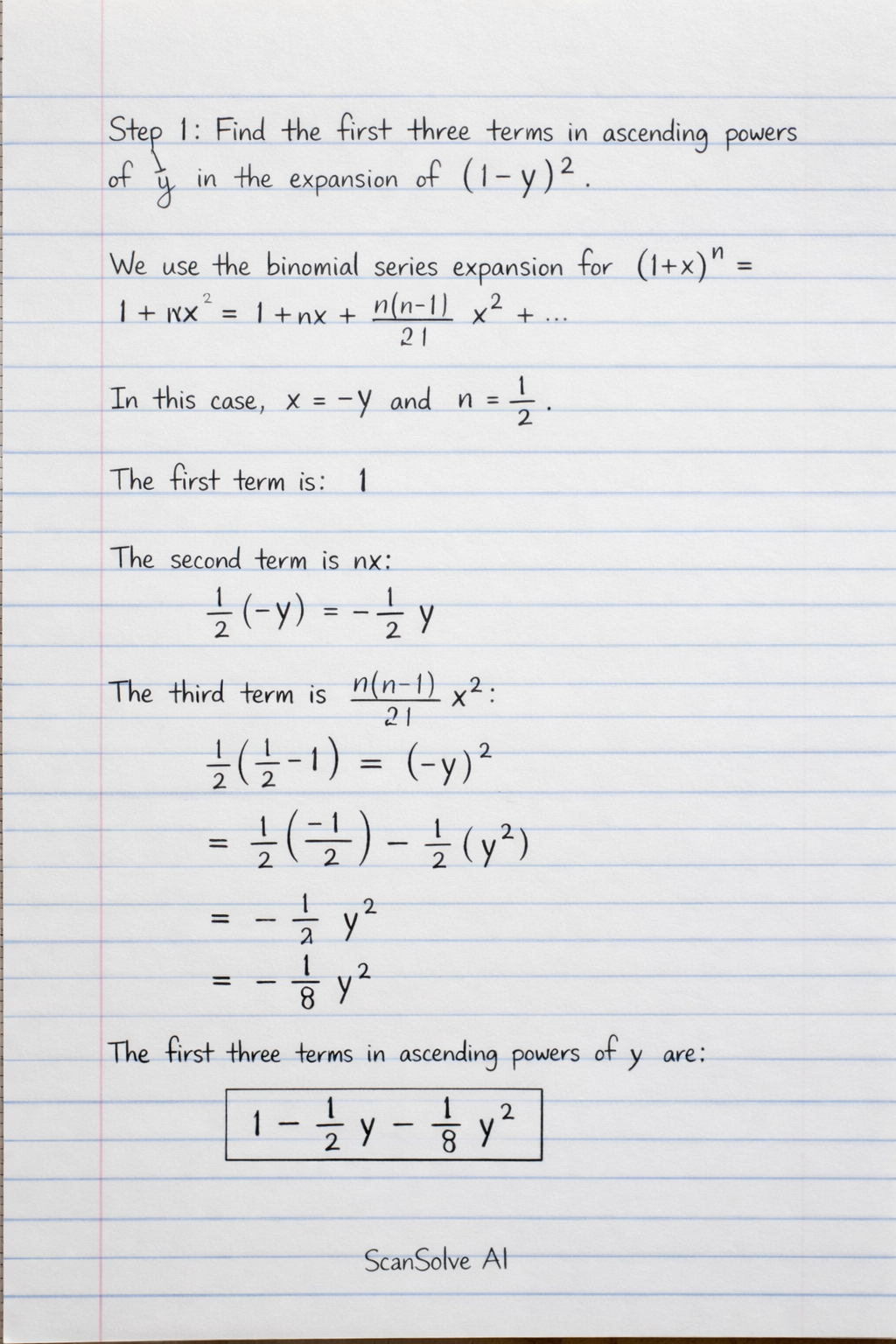
Step 1: Find the first three terms in ascending powers of y in the expansion of (1-y)^(1)/(2). We use the binomial series expansion for (1+x)^n = 1 + nx + (n(n-1))/(2!)x^2 + . In this case, x=-y and n=(1)/(2). The first term is: 1 The second term is nx: ((1)/(2))(-y) = -(1)/(2)y The third term is (n(n-1))/(2!)x^2: (1)/(2)((1)/(2)-1)2!(-y)^2 = (1)/(2)(-(1)/(2))2 × 1 (y^2) = (-1)/(4)2 y^2 = -(1)/(8)y^2 The first three terms in ascending powers of y are 1 - (1)/(2)y - (1)/(8)y^2. Step 2: Find the coefficient of x^-1 in the expansion of ((x+1)(2x-(1)/(x))^3). First, we expand (2x-(1)/(x))^3 using the binomial expansion formula (a+b)^3 = a^3 + 3a^2b + 3ab^2 + b^3. Let a=2x and b=-(1)/(x) = -x^-1. (2x-(1)/(x))^3 = (2x)^3 + 3(2x)^2(-x^-1) + 3(2x)(-x^-1)^2 + (-x^-1)^3 = 8x^3 + 3(4x^2)(-x^-1) + 3(2x)(x^-2) + (-x^-3) = 8x^3 - 12x^2-1 + 6x^1-2 - x^-3 = 8x^3 - 12x + 6x^-1 - x^-3 Now, we need to find the coefficient of x^-1 in the expansion of (x+1)(8x^3 - 12x + 6x^-1 - x^-3). We multiply each term in the first bracket by each term in the second bracket and identify terms that result in x^-1. Terms from x × (8x^3 - 12x + 6x^-1 - x^-3): • x · (8x^3) = 8x^4 • x · (-12x) = -12x^2 • x · (6x^-1) = 6x^0 = 6 • x · (-x^-3) = -x^-2 None of these terms result in x^-1. Terms from 1 × (8x^3 - 12x + 6x^-1 - x^-3): • 1 · (8x^3) = 8x^3 • 1 · (-12x) = -12x • 1 · (6x^-1) = 6x^-1 (This term has x^-1) • 1 · (-x^-3) = -x^-3 The only term that results in x^-1 is 6x^-1. Therefore, the coefficient of x^-1 is 6.