1. If fog(x) = (2x-1)/x and g(x) = 5x + 2 find; a.) f(x) b.) The truth set of g^-1(x) + 3 = gof(x). 2. Find the measure of the obtuse angle between the lines 3x - 5y + 2 = 0 and x + 4y + 5 = 0
This mathematics problem involves applying core mathematical principles and formulas. Below you will find a complete step-by-step solution with detailed explanations for each step, helping you understand not just the answer but the method behind it.
ScanSolve AI Answer
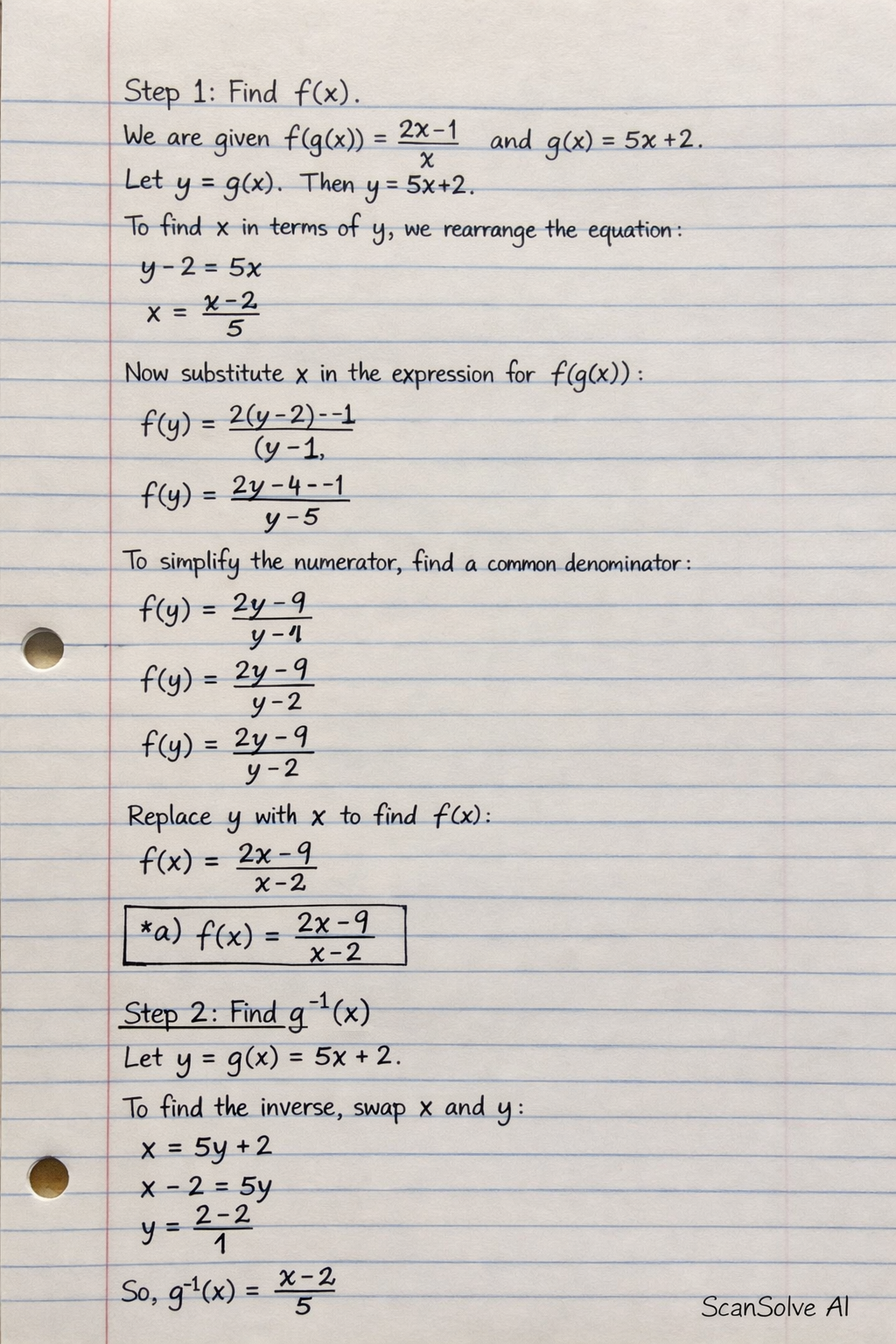
Step 1: Find $f(x)$.
We are given $f(g(x)) = \frac{2x-1}{x}$ and $g(x) = 5x+2$.
Let $y = g(x)$. Then $y = 5x+2$.
To find $x$ in terms of $y$, we rearrange the equation:
$$y - 2 = 5x$$
$$x = \frac{y-2}{5}$$
Now substitute $x$ in the expression for $f(g(x))$:
$$f(y) = \frac{2\left(\frac{y-2}{5}\right)-1}{\frac{y-2}{5}}$$
$$f(y) = \frac{\frac{2y-4}{5}-1}{\frac{y-2}{5}}$$
To simplify the numerator, find a common denominator:
$$f(y) = \frac{\frac{2y-4-5}{5}}{\frac{y-2}{5}}$$
$$f(y) = \frac{\frac{2y-9}{5}}{\frac{y-2}{5}}$$
$$f(y) = \frac{2y-9}{y-2}$$
Replace $y$ with $x$ to find $f(x)$:
$$f(x) = \frac{2x-9}{x-2}$$
*a) $\boxed{f(x) = \frac{2x-9}{x-2}}$
Step 2: Find $g^{-1}(x)$.
Let $y = g(x) = 5x+2$.
To find the inverse, swap $x$ and $y$:
$$x = 5y+2$$
$$x-2 = 5y$$
$$y = \frac{x-2}{5}$$
So, $g^{-1}(x) = \frac{x-2}{5}$.
Step 3: Find $g \circ f(x)$.
We have $f(x) = \frac{2x-9}{x-2}$ and $g(x) = 5x+2$.
$$g(f(x)) = g\left(\frac{2x-9}{x-2}\right)$$
$$g(f(x)) = 5\left(\frac{2x-9}{x-2}\right) + 2$$
$$g(f(x)) = \frac{5(2x-9)}{x-2} + \frac{2(x-2)}{x-2}$$
$$g(f(x)) = \frac{10x-45+2x-4}{x-2}$$
$$g(f(x)) = \frac{12x-49}{x-2}$$
Step 4: Solve the equation $g^{-1}(x) + 3 = g \circ f(x)$.
Substitute the expressions for $g^{-1}(x)$ and $g \circ f(x)$:
$$\frac{x-2}{5} + 3 = \frac{12x-49}{x-2}$$
Simplify the left side:
$$\frac{x-2}{5} + \frac{15}{5} = \frac{x-2+15}{5} = \frac{x+13}{5}$$
Now the equation is:
$$\frac{x+13}{5} = \frac{12x-49}{x-2}$$
Cross-multiply:
$$(x+13)(x-2) = 5(12x-49)$$
$$x^2 - 2x + 13x - 26 = 60x - 245$$
$$x^2 + 11x - 26 = 60x - 245$$
Rearrange into a quadratic equation $ax^2+bx+c=0$:
$$x^2 + 11x - 60x - 26 + 245 = 0$$
$$x^2 - 49x + 219 = 0$$
Use the quadratic formula $x = \frac{-b \pm \sqrt{b^2-4ac}}{2a}$:
$$x = \frac{-(-49) \pm \sqrt{(-49)^2 - 4(1)(219)}}{2(1)}$$
$$x = \frac{49 \pm \sqrt{2401 - 876}}{2}$$
$$x = \frac{49 \pm \sqrt{1525}}{2}$$
Simplify the square root: $\sqrt{1525} = \sqrt{25 \times 61} = 5\sqrt{61}$.
$$x = \frac{49 \pm 5\sqrt{61}}{2}$$
The values of $x$ must not make any denominator zero. For $f(x)$ and $g(f(x))$, $x-2 \neq 0$, so $x \neq 2$. The solutions found are not equal to 2.
*b) The truth set is $\boxed{\left\{\frac{49 - 5\sqrt{61}}{2}, \frac{49 + 5\sqrt{61}}{2}\right\}}$
Step 5: Find the slopes of the lines.
The first line is $3x - 5y + 2 = 0$.
Rearrange to slope-intercept form $y = mx+c$:
$$5y = 3x + 2$$
$$y = \frac{3}{5}x + \frac{2}{5}$$
The slope of the first line is $m_1 = \frac{3}{5}$.
The second line is $x + 4y + 5 = 0$.
Rearrange to slope-intercept form $y = mx+c$:
$$4y = -x - 5$$
$$y = -\frac{1}{4}x - \frac{5}{4}$$
The slope of the second line is $m_2 = -\frac{1}{4}$.
Step 6: Calculate the angle between the lines.
The formula for the angle $\theta$ between two lines with slopes $m_1$ and $m_2$ is:
$$\tan \theta = \left| \frac{m_1 - m_2}{1 + m_1 m_2} \right|$$
Substitute the slopes:
$$\tan \theta = \left| \frac{\frac{3}{5} - \left(-\frac{1}{4}\right)}{1 + \left(\frac{3}{5}\right)\left(-\frac{1}{4}\right)} \right|$$
$$\tan \theta = \left| \frac{\frac{3}{5} + \frac{1}{4}}{1 - \frac{3}{20}} \right|$$
Calculate the numerator:
$$\frac{3}{5} + \frac{1}{4} = \frac{12}{20} + \frac{5}{20} = \frac{17}{20}$$
Calculate the denominator:
$$1 - \frac{3}{20} = \frac{20}{20} - \frac{3}{20} = \frac{17}{20}$$
Substitute these values back into the formula:
$$\tan \theta = \left| \frac{\frac{17