Draw graphs of x-2y=-2 and x-2y=2 on the same axes and state your conclusion from the graph.
This mathematics problem involves applying core mathematical principles and formulas. Below you will find a complete step-by-step solution with detailed explanations for each step, helping you understand not just the answer but the method behind it.
ScanSolve AI Answer
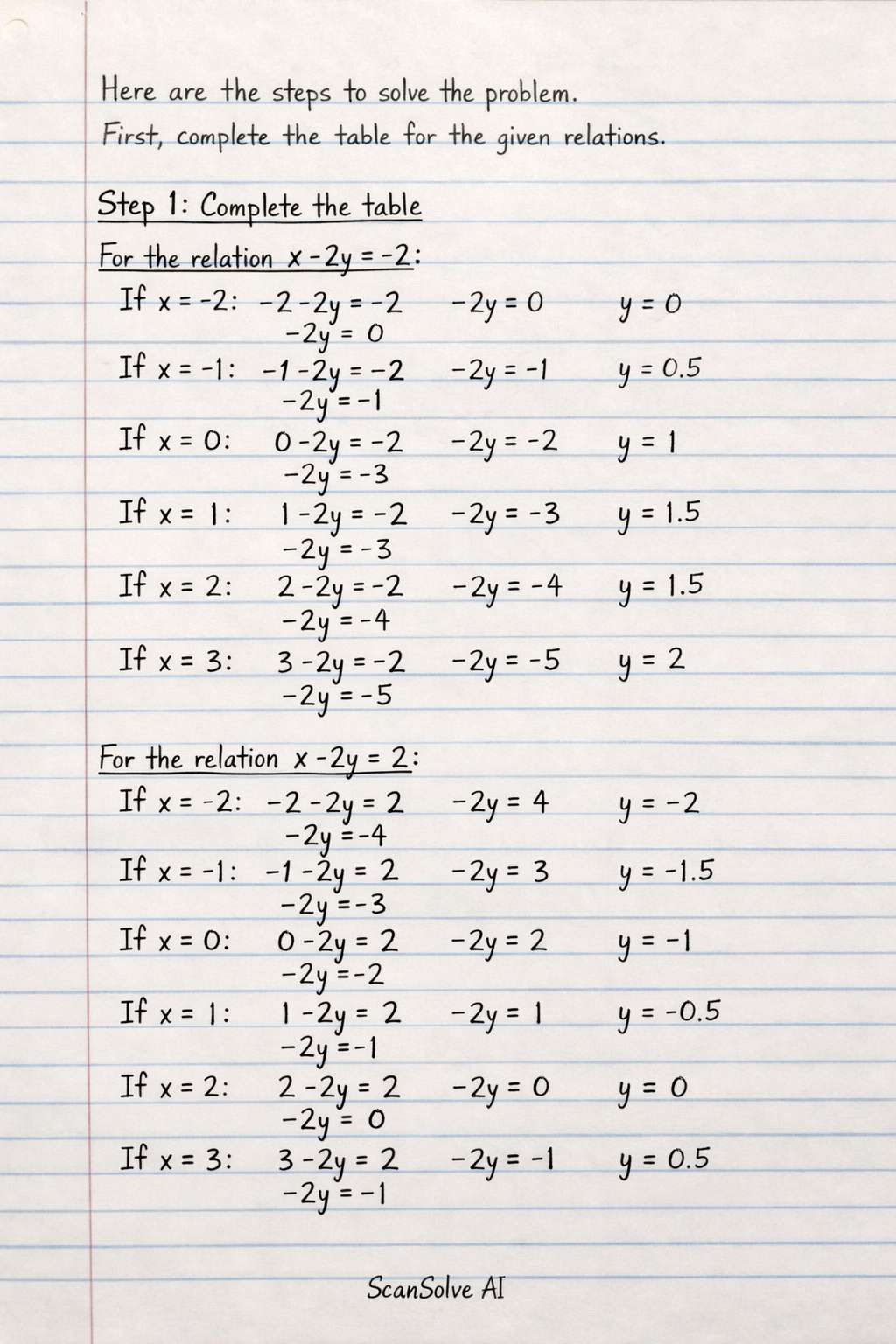
Here are the steps to solve the problem.
First, complete the table for the given relations.
Step 1: Complete the table
For the relation $x - 2y = -2$:
If $x = -2$: $-2 - 2y = -2 \implies -2y = 0 \implies y = 0$
If $x = -1$: $-1 - 2y = -2 \implies -2y = -1 \implies y = 0.5$
If $x = 0$: $0 - 2y = -2 \implies -2y = -2 \implies y = 1$
If $x = 1$: $1 - 2y = -2 \implies -2y = -3 \implies y = 1.5$
If $x = 2$: $2 - 2y = -2 \implies -2y = -4 \implies y = 2$
If $x = 3$: $3 - 2y = -2 \implies -2y = -5 \implies y = 2.5$
For the relation $x - 2y = 2$:
If $x = -2$: $-2 - 2y = 2 \implies -2y = 4 \implies y = -2$
If $x = -1$: $-1 - 2y = 2 \implies -2y = 3 \implies y = -1.5$
If $x = 0$: $0 - 2y = 2 \implies -2y = 2 \implies y = -1$
If $x = 1$: $1 - 2y = 2 \implies -2y = 1 \implies y = -0.5$
If $x = 2$: $2 - 2y = 2 \implies -2y = 0 \implies y = 0$
If $x = 3$: $3 - 2y = 2 \implies -2y = -1 \implies y = 0.5$
The completed table is:
$$
\begin{array}{|c|c|c|c|c|c|c|}
\hline
x & -2 & -1 & 0 & 1 & 2 & 3 \\
\hline
x - 2y = -2 & 0 & 0.5 & 1 & 1.5 & 2 & 2.5 \\
\hline
x - 2y = 2 & -2 & -1.5 & -1 & -0.5 & 0 & 0.5 \\
\hline
\end{array}
$$
b. (i) Drawing axes
Draw two perpendicular lines, one horizontal (OX-axis) and one vertical (OY-axis), intersecting at the origin (0,0). Mark units on both axes such that every 2 cm represents 2 units. This means 1 cm represents 1 unit. Label the positive and negative directions for both axes.
c. (ii) Drawing the graphs
To draw the graphs, plot the points from the completed table for each relation and then draw a straight line through them.
For the relation $x - 2y = -2$:
Plot the points: $(-2, 0)$, $(-1, 0.5)$, $(0, 1)$, $(1, 1.5)$, $(2, 2)$, $(3, 2.5)$.
Draw a straight line connecting these points.
For the relation $x - 2y = 2$:
Plot the points: $(-2, -2)$, $(-1, -1.5)$, $(0, -1)$, $(1, -0.5)$, $(2, 0)$, $(3, 0.5)$.
Draw a straight line connecting these points.
d. Conclusion from the graph
To determine the conclusion, we can analyze the equations in slope-intercept form ($y = mx + c$).
For the first relation: $x - 2y = -2$
$$2y = x + 2$$
$$y = \frac{1}{2}x + 1$$
The slope is $m_1 = \frac{1}{2}$ and the y-intercept is $c_1 = 1$.
For the second relation: $x - 2y = 2$
$$2y = x - 2$$
$$y = \frac{1}{2}x - 1$$
The slope is $m_2 = \frac{1}{2}$ and the y-intercept is $c_2 = -1$.
Since both lines have the same slope ($m_1 = m_2 = \frac{1}{2}$) but different y-intercepts ($c_1 \neq c_2$), the lines are parallel. They will never intersect.
The conclusion from the graph is that the two lines are parallel.
$$\boxed{\text{The two lines are parallel.}}$$