

This biology question covers important biological concepts and processes. The step-by-step explanation below helps you understand the underlying mechanisms and reasoning.
ScanSolve AI Answer
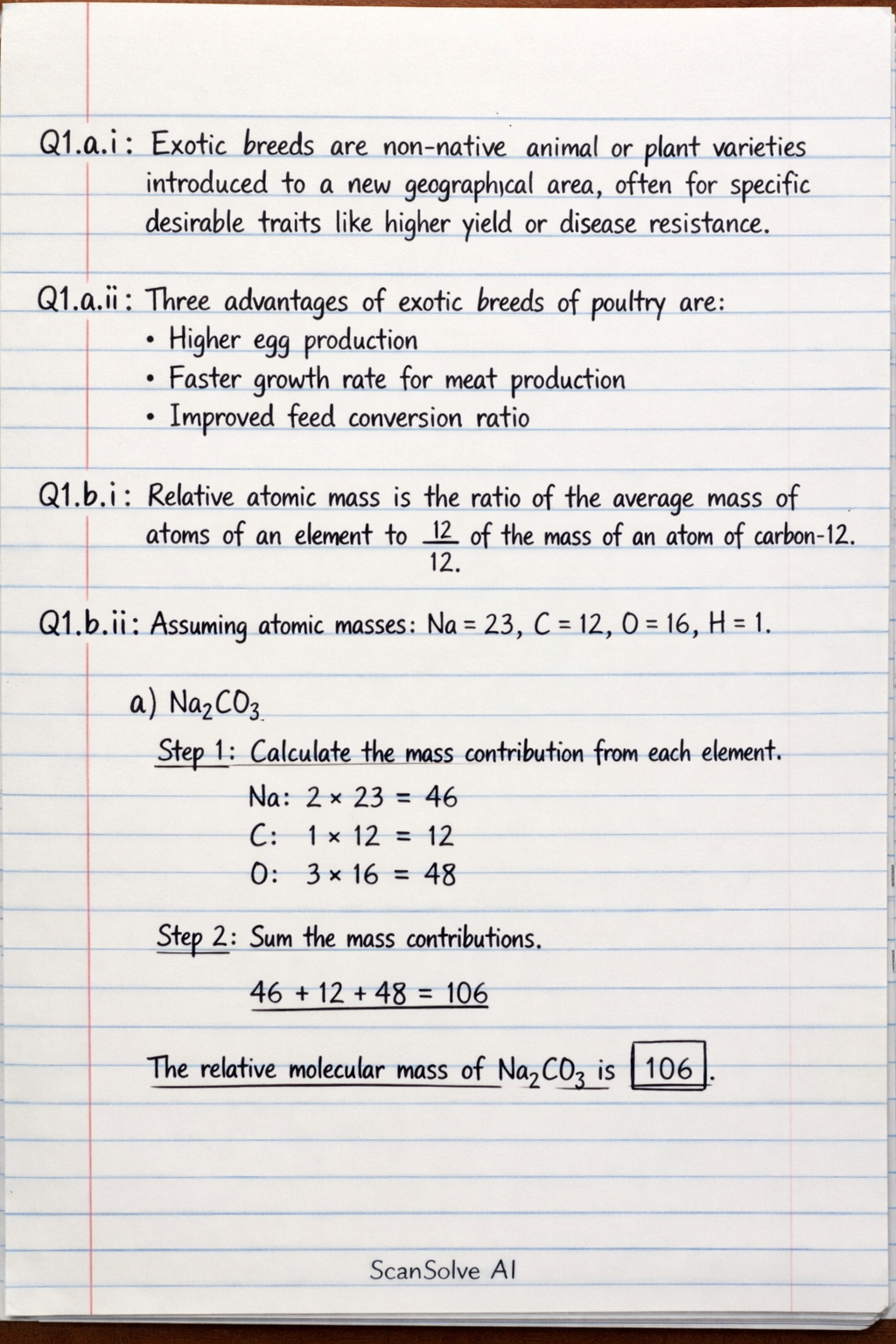
Q1.a.i: Exotic breeds are non-native animal or plant varieties introduced to a new geographical area, often for specific desirable traits like higher yield or disease resistance. Q1.a.ii: Three advantages of exotic breeds of poultry are: • Higher egg production • Faster growth rate for meat production • Improved feed conversion ratio Q1.b.i: Relative atomic mass is the ratio of the average mass of atoms of an element to (1)/(12) of the mass of an atom of carbon-12. Q1.b.ii: Assuming atomic masses: Na = 23, C = 12, O = 16, H = 1. a) Na_2CO_3 Step 1: Calculate the mass contribution from each element. Na: 2 × 23 = 46 C: 1 × 12 = 12 O: 3 × 16 = 48 Step 2: Sum the mass contributions. 46 + 12 + 48 = 106 The relative molecular mass of Na_2CO_3 is 106. b) CH_3COOH Step 1: Calculate the mass contribution from each element. C: 2 × 12 = 24 H: 4 × 1 = 4 O: 2 × 16 = 32 Step 2: Sum the mass contributions. 24 + 4 + 32 = 60 The relative molecular mass of CH_3COOH is 60. Q1.c.i: Two organisms commonly used in biotechnology are: • Escherichia coli (E. coli) • Saccharomyces cerevisiae (Yeast) Q1.c.ii: • Escherichia coli: Used in the pharmaceutical industry for producing insulin and other recombinant proteins. • Saccharomyces cerevisiae: Used in the food and beverage industry for brewing beer, making wine, and baking bread. Q1.d.i: Three other sources of electric power generation apart from hydro and thermal sources are: • Solar power • Wind power • Nuclear power Q1.d.ii: Energy transformations: • Solar power: Solar energy (light) is converted into electrical energy by photovoltaic cells. • Wind power: Kinetic energy of wind is converted into mechanical energy by turbine blades, which is then converted into electrical energy by a generator.