
We read your photo as:
State the Hardy-Weinberg equation and define each term. In a population of 1000 individuals, 360 are homozygous dominant (AA), 480 are heterozygous (Aa), and 160 are homozygous recessive (aa). Calcula
ScanSolve AI Answer
Step-by-step solution
10 stepsHere is the solution to question 6.
Part 6
Part a
State the Hardy-Weinberg equation and define each term. (04 marks)
The Hardy-Weinberg equations are:
Where:
- : Represents the frequency of the dominant allele (e.g., A).
- : Represents the frequency of the recessive allele (e.g., a).
- : Represents the frequency of the homozygous dominant genotype (e.g., AA).
- : Represents the frequency of the homozygous recessive genotype (e.g., aa).
- : Represents the frequency of the heterozygous genotype (e.g., Aa).
Part b(i)· 4 steps
Allele frequencies of A and a. (04 marks)
In a population of 1000 individuals, 360 are homozygous dominant (AA), 480 are heterozygous (Aa), and 160 are homozygous recessive (aa). Calculate the
Total individuals = 1000
Number of AA = 360
Number of Aa = 480
Number of aa = 160
Calculate the total number of alleles in the population.
Total alleles =
Calculate the number of A alleles.
Number of A alleles =
Number of A alleles =Calculate the frequency of allele A ().
Calculate the frequency of allele a ().
The allele frequencies are:
- Frequency of A ():
- Frequency of a ():
Part b(ii)· 1 step
Genotype frequencies of AA, Aa, and aa. (04 marks)
Calculate the frequency for each genotype.
The genotypic frequencies are:
- Frequency of AA:
- Frequency of Aa:
- Frequency of aa:
Part b(iii)· 2 steps
Phenotype frequencies of dominant and recessive traits. (04 marks)
Calculate the frequency of the dominant phenotype (AA + Aa).
Calculate the frequency of the recessive phenotype (aa).
The phenotype frequencies are:
- Frequency of dominant trait:
- Frequency of recessive trait:
Part b(iv)· 3 steps
Number of homozygous dominant, heterozygous, and homozygous recessive individuals in the next generation, assuming the population is in Hardy-Weinberg equilibrium. (04 marks)
Using the allele frequencies and from part (i) and the total population of 1000 individuals:
Calculate the expected frequency of homozygous dominant (AA) individuals ().
Number of AA individuals =
Calculate the expected frequency of heterozygous (Aa) individuals ($2pq$).
Number of Aa individuals =
Calculate the expected frequency of homozygous recessive (aa) individuals ().
Number of aa individuals =
The number of individuals in the next generation, assuming Hardy-Weinberg equilibrium, are:
- Homozygous dominant (AA):
- Heterozygous (Aa):
- Homozygous recessive (aa):
Still stuck on this one?
Ask a follow-up, and the answer starts from this question.
More Biology Questions
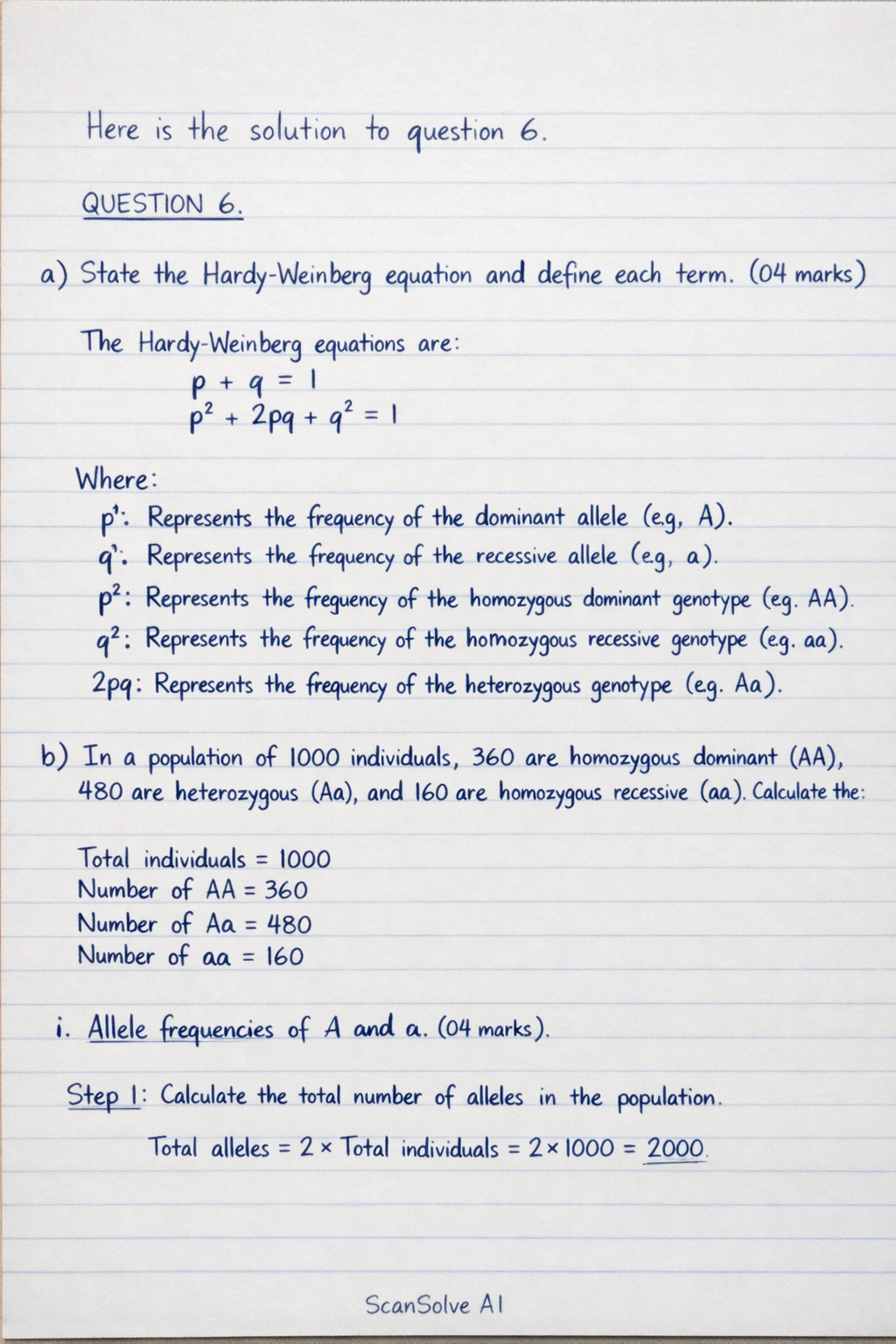
Handwritten Step-by-Step Solution
Get this as a handwritten image on WhatsApp — like a tutor wrote it for you.
Try on WhatsApp